Showing posts with label flop. Show all posts

Monday, August 28, 2017

It Came From The Cineplex: The Dark Tower

The Dark Tower was written by Akiva Goldsman (oy!), Jeff Pinkner (double oy), Anders Thomas Jensen and Nikolaj Arcel. Yep, believe it or not, it took a whopping FOUR people to write this gem. It was directed by Nikolaj Arcel.

Goldsman is a prolific and VERY uneven screenwriter, who previously penned The Client, Batman Forever (!), A Time To Kill, Batman & Robin (!!), Lost In Space (!!!), A Beautiful Mind, I, Robot, Cinderella Man, The Da Vinci Code, I Am Legend, Angels & Demons, Winter's Tale, Insurgent and The 5th Wave. You read right— somehow the man responsible for the Oscar-winning A Beautiful Mind also wrote the execrable Batman & Robin! The world is a very strange and nonsensical place.

Pinkner has mostly worked in TV, writing episodes of Ally McBeal, Profiler, Alias, LOST and Fringe. He also co-wrote The Amazing Spider-Man 2 (the one with Electro) and The 5th Wave. Jensen is a Danish writer with fifty one credits to his name, not a single one of which I've ever heard of.

Arcel is a writer and director, who previously helmed King's Game (?), Island Of Lost Souls (??), Truth About Men (???) and A Royal Affair (????).

The film's VERY loosely based on Stephen King's The Gunslinger series of books.

It's a bland, dull and mediocre film that tries to cram eight books worth of world-building and mythology into its brief ninety five minute runtime. Little of what's happening is ever explained and none of the scenes are ever given proper time to breathe, as it races from one nonsensical setpiece to the next.

As a result of this breakneck pace, none of the various characters have any motivation, as they do the things they do simply because it says so in the script. For example, main baddie Walter wants to topple the titular Dark Tower, which will destroy the entire multiverse. But why? What's he plan to do after that? What's in it for him? Where's he gonna keep all his stuff once the universe is gone? Apparently it's none of our business, as the reasons for his villainy are never addressed.

The Dark Tower is a Sony film, which explains everything. Sony Pictures is the wonderful studio that pumps out hit after hit, year after year to universal critical accla... HAW, HAW, HAW! Sorry, I couldn't finish that sentence with a straight face. Sony's the absolute worst, as they consistently turn out flop after flop. Why, in just the past three years they've produced such wonderful films as:

The Monuments Men • Robocop (2014)
The Amazing Spider-Man 2 • 22 Jump Street • Think Like A Man Too
Sex Tape • The Equalizer • Fury • The Interview • Chappie
Paul Blart: Mall Cop 2 • Aloha • Pixels • Ricki and the Flash 
Hotel Transylvania 2 • The Walk • Goosebumps • Freaks of Nature 
Spectre • The Night Before • The 5th Wave • The Brothers Grimsby
Money Monster • Angry Birds • The Shallows • Ghostbusters 2016
Sausage Party • The Magnificent Seven • Inferno • Passengers
Resident Evil: The Final Chapter • Underworld: Blood Wars
Life • Smurfs: The Lost Village • Rough Night

With the exception of Spider-Man: Homecoming (which they made with the help of Marvel Studios) and Baby Driver, this year was another grim one for Sony. Seeing them desperately try to come up with a hit is like watching a train wreck in slow motion. Virtually every decision they make as a corporation is wrong. How the hell do Anthony Vinciquerra and Tom Rothman keep their jobs?

An example of some of Sony's brilliant thinking: Ever since the success of the Harry Potter and Hunger Games films, studios have been scouring bookstores, desperately searching for series they can turn into lucrative movie franchises. Stephen King's The Gunslinger Saga consists of a whopping EIGHT books, just waiting for some savvy filmmaker to come along and adapt them.

Yet for some unfathomable reason, Sony chose to ignore all that and make ONE short film that bears little or no resemblance to the source material. What the hell? Why wouldn't they hire a top notch writer and director and simply film all eight books? It's like a license to print money! Yes, yes, I've read the articles that claimed the books are "unfilmable." But that's what they used to say about The Lord Of The Rings, and look how that turned out. With the right talent, nothing's impossible. Jesus Christ, is it any wonder Sony's film division is bleeding cash?

The Dark Tower has been in Development Hell as far back as 2007, when the "dream team" of JJ Abrams, Carlton Cuse and Damon Lindelof (shudder) were attached to the project. Fresh off the success of LOST, they were thought to be the perfect candidates to translate the book to the screen. Abrams and the others eventually bowed out, as they were unwilling to take on another lengthy project while still working on LOST.

After that Ron Howard was set to direct an adaptation which would alternate between theatrical films and TV series, which sounds needlessly complicated. Unfortunately Universal Studios got cold feet, slashing the budget before scrapping the project altogether.

Sony then picked up the project, scheduling it for a January 2017 release, with Nikolaj Arcel attached to direct, and Ron Howard staying on as producer. Sony then pushed the film back to February. As we all know, any time a movie is pushed back for any reason, it's ALWAYS a bad, bad sign. Sure enough, poor test screenings caused Sony to contemplate replacing Arcel with "a more experienced filmmaker," until Howard talked them out of it for some reason.

Sony then spent a whopping $6 million on reshoots to refine the confusing story and flesh out Idris Elba's Roland character. The movie was then pushed back to July 28, 2017, and finally to August 4. Oy. I hope all that was worth it, Sony!

The fact that The Dark Tower is a dud should come as no surprise to anyone, as the red flags were there months before the film premiered. The mild PG-13 rating angered and upset fans of the books who thought it warranted an R. The film's slim $60 million budget meant the filmmakers wouldn't be able to properly realize King's intricately described alien vistas. And the short runtime meant there was no way the nuances of the story could ever be properly adapted.

In the end, The Dark Tower doesn't seem to be a film for anyone. Fans of the books will be put off by how much is left out, while newbies will be completely lost by the truncated mythology and dimension-hopping. It's a movie without a country, so to speak.

Oddly enough this isn't even a proper adaptation of the book series, but is actually a SEQUEL to it. How can that be, you ask? How can you make a sequel before you make the original? WARNING! SPOILERS FOR THE BOOKS AHEAD! The way I understand it, the Gunslinger character spends the whole series searching for the Dark Tower. He finally finds it in the final book, only to discover he's been there many times before. He's cursed to play out the same quest over and over for eternity as some sort of cosmic punishment. Apparently this film is not an adaptation of the books, but instead represents the next cycle in the Gunslinger's never-ending quest to destroy the Tower, and explains how Sony can make a sequel before it films the original. Ugh. I can't imagine a more unsatisfactory scenario.

For the record, I know little or nothing about The Gunslinger series. I tried to read the first book many years ago, but just couldn't get into it and gave up after fifty pages. I've been told by many people that this is common, as the first book is a hard read, but "once you get past that, it gets really good!" Thanks, but I read books for pleasure, not pain. I don't want to have to slog through one I don't like just to get to the "good stuff."

Anyway, because I'm not steeped in all the mythology, I didn't despise the movie. I didn't like it by any means, but I couldn't summon up the conviction to actually hate it. It honestly made me feel nothing one way or the other. It feels like there are things going on just under the surface, that the film doesn't care to share with the audience. I have a feeling if I was a fan of the books this film would have made my head explode.

Supposedly producer Ron Howard has plans to turn The Gunslinger books into a TV series that's connected to this film. Yeah, that's never gonna happen. At least not for several years, until the stench of this film has faded from the public's mind.

The Dark Tower had a VERY modest budget of just $60 million, which is surprising in these days of $200 million blockbusters. So far it's only managed to gross an anemic $44 million here in the States, and $43 million overseas, for a total of $88 million. As you're tired of hearing me say, due to marketing and other hidden costs, movies need to gross around twice their production budgets just to break even. It seems extremely unlikely The Dark Tower will ever reach the $120 million amount, much less surpass it. Chalk it up as yet another disappointment for Sony.

SPOILERS, I GUESS!

The Plot:
A helpful caption gives us a brief rundown on the Dark Tower. Apparently the Tower exists in the center of the multiverse, and somehow protects all the various parallel Earths from ravenous CGI monsters. If the Tower ever falls, all universes (universi?) will be doomed.

On End-World (I think that's what it's called— honestly, it doesn't matter), a group of children frolic in slow motion in an idyllic playground. Suddenly a harsh klaxon sounds, and the kids line up and file into a large, bucket-shaped building. Inside, strange creatures (known as the Low Men, although I don't think the movie ever calls them that) wearing human masks pick one of the children and strap her into a chair. They fit an apparatus to her head, which drains her brain power or life essence or something. The Man In Black, aka Johnny Cash, er, I mean Walter O'Dim (played by Matthew McConaughey) looks on. The child's energy is then catapulted into the air, where it sails across the sky and slams into the side of the Dark Tower (!). Fortunately for us, it doesn't destroy it.

Cut to our world, which for some reason is called Keystone Earth. We're introduced to Jake Chambers, an eleven year old boy who lives in New York City. Jake has vivid nightmares about the Dark Tower, the Man In Black and a mysterious Gunslinger who opposes him. Jake draws his visions and plasters his room with them, much to the concern of his mother, who's afraid he's been traumatized by the recent death of his father.

When Jake gets into a fight at school, his principal contacts his mother, suggesting she send him to an upstate psychiatric hospital. When the hospital officials arrive at his apartment, Jake recognizes them as Low Men, and sneaks out.

With nowhere else to go, Jake tracks down a mysterious abandoned house he saw in one of his dreams. Inside he accidentally activates a machine (complete with old school dial-up modem sound effects!) that opens a portal to another dimension. He's then attacked by a "house demon," and runs through the portal to escape it. He emerges in the barren landscape of Mid-World, as the portal closes behind him. Jakes looks up and sees several large planets hanging in the sky, in a shot designed to show even the dimmest audience member that this is another planet.

Jake  wanders the desert landscape, slowly dying of thirst, until he encounters Roland Deschain, the Last Gunslinger (played by Idris Elba). Jake recognizes Roland from his visions, and asks to tag along. Roland has near supernatural skill with his guns, and can kill virtually anything. He's seeking revenge against the Man In Black, who killed his father Steven (played in a flashback by Dennis Haysbert, the Allstate commercial guy).

As the two travel through the wasteland, Roland infodumps the story of the Man In Black and the Dark Tower to Jake. He takes him to a village, where a Seer senses that Jake has the Shine, aka psychic powers. Right on cue, Walter detects Jake's psychic energy, realizing it's powerful enough to topple the Tower for good. He travels to Keystone Earth, determined to find Jake. He kills Jake's stepfather, then interrogates his mother before killing her as well. He admires Jake's drawings, and somehow figures out that he went to Mid-World. He sends his minions (called the Taheen) to Mid-World to capture Jake.

Meanwhile in the village, the Seer tells Roland where to find Walter's secret base in New York on Keystone Earth. Before they can go, the Taheen arrive, attack the villagers and capture Jake. Roland easily shoots 'em all dead. He and Jake then use a portal to travel to New York, in a desperate attempt to give the movie's budget a break.

There's suddenly lots of "hilarious" fish out of water humor, as Roland is amazed by the sights and sounds of New York. Jake returns to his apartment (which seems like a bad idea, as it's probably the first place the Man In Black would look for him) and finds the bodies of his parents. Roland comforts Jake, and vows to avenge them. He teaches Jake the Gunslinger's Creed ("I shoot with my heart, not with my hand" or some such nonsense) and shows Jake how to fire a gun.

Jake takes Roland to an gun shop, where he "comically" robs the owner and stocks up on ammo. Just then Walter shows up and captures Jake. He drags Jake back to his HQ in New York, and uses a portal to take him to End-World.

Walter watches breathlessly while his minions hook Jake up to his Tower-destroying machine. Back on Keystone Earth, Roland battles Walter's henchmen. Jake sends a psychic signal to Roland, telling him where he is. Roland's about to travel to End-World, when Walter comes through the portal and confronts him. They have an epic (sort of) battle, as Roland fires shot after shot at Walter, who easily catches or deflects each one. Finally Roland uses a trick shot to ricochet a bullet off a wall, which strikes Walter in the head, killing him instantly. That was easy! A little too easy, if you ask me!

Roland enters the portal to End-World, frees Jake and destroys Walter's machine. Hooray, the Dark Tower is saved! Roland tells Jake that he can't stay on Keystone Earth (although why is apparently none of our business). He points out that Jake has no reason to stay either, and invites him to join him on further film adventures that'll never happen. They both enter the portal to Mid-World.

Thoughts:
• Honestly there's not much to say about this cinematic turd, so this'll be mercifully brief.

• Months before the movie premiered, the internet went crazy over the news that English actor Idris Elba had been cast as Roland The Gunslinger (despite the fact that Stephen King said he based the character on Clint Eastwood). Social Justice Warriors praised this progressive, colorblind casting.


Annnnnnd then Elba was immediately demoted to second fiddle status, as the filmmakers inexplicably chose to shift the movie's focus onto the Jake character. So much for diversity! Who needs a strong black actor as your lead, when you can cast an unknown child?

I assume they made this change so they could use Jake as an expository device. Once he enters Mid-World he has no idea what's going on and asks a ton of questions. Roland then explains what's happening to Jake, and by extension, the audience. It's a cheap trick used a lot by hack screenwriters.

• Javier Bardem, Viggo Mortensen, Russell Crowe and Liam Neeson were all considered for the role of Roland The Gunslinger. Eh, honestly I don't think it mattered who played him. Movie Roland bears so little resemblance to the book version that they could have cast Danny DeVito and it wouldn't have made any difference.


Personally I wasn't happy with either of the film's leads, as I felt they were both severely miscast. Idris Elba looked suitably heroic, but I thought he was too stern and humorless to be likable. He'd have made a much more suitable villain, in my opinion. On the other hand, Matthew McConaughey as The Man In Black was a bit too easy going to be the literal embodiment of evil. I think it would have worked out much better if Elba and McConaughey had swapped roles.


• The Dark Tower had a budget of just $60 million, and it shows! Everything looks cheap and uninspired, like it's an episode of a TV series. Heck, Game Of Thrones has better production values than this thing.

A good part of this cost-cutting was accomplished by having a large hunk of the story take place on Earth. The filmmakers would have to create every single aspect of Mid-World. If the characters come to New York, then the film crew doesn't have to build anything!

• Jake suffers from terrifying visions of the Dark Tower and The Man In Black. To cope with this he draws the things he sees in his nightmares.

He's quite an artist for a kid, with a very eclectic style. In fact it almost looks like his drawings were done by several different production artists working on a film crew, who all had different levels of talent. But that's impossible, right?


• At one point Roland takes Jake to a village, where he's examined by a mystic Seer. Shortly afterward the Taheen invade the village and kill the Seer. Hmm... she must not have been much of a psychic if she didn't see her own death coming.


• So Walter's a sorcerer who possesses terrifying supernatural powers. In fact he can even kill just by telling people to "stop breathing." And yet this ultra powerful demon is killed by a simple bullet to the head. Really, that's it? That's all it takes to kill what is basically the Devil incarnate? Talk about anti-climactic!


• An early poster for the film showed Roland with his trademark guns, which were glowing with a cool blue light. Unfortunately there's no gun glow in the actual movie. They're just plain old six shooters, forged from Excalibur or something.

So what happened? Why'd the director change his mind about the glowing guns?

This is just my theory, so it could be completely wrong, but I think they changed it because of Legends Of Tomorrow. Over on that show, former Time Master Rip Hunter wears a full length duster much like Roland's, and his weapon of choice is a futuristic six shooter that fires blue energy bolts!

I'm betting the filmmakers planned for Roland's guns to glow blue until someone on the crew flipped on The CW, saw Legends Of Tomorrow, said, "Son of a bitch!" and changed their minds.

• 
Almost all of Stephen King's novels and short stories take place in various realities that are linked together by The Dark Tower series. For example, Randall Flagg, the evil antagonist of King's The Stand, is supposedly an aspect of Walter O'Dim.

Of course at just ninety five minutes, the movie has no time to adequately dive into any of these connections. Instead it packs the screen with tons of references, shout-outs and Easter eggs. Most of these will sail far, far over the head of the average viewer, while likely infuriating fans of the books.

Ultimately these references are completely meaningless, as they have absolutely nothing to do with the plot. The movie's basically shouting, "Hey, remember this?" over and over. Even worse, these constant references will likely infuriate fans of the books, as they shake their heads and realize what could have been.

Anyway, here are a few of the King connections in The Dark Tower. There may be even more, but I honestly don't care.

At one point Jake visits his psychiatrist, to discuss his visions. We get a very conspicuous shot of the doctor's desk, which contains a framed photo of the Overlook Hotel, which was the setting of 1980s The Shining.

Note to would-be directors— it's never a good idea to remind the audience of a better movie while they're watching yours.

Also, the Seer tells Jake that he has "The Shine," aka psychic powers. That's exactly what Dick Halloran called Danny Torrance's supernatural ability in The Shining. This is a movie-only connection though, as in The Dark Tower books psychic powers are called "The Touch."

Early in the film there's a scene in which Jake plays with a red toy car. This is obviously a reference to Christine, the evil 1958 Plymouth Fury from the book and movie of the same name.

While wandering through Mid-World, Jake finds an abandoned theme park called "Pennywise." That's of course the name of the evil clown in King's It.

Roland enters Jake's room on Keystone Earth, and sees a message— complete with smiley face— from Walter. Supposedly this is a reference to King's 2014 novel Mr. Mercedes.

Over on End-World, Walter has a copy of Misery's Child. It was written by Paul Sheldon, the novelist hero of King's Misery.

When Jake discovers the portal, the numbers "1408" are scribbled above it. That's a reference to 2007's 1408 (starring John Cusack), which was based on King's short story of the same name.

On Keystone Earth, Roland takes a long hard look at a poster of actress Rita Hayworth, which is of course a shoutout to King's The Shawshank Redemption.

Also on Keystone Earth, Roland stops near a store sign that reads "Barlow and Straker." They were "partners" who ran an antiques store in King's vampire novel 'Salem's Lot.

There's also a very quick shot of a woman walking a St. Bernard on Keystone Earth. That's gotta be a reference to King's Cujo. There's no other reason for it to appear!

I don't have a photo of it, but after the Taheen invade the village, Jake hides out in a cornfield. This is likely a nod to King's Children Of The Corn.

As I said, this is all meaningless window-dressing, added in a desperate attempt to make the film look like a proper adaptation of the books.

The Dark Tower is a bland and mediocre film that's VERY loosely based on Stephen King's eight book series. It fails in every measurable sense though, as newcomers will have little or no idea what's going on, and fans of the novels will be infuriated by how much was left out. Skip it and read the books instead. As someone who's not read the books, I give it a well-deserved C-. If I were a fan of the books I'd probably give it a D!

Friday, June 2, 2017

Not So Fast There, Power Rangers!

A few weeks ago I reviewed the dreadful new Power Rangers movie, noting that producer Haim Saban and Lionsgate Studios had high hopes for the film. They honestly expected the movie to be a massive hit, and were planning on leveraging it into a lucrative SIX film franchise (!).

In my review I pointed out that the film wasn't exactly burning up the box office, and I wouldn't hold my breath waiting on Power Rangers 2 - 6.

How frighteningly prescient of me. After a little over a month in theaters, the $100 million dollar film only managed to scrape up a disappointing $85 million here in the states. Ouch! Oddly enough it's done even worse overseas, where it grossed an anemic $54 million, for a worldwide total of $140 million.

Lionsgate was banking on the Chinese market to save the film, but they didn't want anything to do with it either. Power Rangers could only manage an embarrassing $3.3 million in its opening weekend in China! Double ouch! Meanwhile, Guardians Of The Galaxy Vol. 2 raked in almost $50 million in its Chinese debut!

Lionsgate's hoping the Japanese market can save the film, especially since it's based on the Super Sentai TV series there. I don't see any way that's gonna happen. Why would the Japanese go see a movie based on a pale imitation of one of their own shows?

So say goodbye to the Power Rangers Cinematic Universe!

If it sounds like I'm gloating here, it's because I am. I resented sitting through every second of this dreary film's bloated 124 minute runtime. Look, I know Power Rangers isn't Shakespeare. But it's a silly proper about superpowered teens who ride around in robotic dinosaurs. How the hell can you make an insane concept like that boring? The last thing a Power Rangers movie should ever be is dull. There's no reason Lionsgate couldn't have made a fun movie like Guardians Of The Galaxy Vol. 2.

Note that Warner Bros. had similar plans for their recent King Arthur: Legend Of The Sword film, as it was designed to be the first of a six film series as well. And just like Power Rangers, it tanked at the box office, dashing all hopes of any follow up films. 

Hey, movie studios, here's an idea for you! Instead of foolishly betting your company's future on a series with no chance in hell of ever becoming a reality, maybe make one movie and see how that goes. If it's a hit, THEN go ahead with plans for a franchise. It's simple common sense, guys.

Tuesday, August 11, 2015

It Did NOT Come From The Cineplex: Roger Corman's The Fantastic Four

Note, this is NOT, repeat NOT, a review of Josh Trank's new Fantastic 4 movie. If you're looking for a review of that cinematic abomination, I advise you to please search elsewhere. 

Fox's new Fantastic 4 movie, or Fant 4 Stic, as it's called on the poster, finally premiered last week. That's bad news for fans of both the Fantastic 4 and of movies in general. It's also bad news for the three or four readers out there who actually enjoy my movie reviews, as I will not be seeing or recapping this film.

So why the boycott? It's simple. Ever since I was a wee lad, the Fantastic 4 has been my favorite comic book. And Ben Grimm, aka The Thing, is my all-time favorite comic character as well. For years I've been longing for a good big-budget FF movie, especially now that special effects have evolved to the point where filming literally anything is possible. Alas, I'm still waiting.

I was not a fan of Fox's previous two FF movies, but this new one somehow looks even worse. What the hell's the problem, Fox? Last year Marvel Studios made a compelling and entertaining movie starring a talking tree and raccoon, and they just released a very good film about a man who shrinks and rides around on an ant. How hard can it be to come up with a decent Fantastic 4 movie? Four people who form a makeshift family get superpowers and use them for good. It's an incredibly simple premise. So why do you keep screwing it up so badly?

I've already sat through two bad FF movies, and at the risk of sounding overly dramatic, I just don't have it in me to endure a third. I'm tired of seeing my favorite superhero team sullied and dragged through the mud. This new film will just have to watch itself.

You know, even though I'm never going to see this movie, I still feel like Fox still owes me a refund.

So far Fant4Stic is a spectacular failure on every conceivable level— critically, financially and artistically. Rarely have I seen such a big budget studio film earn such universal scorn, and deservedly so. I know of what I speak— I've been following the progress of this new film since it was first announced with morbid curiosity. Like a rubbernecker gawking at a car wreck on the highway, I'm horrified, yet I can't look away.

Literally every single decision Fox made regarding this film was the wrong one. 

First there was Fox's choice of director, Josh Trank. His only previous directorial effort was the found footage superhero film Chronicle in 2012. Somehow Fox was convinced that a man who'd directed one moderately successful low budget film would be the perfect choice to helm a multimillion dollar tent pole epic.

Trank immediately began trying to make the already established Marvel property his own, by giving it a more realistic, "grounded" tone. Ugh. There's that word again, "grounded." Because lord knows, a story about a group of superheroes with bizarre powers who battle metal-masked dictators and giant space men definitely needs to feel grounded.

I think maybe he was trying to give the Fantastic 4 the Christopher Nolan treatment— you know, sucking every ounce of fun, adventure and excitement from it and turning it into a dark, dour and ultra-serious tale. Which is pretty much the exact opposite of the comic book's tone.

Trank also said he wanted the film to be a "dark sci-fi/body horror tale," ala David Cronenberg. While that might have actually made an interesting original movie, it's a terrible idea for a Fantastic 4 film. 

I'm beginning to see why the film is such a failure. Even the goddamned director couldn't decide on a tone.

The casting of the film was also problematic. First the studio decided to "de-age" the normally adult characters to teens, no doubt to appeal to fans of the YA genre (you know, Hunger Games, Divergent and the like). Then there was the controversial casting of black actor Michael B. Jordan in the traditionally white role of Johnny Storm. It was an extremely divisive issue among fandom, and seemed less like an attempt at diversity and more like blatant pandering. In fact none of the actors seem right for their parts, especially the punchable Miles Teller as Reed Richards and the diminutive Jamie Bell as Ben Grimm.

The film also continues the tradition, started in 2005, of artificially tying Doctor Doom's origin in with that of the Fantastic 4, like he's a fifth Beatle or something. I don't know why Fox keeps insisting on doing this. In the comics (at least the ones I read), Doom's origin has always been separate, which is as it should be. The Fantastic 4 have the powers of the four elements— Reed's power represents water, Sue's is air, Johnny's is fire and Ben's is earth. Inserting Doom into the origin ruins that elemental theme.

Then there were the rumors of troubles on the set, specifically unprofessional behavior from Trank himself. There were numerous stories of dissatisfied studio executives, frantic rewrites, and lengthy reshoots. True or not, Trank was all set to direct the next Star Wars movie for Disney, but was unceremoniously fired from the project, which lends a certain amount of credence to the rumors.

Fox then announced they were cancelling plans to convert the film to 3D. That's generally a bad sign, indicating that the studio knows a film is a dog and doesn't want to throw in good money after bad. They also announced a review embargo— no one was allowed to post reviews until a few hours before the film premiered. That is a HUGE red flag in the movie world, indicating the studio knows they have a steaming turd on their hands.

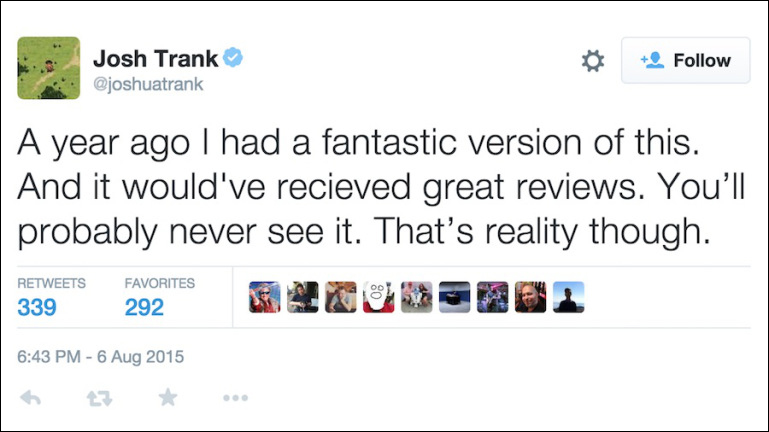
Even Josh Trank himself is trying to distance himself from the film. He posted a tweet (which he since deleted) complaining that the film currently in theaters is not his true vision, and that his was actually better. In addition to being extremely unprofessional, that claim seems highly unlikely.

The film is underperforming at the box office, which fills me with mixed emotions. On the one hand I'm glad it's tanking, not only because it's a horribly misguided and mishandled project, but because it tells me that the general public has a small modicum of taste. On the other hand, its failure saddens me, because I hate to see my favorite comic characters treated so shabbily.

One thing I hope is very clear to anyone who, despite all logic and common sense, sees this film— this is NOT a Marvel movie. I cannot emphasize that enough. Yes, yes, I know it says "MARVEL" at the beginning of it, but this film was made by Fox. Marvel Studios— the people who brought us Iron Man, The Avengers, Guardians Of The Galaxy and even Ant-Man (among many others) had absolutely nothing to do with this cinematic abomination. 

Sadly, Marvel sold the movie rights to the FF (along with the X-Men) to Fox several years ago, during the dark period in which they very nearly went bankrupt. And ever since then, Fox has demonstrated that they have absolutely no idea what to do with the property. Dear God, if you really exist, please let the rights to the Fantastic 4 revert back to Marvel.

I wish Marvel's name wasn't attached to this film. The general movie-going public doesn't know which studio owns what, so when they see the bright red and white logo at the beginning of this flop, they're going to think, "Man, Marvel finally made a dud." I feel like this movie's going to tarnish their brand, and it would have been in their best interest to insist their name be taken off it.

Speaking of ownership, the only reason this movie exists is because Fox wants to retain the movie rights. According to the terms of their agreement, they have to make a Fantastic 4 movie every seven years or the rights revert back to Marvel. Fantastic 4: Rise Of The Silver Surfer came out in 2007. This new FF movie began production in 2014. Let's see, carry the one, and... yep, that adds up to exactly seven years.

So Fox didn't make this new movie because they had a compelling story they wanted to share with fans, or a unique vision to splash across the silver screen. They waited until the last godammned possible minute and made it as a contractual obligation to keep the property out of Marvel Studios' hands. Like a petulant child, they licked the Fantastic 4 cookie so Marvel wouldn't want it. Well done, Fox.

---------------------------------------------------------------------------------

Since I refuse to pay to see this cinematic disaster, I will instead review Roger Corman's infamous, unreleased and little-seen 1994 Fantastic 4.

What's that, I hear you saying? There was yet another Fantastic 4 movie? In the 1990s yet? Yep, there was. See, back in 1992, German financier Bernd Eichinger somehow acquired the movie rights to the Fantastic 4, and commissioned a shooting script. Unfortunately this script would have cost around $30 million to shoot, an amount Eichinger did not have. His rights to the film were set to expire at midnight on December 31, 1992.

Eichinger then met with successful B-movie producer Roger Corman, whose works included such low budget classics as The Little Shop Of Horrors, X: The Man With The X-Ray Eyes, Dementia 13, Deathrace 2000, Piranha, Battle Beyond The Stars and hundreds of others. Corman had a reputation for making cheap, quick and best of all, profitable films.

Eichinger hired Corman to quickly produce a low-budget version of his Fantastic 4 script, which would allow him to retain the rights until he could come up with the cash for the $30 million version. Yes, the first FF movie was made solely to hold onto the rights— exactly like the new one! Despite its dubious origin though, this film was made by people who actually gave a sh*t, unlike the executives at Fox.

Corman accepted Eichinger's challenge and somehow managed to produce the film for an amazing $1 million dollars! That was cheap even by 1994 standards!

There seems to be great confusion as to whether the film was meant to be released or was simply a placeholder. Marvel spokesman Stan Lee says it was never meant to be seen by the public, a fact the cast and crew were unaware of during shooting. Eichinger claims otherwise, saying it was scheduled for nationwide release in 1994, which obviously never happened. Eichinger later stated that Marvel was afraid a low budget film might cheapen the brand, and so bought the film from him and buried it. We may never know the truth.

By the way, Eichinger's production company eventually went on to produce Fox's big budget Fantastic 4 in 2004 and Fantastic 4: Rise Of The Silver Surfer in 2007. So he really did make good on his plan to film a big budget FF movie!

Even though the Corman version was never officially released to the public, it's been readily available at flea markets and comic conventions for the past few decades, as well as online. You can easily dig up a copy if you're curious about it.

Despite the fact that the film was quickly made for nearly nothing, it's actually not that bad. In fact, of all the FF films made so far, it probably comes closest to capturing the tone, the characters and the family dynamic of the comic. 

Additionally, the characters definitely all look like themselves. The costumes are spot on, as every character seems to have just stepped off the comic book page. There's a healthy respect for the source material evident in the film. Why, it's as if the producers looked at the comic and said, "What can we keep?" instead of "What can we change?" as seems to be the case today. What a concept!

The movie suffers from a case of Tim Burton-itis though. It practically pulls a hamstring trying to look and feel like his two Batman films. Batman Returns was released in 1992, the year this film was made, so it's influence isn't all that surprising. The Jeweler and his mincing minions in particular are very Burton-esque.

The script as well is fairly decent, and while it's not perfect, it gets far more right than wrong. It's a bit too campy at times, and is little too simplistic, but that's due to the era in which it was made. With just a bit of polishing and a larger budget, it could have been epic.

Roger Corman's Fantastic 4 was written by Craig J. Nevius and Kevin Rock, and directed by Oley Sassone.

Nevius was a writer on the Black Scorpion TV series, while Rock wrote The Howling IV: Freaks and Warlock: Armageddon. Sassone directed several episodes of the Hercules: The Legendary Journeys and Xena: Warrior Princess TV series.

SPOILERS FOR A TWENTY ONE YEAR OLD UNRELEASED MOVIE!

The Plot:
Reed Richards (played by Alex Hyde-White) is a genius level college student, whose best friend is college jock Ben Grimm (played by Michael Bailey Smith). The two of them live in Mrs. Storm's Boarding House, along with her children Sue and Johnny. Unknown to Reed, the much younger Sue has a crush on him.

Reed and his colleague Victor (no last names, please), are working on a way to somehow harness the energy of a passing comet-like object called Colossus.

As Colossus approaches, Reed and Victor begin their experiment. Unfortunately it goes terribly wrong, due to Victor's arrogance. Colossus' energy fills the lab, Victor is horrifically burned, and seemingly dies.

Cut to ten years later. Reed now has a sophisticated lab in the Baxter Building in New York. He's spent the last decade perfecting the Colossus experiment, to honor his friend Victor. He plans to fly a ship into space to study Colossus or something. It's all very vague. The ship will be flown by professional pilot Ben Grimm. The now adult Sue (played by Rebecca Staab) and Johnny (played by Jay Underwood) will also be on board, for... reasons.

Shortly before the mission, Ben meets-cute a blind sculptress named Alicia Masters. The two fall in love after a thirty second encounter.

The spaceship's shielding system is somehow powered by a large, uncut diamond. A villain called The Jeweler steals the diamond and replaces it with a fake. He plans to give the diamond to Alicia, with whom he's infatuated.

Reed and his team fly the ship into space, but disaster strikes due to the fake diamond. The crew is bathed in the energies of Colossus and the ship subsequently explodes. Somehow they survive as the ship crash lands back on Earth.

The team then finds they've all been altered— Reed can stretch his limbs to incredible lengths, Sue can become invisible and project force fields, Johnny can burst into flames, and Ben becomes a Thing with a rock-like hide. They're taken into custody by Marines who are secretly working for Doctor Doom, the dictator of an Eastern European country called Latveria.

After Doom's men run endless tests on them for weeks, the four escape and regroup at the Baxter Building. Ben grows increasingly hostile over his freakish appearance and leaves. He's discovered and taken in by the Jeweler.

Doom steals the diamond back from the Jeweler to power a giant laser of his own design. He plans to use the laser to hold the world hostage, or something. Reed finally realizes Doom is actually his old friend Victor, and the FF fly back to his castle in Latveria to stop him. Doom fires the laser at New York City. Johnny somehow flies ahead of the beam and forces it into space with his fire powers. Ben and Sue subdue Doom's men. Reed and Doom battle one another, and Doom seemingly falls to his death.

Ben and Alicia are reunited, and she seems unfazed by his new appearance. Sue declares her love for Reed, and the two marry.

Thoughts:
• I mentioned it before but it bears repeating—  this may be the most accurate and authentic looking FF movie ever made. The costumes all look exactly like their comic book counterparts.

Doctor Doom in particular looks amazing. This is hands down the best live action representation of Doom so far. He's leaps and bounds ahead of the Doom in the 2005 movie and the "melted Tin Man" abomination in the new one. How is it that the best version of Doom comes from a film with a million dollar budget? I hope all the Fox executives responsible for the new film are hanging their heads in shame.

All's not perfect when it comes to the costumes though. Sue Storm's FF suit bugs me. Instead of tailoring her uniform to fit her smaller frame, she has the same large "4" logo on her chest as Reed and Johnny. So most of the time her emblem appears to be tucked into her belt. They couldn't have made her 4 emblem a little smaller?

There are a couple of problems with Doom as well. First of all it sounds like they recorded all his lines live on set, and then never did any ADR in post. So his voice is constantly muffled, as if he's speaking behind a full face mask, which is exactly what he's doing. It makes it difficult to understand what the hell he's saying at times.

Also, the fingers of his metal gauntlets consist of many separate pieces. Unfortunately these pieces clink and clack together any time he moves his fingers, which he does constantly in every scene. At times the din from his clanking digits practically drowns out his dialog. It's very distracting.

The Thing suit looks pretty darned good, in my opinion. He even has three fingers and a thumb, just like in the comics! I like it better than the one Michael Chiklis wore in the 2005 film, which tended to make the Thing look like a burn victim. It's definitely better than the CGI pantsless version in the new film. The face of this costume, while a bit crude by today's technical standards, is actually quite emotive. 

Some have complained that the Thing doesn't look big enough in this film (heh). Actually he looks pretty much exactly like he's supposed to. Jack Kirby drew the Thing about the same height as a normal man, just covered in rocky skin. It wasn't until much later that other comic artists started gradually drawing him ever bigger and bulkier.

• Roger Corman must have been very impressed with 1978's Superman The Movie. The opening credits of the Fantastic 4 look very, very similar to those of Superman, what with the glowing blue text set against cosmic, exploding backdrops.

• The mysterious energy source Colossus plays a big part in the film, but what the hell's it supposed to be? Reed's professor (played by George Gaines, aka Punky Brewster's dad) says it's a "radioactive, comet-like energy source that comes around once every ten years." I guess its weird energy is what gives the FF their powers. 

Seems to me they should have just stuck with the simpler "cosmic rays" of the comic and have been done with it.

Also, Reed and Victor's project involves harnessing Colossus' energy, which will somehow "change the world." That's going to be a neat trick. What good is an energy source that only comes around once every ten years? Are they storing the energy in a gigantic battery?

• The two Latverian comedy relief agents seem like they wandered in from another movie. They also have their own theme music (as does just about everyone in the film), that sounds amazingly like the whimsical Jawa theme from the first Star Wars film.

• Reed lives at Mrs. Storm's boarding house. Her daughter Sue appears to be about ten years younger than Reed, and has a massive crush on him. This is another plot element lifted directly from the comic.

• Ten years pass after Victor's apparent death. When we next see Reed, he has his characteristic grey temples. At first I didn't think he seemed old enough to be going gray, but Reed was in college at the beginning of the film, meaning he was probably around 24. So ten years later he'd be 34. So it's possible his hair would be starting to go grey (sadly, I know of what I speak).

• Reed has a lab inside the Baxter building. In the comic, the building was as much a character as the Fantastic 4.

By the way, the address of the Baxter Building is 4444, because of course it is.

• Ben and Alicia Masters fall deeply in love with one another after a chance thirty second meeting. I would make a joke about the blind Alicia falling in love at first sight, but... eh.

• Reed is planning a fly a ship into space to harness the energy of Colossus, or study it more closely, or... something. Once again, it's all very vague.

He plans to take Ben Grimm along on the mission. This seems somewhat logical, as Ben is supposedly a capable pilot (of planes though, not spaceships). But he also plans to take Sue and Johnny along for the ride, which makes absolutely zero sense. They try to justify it by saying the two siblings "know more about the project than anyone," but it's pretty weak sauce.

I can't fault the movie too much for this though, as that's pretty much the way it happened in the comics. This is a rare case in which being faithful to the source is a bad thing.

• Mrs. Storm takes a look at the four adventurers right before their mission and gives the team the name of the Fantastic 4.

• The Jeweler was obviously inspired by the Tim Burton Batman films, and wouldn't look out of place in them. He's obviously supposed to be some sort of ersatz Moleman, who was the very first villain the FF faced in the comics.

In the comics, the Moleman was an ugly little troll of a man who was rejected by society and fled underground. There he built up his own kingdom, sat on a throne, and commanded an army of pale-skinned minions and subterranean monsters.

Obviously this film couldn't afford any of that, so instead we get The Jeweler, who lives in the sewers under NYC, sits on a throne and commands an army of homeless outcasts. He's a very, very, very poor man's Moleman.

• The Jeweler falls in love with Alicia Masters and wants to make her his "queen." In order to impress her, he steals an important and enormous diamond from Reed's lab, intending to give it to her as a gift. Several things here.

First of all, this enormous diamond is uncut. It looks like a hunk of lumpy quartz or something, and is a far cry from an angular, sparkling cut diamond. Secondly, The Jeweler sneaks into the lab and steals the diamond, and replaces it with an exact duplicate (and I do mean exact) he just happens to have lying around his subterranean lair. Where the hell did he get such a thing?

Lastly, Alicia is blind. What good is a beautiful diamond going to be to someone who can't see it and appreciate its beauty? I guess maybe she's supposed to run her hands over it and admire the shape of it?

• Sadly, the film's low budget really shows in the spaceship scenes. First we're treated to a model of Reed's airplane-like rocket ship. Then we see it blast off through the magic of declassified NASA stock footage, which of course doesn't match the model.

We then see a shot of a model ship zooming through space. Trouble is, this model looks nothing like the first one we saw. In fact it looks very much like the one in Corman's sci-fi opus, Galaxy Of Terror. I'm not 100% sure if it's the same one, but it's very similar. 

There's also a very low budget spaceship crash site. It looks like some sort of cow pasture, littered with a few strategically placed pieces of debris. I guess when ships fall to Earth from space, they land in a small, hundred square foot area.

• How do Reed's clothes stretch along with his limbs? I suppose we could be generous and say his FF uniform could be made of some kind of spandex-like fabric, but how do his street clothes stretch as well?

• The Metro Times newspaper is absolutely obsessed with Reed Richards and his experiment. The blast off and crash are front page news headlines at least twice (accompanied by the traditional "spinning newspaper" effect).

• The Jeweler's army of misfits all act like a troupe of demented circus acrobats. His right hand man is particularly guilty of this, gesturing and moving in a bizarre, over the top manner. They remind me a lot of the Penguin's henchmen in Batman Returns, which I'm sure was intentional.

• Alicia is chosen to sculpt a memorial statue of Reed and his co-pilots, after they're presumed dead. She receives a shipment of life casts of their heads, that we're told were taken for their "space helmet fittings." This is especially hilarious, considering the helmets in the film all look like low budget, one size fits all loose beekeeper hoods.

• Once the FF are rescued, they're taken to a secret medical facility for study. Unknown to them, this facility is really inside Doom's castle.

A Dr. Hauptmann examines and tests the quartet. Hauptmann really was a character in the comics, and was one of Doom's assistants.

• As the FF escape their cell, there's a cute scene in which Sue turns invisible, sneaks into a guard shack and punches out the man on duty. When she becomes visible again, she's rubbing her sore knuckles. 

• When Doom appears and introduces himself to the FF, Reed stares at him stoically and acts like he has no idea who he is.

Um... wasn't Victor supposed to be Reed's close friend and colleague? Didn't he mourn his accidental death, and dedicate the next ten years of his life to finishing the Colossus experiment to honor his memory? So why doesn't he recognize him? Sure, Doom's wearing a metal mask, but he just told Reed who he is.

Did Victor just go by his first name in college? Or did he use a different name, and is only now calling himself "Doom?"

• Reed deduces that the FF's powers are tied to their psyches. Sue is shy, so she turns invisible, Johnny has a fiery temper, so he bursts into flame and so on. That's actually an interesting idea, and it even fits the characters and their powers. I don't know if that's what Stan Lee and Jack Kirby really had in mind back in 1963, but if they did, well done.

By the way, when Johnny hears Reed's psychological explanation for their powers, he exclaims, "Holy Freud, Batman!" Wakka wakka! This is an example of the slightly campy tone of the film. It probably played OK back in the 1990s, but it would never go over today.

• Ben begins feeling sorry for himself and flees the Baxter Building, wandering the streets and alleys of New York in despair. He's eventually found by The Jeweler's gang and taken in by them.

Why does Ben start acting like a guy in a gorilla suit in this scene? As the minion sweet talks him, he purrs and hoots exactly like a movie gorilla.

• When Alicia tells Ben she loves him, he reverts back to his human form for a few minutes. He does this through the power of a primitive and early CGI morph. It's not the worst effect I've ever seen, especially considering the budget.

A few minutes later he turns back into his rocky form. Unfortunately they must not have been able to afford a second morph, so they accomplish this sophisticated effect by spinning an image of human Ben around and slowly dissolving into a spinning image of the Thing. Yikes.

• Doom appears on the large screen in Reed's lab and gives the FF an ultimatum. All during his speech he makes these bizarre and elaborate hand gestures, almost like he's using some form of faux sign language. Was that just in case the audio wasn't on in the lab?

• The Fantasticar makes a VERY brief appearance late in the film. It's literally on screen for five seconds. Despite the brevity, it looks pretty good, just like it did in the comic. It's really too bad this film didn't have a larger budget. The producers definitely knew what they were doing, and obviously had a healthy respect for the source material.

• Doom visits The Jeweler's lair to steal the diamond from him. While Doom is monologing, The Jeweler buggers off and abruptly exits the movie, never to be seen again. No comeuppance, no punishment, no nothing. Were they setting him up for a sequel that never happened? Or did they just run out of money and couldn't film a decent ending for him?

• Sue finally uses her force field power very late in the film. She does so seemingly out of the blue, with no explanation or fanfare. Up to that point she'd only used her power to turn herself invisible, and never indicated she had any secondary powers.

It's almost like the director thought, "Whoops! We forgot all about her force fields! Better throw that in or the fans'll complain!"

• Doom fires his laser from Latveria (which is somewhere in Eastern Europe) to New York. Unless this beam can somehow bend and follow the curvature of the Earth, I don't see how that's possible. The two locations are on opposite sides of the planet. The beam should just shoot straight out into space.

• Johnny finally goes "Full Human Torch" in the final minutes of the film and flies off after the laser beam. The Human Torch effects are very, very primitive, as if he suddenly turned into a 2D cartoon character. I'm willing to cut them a bit of slack though, as the film had a minuscule budget and I'm sure they did the best they could. 

On the other hand, Terminator 2: Judgement Day was made around the same time as this film, and gave us the liquid metal T-1000. So a better Torch affect was theoretically possible.

Somehow Johnny manages to not only catch up to the leading edge of the laser beam, but actually gets in front of it. So... that means Johnny can fly faster than the speed of light. Nope!

Johnny then uses his flame powers to stop the beam and somehow reverse it. I'm having trouble understanding how fire could possibly affect a concentrated beam of laser light. He then forces the beam into space, where it explodes, which isn't really something that light can do, but whatever. Johnny then makes a couple of victory laps before heading back to Earth. That's right, his body is somehow burning in the vacuum of outer space. Whoops!

• In the film's final scene, Reed and Sue get married and drive off in a limo. Reed stretches his arm out the sunroof and gives the crowd a wave. The less said about the rubbery waving arm effect, the better.

Despite it's microscopic budget, Roger Corman's Fantastic 4 is probably the best screen representation of the team yet. It's not perfect by any means, but it gets more right than wrong and was obviously made by people who respected the source material, and is definitely more entertaining that any of the subsequent versions. With a script polish and a larger budget, it could have been awesome. I give it a B.
Related Posts with Thumbnails
 
Site Meter