Showing posts with label interstellar. Show all posts

Saturday, November 26, 2016

It Came From The Cineplex: Arrival

Arrival was written by Eric Heisserer and directed by Denis Villeneuve.

Heisserer is a very uneven screenwriter, who previously penned the awful A Nightmare On Elm Street remake (the one that turned Freddie Krueger into an outright pedophile), Final Destination 5 (eh, OK), The Thing remake (ugh), Hours (didn't see it) and Lights Out (meh). Wow. That is a spectacularly unimpressive body of work. How the hell did a guy with a resume like that manage to pump out a thoughtful and intelligent hard sci-fi movie like this? I guess one can't strike out every time at bat. I wouldn't be surprised though if some day, when Eric Heisserer is old and gray, a large puff or brimstone will appear before him and Satan will lean out and say, "Did you think I'd never come to collect on our bargain?"

Villeneuve previously directed Prisoners, Enemy and Sicario.

Arrival is based on the book Story Of Your Life by Ted Chiang. It should not be confused with The Arrival, the 1996 scifi opus starring Charlie Sheen (!).

I like science-fantasy movies like Star Wars and Guardians Of The Galaxy just fine, but I've always liked hard scifil films even more. 
Movies like 2001: A Space Odyssey, The Andromeda Strain and more recently The Martian. Films that are full of ideas and involve actual science. Stories that make you think, instead of sitting there like a lump, passively absorbing whatever flashes across the screen. 

Unfortunately the vast majority of the movie-going public doesn't want to think— they just want to see amazing visuals and watch CGI buildings explode. That's why it's all the more amazing when a thoughtful scifil movie like Arrival finds its way into the cineplex these days.

Predictably, the film is being whupped at the box office, by both Doctor Strange ($600 million so far) and, god help us, Trolls ($260 million). Heck, even Boo! A Madea Halloween out-grossed Arrival during its brief run, racking up an astonishing $72 million!

Meanwhile, poor Arrival's only manged to gross an anemic $53 million worldwide against it's $43 million budget. Due to marketing and other costs, movies generally need to make twice their production cost before they begin showing a profit. Arrival's gonna have an uphill climb just to break even.

Sadly, this doesn't surprise me. 
I'm sure most of the audience was expecting Arrival to be a clone of Independence Day, only to be bitterly disappointed when it turned out to be a thoughtful, slow-moving film about language and our perception of time. In fact as I was leaving the theater, I overheard at least two different groups complaining that Arrival was "stupid" and that they should have seen Doctor Strange instead.

Sigh...

MASSIVE SPOILERS AHEAD! THIS IS A FILM THAT'S BEST EXPERIENCED WITH NO PREVIOUS KNOWLEDGE OF ITS PLOT! YOU HAVE BEEN WARNED!

The Plot:
As the film opens, we see linguistic professor Louise Banks (played by Amy Adams) as she recalls bittersweet memories of her late daughter, who died as a teen. Smells like foreshadowing to me! Later that morning, Louise drives to class and is puzzled to find it practically deserted. At a student's request she turns on the TV and is shocked to see new reports of an alien invasion.

It seems twelve massive alien "shells" have suddenly appeared and are hovering a few feet above seemingly random spots across Earth. No one knows just why the aliens are here or what they want, which causes a worldwide panic. U.S. Army Colonel Weber (played by Forest Whitaker) arrives at Louise's house in the middle of the night, claiming the government needs her translation skills to help decipher the aliens' language.

Louise is flown to Montana, where one of the alien shells is hovering. The army's set up a large temporary headquarters near the "landing" site. Louise is joined by theoretical physicist Ian Donnelly (played by Jeremy Renner), and after a brief indoctrination, they're dressed in hazmat suits and taken to the meet the "visitors." Every eighteen hours, a hatch opens in the bottom of each of the shells. Louise, Ian, Col. Weber and a few other soldiers are scissor-lifted into the shell.

Inside, Louise sees a wide rectangular chamber with a glass wall at the end. She approaches the glass, and two of the aliens emerge from their cloudy atmosphere so she can get a good look at them. They vaguely resembling large floating squids with seven tentacles. She tries to communicate with them, but their language is composed of incomprehensible squeals and moans hat a human voice could never reproduce. Later back at the base, Louise is flustered by the encounter.

The next day, Louise and the others return to the ship. She realizes they're never going to get anywhere while she's wearing a bulky hazmat suit, so she peels it off, marches up to the glass and writes "human" on a dry erase board. One of the aliens squirts an inky substance into its atmosphere, which forms a lumpy ring. Louise correctly guesses this it the alien's "written" language.

Ian dubs the aliens "Heptapods" due to their seven arm symmetry, and names the two they're working with "Abbott" and "Costello" (ask your grandparents, kids). The Heptapod's writing system is nearly impossible to comprehend, as each little flourish on the circular symbols relates to and affects all the others. Through the power of a montage, Louise and the aliens slowly learn one another's written language. She even writes an app allowing her to type out sentences in Heptapodese!

Louise translates one of the Heptapod's messages as "Offer weapon." Naturally this alarms the nations of the world, destabilizing the already fragile peace. The leader of China's army, General Shang, panics and threatens military action against the Heptapods. Panic grips the populace and seeps into the army base, as many of the soldiers become suspicious of the Heptapods' motives. Louise tries to tell Col. Weber and the others that "weapon" could also mean "tool," but her explanation falls on deaf ears.

Meanwhile Louise begins dreaming about her late daughter, as well as the aliens. Ian wonders if trying to understand and think in the Heptapod language is beginning to affect her brain.

The next day a group of soldiers somehow sneak a bomb into the chamber of the Heptapod ship. Louise and Ian enter and talk with Abbot and Costello. The aliens seem agitated as they pound on the glass, as if they're trying to tell the humans something. They write a complicated "sentence" with hundreds of circular symbols, then suddenly fly away from the glass. The Heptapods use some sort of invisible force to shove Louise and Ian out of the chamber a split second before the bomb explodes.

Louise is knocked out, and when she wakes, the Heptapod shell is now inaccessible, floating high in the air. Col. Weber has been ordered to evacuate the Montana base. China has their weapons aimed at their Heptapod ship, and the other nations follow suit. War and destruction seem inevitable.

Ian somehow translates part of the complicated message, saying it has something to do with the concept of time. He says Abbott and Costello only gave Louise one twelfth of the message. To translate it fully, they'll have to get the remaining pieces from the other eleven nations. Since none of the countries are speaking to each other, that seems unlikely.

Louise rushes out and stands under the ship. It sends down a small pod that takes her inside. She's brought into the Heptapods' atmosphere, which apparently isn't poisonous to humans. Costello tells her that Abbott was injured by the bomb and is dying. He helps her realize that understanding the Heptapods' language unlocks something in the speaker's brain, allowing them to experience the past, present and future all at once. Costello tells Louise the reason they came to Earth is to give us their language and save us, because they've foreseen that three thousand years from now, we'll save them from... something.

Louise realizes the Heptapod language has already altered her perception, and she no longer sees time linearly. It turns out her late daughter hasn't even been born yet, and the "memories" she has of her are actually flash-forwards (!). Woahhhh... this movie just blew my mind, man.


Louise returns to the camp and has another flash-forward, in which General Shang thanks her for changing his mind about firing on the Heptapods' ship. She asks him how she did this, and he says she called his private number (!) and repeated his late wife's last words to him.

Louise is then pursued by various base personnel for... reasons. I think maybe they're afraid she's been compromised by the aliens? She steals a satellite phone and miraculously gets through to General Shang in the present. Right before the soldiers open fire on her, she relays her message to Shang. He's so flustered and amazed by what she tells him that he orders the Chinese military to stand down. Following China's lead, the other nations back off as well, and the various countries start working together again, sharing all their info with one another.

The aliens decide they've caused enough trouble for humanity, and the twelve shells simply fade away.

As they're dismantling the Montana base, Ian tells Louise he loves her. She sees a future vision in which he asks her if she wants to make a baby. Despite already knowing the tragic fate of her daughter, she says yes.

Thoughts: 

• Oddly enough, I don't have a lot to say about this movie. It's pretty darned good and I liked it a lot. That means this review's gonna be pretty short.

See, when I hate a movie, I can work up a pretty good head of steam and write 100,000 words ripping it apart. But when a movie's actually good, well... there are only so many ways to say, "It's great!"

This is the irony of movie reviews, I guess. The worse the movie, the more spirited and interesting the review, while good films just get a pat on the head.

• Director Denis Villeneuve insisted that the movie's use of linguistics and linguistic science was as accurate as possible.
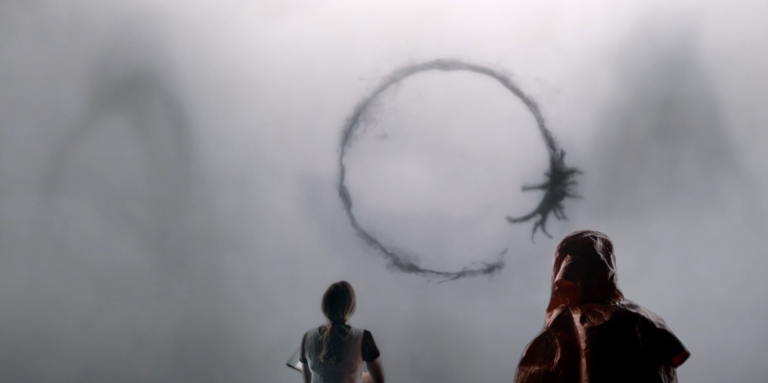
Villeneuve and screenwriter Eric Heisserer also created a fully functioning written language for the Heptapods to use in the film. They created a list of over a hundred different circular "logograms," seventy nine of which are seen in the film.

• I could easily accept Amy Adams as a professor of linguistics. Unfortunately I didn't for one minute buy Jeremy Renner as a theoretical physicist. Renner seems much too "blue collar" to play a brainy scientist. That isn't necessarily a criticism of his acting talent; he was just miscast. 

• At no time in the film do any of the Heptapods or their ships ever actually touch the Earth. The aliens never leave their ships, which all hover just a few feet above the surface.

• Kudos to the design team for the look of the Heptapods. It was nice to finally see extraterrestrials that actually looked alien, instead of like humanoids with wrinkly foreheads.

• The movie bases a big chunk of its plot on the Sapir-Whorf hypothesis. The hypothesis was created back in 1929, and there are two versions: "strong" and "weak."

The strong version states that all human thought, perceptions and actions are bound by the restraints of language. In other words an English speaker perceives the world much differently than someone who uses Mandarin. If a person learns a new language, then new areas of the brain are opened up and they begin thinking in new ways.

The weak version of the hypothesis says that language plays a much, much smaller role in shaping our minds.

Most modern linguists have discounted the strong version of the Sapir-Whorf hypothesis, citing that if it was true, instruction manuals and works of fiction would be impossible to translate from one language to another.

Unfortunately Arrival heavily utilizes the Sapir-Whorf hypothesis, as simply learning the Heptapods' language causes Louise to begin experiencing time non-linearly. Given the fact that most scientists have thoroughly discredited the theory, this puts the entire plot of the film in serious doubt.

• The 2009 Torchwood miniseries Children Of Earth featured an invasion by an advanced race of aliens called the 456, who demanded the world hand over ten percent of the planet's children to them or else. 

The 456 enclosed themselves in a special glass chamber that was filled with their toxic atmosphere. Earth representatives met with the aliens by standing in front of the glass wall of their chamber.

The scenes of Louise and Ian meeting the Heptapods in Arrival looked amazingly similar to Children Of Earth. Wait, did I say similar? I meant EXACTLY like it.

This isn't necessarily a case of plagiarism. It could be that there are only so many ways to film humans standing in front of a smoky glass box full of aliens.

• What was up with Ian's odd narration? Halfway through the movie, he suddenly begins infodumping the plot to us, telling how Louise made a breakthrough that let her decipher the alien pictograms.

Hey guys, it's a movie. You're supposed to show, not tell.

I have a feeling the narration was a studio mandate. I'm betting a nervous studio executive watched a rough cut of the film, and was worried that the dimmer members of the audience wouldn't be able to figure out what was happening, and insisted on spelling it out for them.

• Arrival kind of skates over the specifics of exactly how Louise finally cracks the Heptapods' language. 

One minute she's commenting that their circular sentence structure baffles any attempt to decipher it, then a couple scenes later she's using a Heptapod language app on her IPad, tapping out sentences with ease.

• This movie contains a perfect example of what I call The Fantastic Four Effect.

See, back in the awful 2005 Fantastic Four movie, there's a scene in which the Thing sits brooding on the Brooklyn Bridge. He sees a man about to commit suicide and saves him, but accidentally causes a huge traffic pileup that escalates into a full blown disaster. The Thing, Mr. Fantastic, Invisible Girl and the Human Torch then spring into action, each using their powers to save the city. The media dubs the team the Fantastic Four as the public celebrates them.

What no one seems to realize is the Fantastic Four became famous while cleaning up the huge mess they created. There wouldn't have been a disaster if not for them.

And so it is in Arrival. The Heptapods tell Louise they came to Earth to save humanity, because they've foreseen that three thousand years from now, humanity will somehow save them.

But we wouldn't have needed saving if they hadn't come here and freaked everyone the hell out by ominously hanging their ships over our heads. We were getting along just fine before they showed up and destabilized our society.

• These days many films count on the Chinese box office for a significant portion of their worldwide gross. In fact some studios are beginning to tailor their films to appeal to Chinese audiences.

I have a feeling Arrival probably won't be playing there. Sure, General Shang ends up saving the day, but China's the first country to threaten to destroy the alien ships. That's probably not gonna play well in the Middle Kingdom.

Arrival is a rare sight at the cineplex these days— a well-written, thoughtful hard scifi movie that contains ideas and concepts instead of explosions and CGI disaster porn. Better hurry and see it before it's nudged out of the theater by the holiday blockbusters. I give it an A-.

Monday, June 29, 2015

Science Faction

This week the American Journal Of Physics, which is apparently a thing, suggested that Christopher Nolan's 2015 film Interstellar should be shown in science and physics classes in order to teach students about space phenomenon.

Dr. David Jackson, editor of the Journal, examined the film and declared that its depiction of "Love" as a quantifiable, measurable force is one hundred percent accurate.

According to Jackson, "The publication will encourage physics teachers to screen the film in their classes in order to teach students woefully inaccurate concepts about the way black holes, wormholes and other cosmic phenomenon look and behave. I also encourage teachers to use the film to mislead students into thinking that "Love" is not simply a human emotion, but in fact a higher dimension and a tangible force that transcends time and space."

"Oh, and don't forget the sassy, wisecracking robot!" said Jackson. "That TARS had me rolling in the aisle! Interstellar is a literal goldmine of misinformation as to how actual robots function!"

Critics have denounced the idea of using the film in an academic setting. Morey Shoedsack, editor in chief of Screenwriter's Monthly, said that not only does the film have no business being shown in science classes, but shouldn't be seen anywhere near film schools either. "I shudder to think what would happen if future screenwriters were to study the film's needlessly dense and impenetrable plot," said Shoedsack. "Brace yourselves for an onslaught of self-important and indulgent tripe in about ten years."

Jackson remains undeterred though, and plans to call for the screening of additional sci-fi films as teaching aids, including Invasion Of The Neptune Men, Earth Vs. The Flying Saucers, The Man From Planet X, Robot Monster, Cat-Women Of The Moon, Devil Girl From Mars and the Transformers series. 

Monday, December 8, 2014

It Came From The Cineplex: Interstellar

Interstellar was written by Jonathan and Christopher Nolan, and directed by Christopher Nolan.

I was very much looking forward to this film, as the trailer promised a compelling hard sci-fi story, rather than the typical explosion-packed science fantasies that litter the cineplex these days. Something along the lines of 2001: A Space Odyssey and Contact. It delivers on that promise for the most part until the third act, when unfortunately it becomes bogged down with new age mumbo jumbo and outright magic to resolve the plot. Just like 2001: A Space Odyssey and Contact, now that I think about it.

Like most of Nolan's work, the plot is convoluted and sometimes vague, demanding multiple viewings to sort it all out. He reminds me of British pop band Duran Duran. Way back in the 1980s, they pumped out a series of baffling music videos that made little sense at first glance. When asked about the meaning of them, the band said they purposely made them enigmatic to encourage viewers to watch them over and over. I'm convinced Nolan does the exact same thing in his films (I'm lookin' at you, The Prestige and Inception). Sometimes I wonder if even he can unravel his tangled plots.

I'm generally terrible at solving mysteries and foreseeing plot twists in books and movies. Not so in Interstellar. Half an hour into it I correctly predicted every upcoming twist. You could see them all coming down the street from blocks away, like a parade. In fact I even called the "Cooper stays young while his daughter Murphy ages back on Earth" reveal just from seeing the trailer.

SPACE/TIME SPOILERS AHEAD!

The Plot:
Sometime in the near future, humanity is slowly dying as a crop blight wipes out the world's food supply. Cooper (played by Matthew McConaughey) is a former NASA pilot turned farmer who apparently can't afford a first name. He's raising his teenaged son Tom and ten year old daughter Murphy. Murphy believes there's a ghost in her room that's trying to communicate with her, in what is possibly the most obvious bit of foreshadowing I've ever seen.

Using gravity and Morse code (don't ask), the "ghost" sends a series of coordinates to Cooper and Murphy, which they follow to a secret NASA base headed by Professor Brand (Michael Caine, who's apparently contractually obligated to appear in all Christopher Nolan films). 

Brand has discovered an artificial wormhole near Saturn that opens into a distant galaxy. Ten years ago his team sent several explorers on one-way trips through the wormhole, and they've identified three potentially habitable worlds on the other side. Brand wants to send a larger crew through the wormhole to discover which planet is the best choice, so the rest of humanity can follow shortly after in a giant space ark. Yep, a space ark. 

Cooper's chosen to pilot this exploratory ship, but he's reluctant to leave his children, knowing he'll be gone for years, possibly even decades. He eventually decides that the needs of the many outweigh the needs of the few, and agrees to go.

Cooper and a team of astronauts, including Dr. Brand's daughter Amelia (played by Anne Hathaway) fly through the wormhole and investigate a planet orbiting an enormous black hole they name Gargantua. The planet turns out to be uninhabitable, due to its charming thousand foot tidal waves. Because of science, when they get back to the ship they find that although just three hours passed for them, over twenty years have passed on Earth. Murphy is now a grown woman working with Professor Brand.

They try another planet and meet Matt Damon, but his planet's no good and he's crazy. He damages their ship and Cooper sends Amelia to the third planet, while he's captured by the massive gravity of Gargantua and falls into the black hole.

Because of science again, he's not crushed by the hole's immense gravitational forces, and finds himself floating in some kind of weird Inception-style tesseract world. He figures out that inside this world he can see into the past, and— you guessed it— he begins communicating with ten year old Murphy. Yep, he was the "ghost" in the room all along, in a plot twist that I'm betting Nolan thought would blow the audiences' collective mind, but which everyone figured out in the first ten minutes of the 169 minute run time.

Apparently pretty much everything in the film has been orchestrated by advanced humans in the far future, who've discovered how to manipulate time and gravity and everything else to make sure the species survives.

Cooper somehow uses Morse code to communicate the equation that will allow humanity to launch its giant space ark. Amazingly he then wakes up on the ark station near Saturn and sees that Murphy is now an old woman on her death bed. He says "Sorry about that whole missing your entire life thing," and goes off into space to find Amelia.

Thoughts:
• I'm suspicious of some of the science presented in the film, but Nolan worked closely with theoretical physicist Kip Thorne, who insisted on as much accuracy as possible. Since he probably knows more about science than I do, I'll have to give him the benefit of the doubt. Thorne was also a scientific consultant on 1997's Contact.

• Kudos to Nolan for setting the film in an unspecified future year. One of my pet peeves is when a sci-fi film features incredibly advanced technology, but is set only fifteen or twenty years from now, which instantly dates it.

Keep the year of your futuristic film vague, directors.

• When Cooper's driving his kids to school, he spots an unmanned drone flying through the sky and takes off after it. He drives off the road and through his own fields in pursuit of the errant drone, completely destroying tens of thousands of corn stalks.

First of all, he covets this thing so badly because he says its solar cells could power an entire farm. That seems unlikely, as we see there are about four feet of solar cells on each of the drone's wings. Doesn't seem like they'd be able to generate all that much power. Are solar cells in the future exponentially more powerful than the ones we have today?

Secondly, this is a world on the brink of starvation. We're told that corn is one of the few crops that will still grow. So it only makes sense that Cooper would flatten several acres of this precious commodity just so he can get his hands on the drone. "Sorry we won't have enough to eat for the winter, kids, but hey, look at this bitchin' drone I found!"

• Tom teases Murphy about her name, and she tearfully asks Cooper why he named her after something bad ("Murphy's Law"). Cooper tells her that Murphy's Law doesn't mean that something bad will happen, but that "whatever can happen, will happen."

NOPE! Sorry Cooper, but you're full of crap. The official definition of Murphy's Law is indeed "anything that can go wrong will go wrong."

It's possible that Cooper knows this and he's just trying to make Murphy feel better, so I'm willing to give them this one.

• Professor Brand's headquarters also doubles as a giant space ark that will save humanity, provided he can solve the "gravity problem." He plans to load the ark with people and lift it up into space, abandoning our dying planet.

Oddly enough this ark looks more like the interior of a mall instead of a space ship, complete with giant concrete support columns. Do they really make space ships out of cement? I'm guessing no. No they do not.

• This space ark is a massive undertaking and no doubt requires a vast amount of manpower, resources and energy. 

Early in the film Cooper mentions that if they still had MRI machines, his wife's illness would have been diagnosed sooner and she'd still be alive. From his statement it's obvious that technology and resources are stretched thin. So how in the name of sanity would a society on the brink of starvation be able to engineer and construct such a station? It would be like the Irish putting a man on the moon during the Great Potato Famine.


• The Endurance spaceship consists of twelve modules on a ring, and looks a lot like a clock. I wonder if that was intentional, given the importance of time in the story?

• Kudos to Nolan for insisting on using practical special effects and as little CGI as possible. All the scenes of the Endurance and the Ranger spacecraft were filmed with models, which is pretty rare these days.


• I really liked TARS and CASE, the robots in the film. Their design was very simple— they're basically just four black rectangles stuck together— but they were amazingly emotive.

For most of the scenes the robots were large puppets manipulated by the voice actors, who were digitally removed from the scenes in post.

• Once the Endurance has lifted off from Earth, the crew beds down in their cryosleep chambers in order to doze away the two years it'll take to reach the wormhole next to Saturn.

Two years? Hmm. If you traveled at the speed of light you could get from the Earth to Saturn in about 75 minutes. The Endurance must be going very, very slowly.

• Once they go through the wormhole, the Endurance crew decides that Miller's Planet is their best shot, because they've been receiving telemetry "pings" from it for years. When they get there, they discover that due to the time dilation effect, the first exploratory ship was torn apart by massive waves just a few hours ago. The "years" of transmissions were actually just a few minutes' worth of data. 

Wait a minute... OK, this is complicated, so bear with me. I get all the relativity stuff, and how an hour on Miller's Planet equals seven years to the rest of the universe. But Professor Brand said that because communication through the wormhole is problematic, each explorer was to send out a thumbs up or thumbs down signal from their respective planet once a year. Apparently they've been receiving an annual ping from Miller's for the past ten years.

I can't figure out how that's possible. First of all I don't see why Miller would send out a thumbs up in the first place— her planet was ravaged every few minutes by thousand foot tidal waves. But even if she did send out one the instant she landed... she didn't live there for a year. She died an hour or so after landing. So how was NASA receiving pings from her for the past ten years?

Did they receive her one and only ping, and the black hole distorted it so it was one ten year long ppppiiinnnggg?

Maybe I'm missing something or I'm not as smart as I like to think, but it seems like a pretty serious error on the part of the crew. Not to mention the screenwriters.

• When the giant wave hits the Ranger on Miller's Planet, one of the Endurance scientists (Doyle) is washed away. His death was very poorly filmed. In fact I wasn't even sure he'd died for a good five minutes or so after the wave hit.

• Professor Brand says the initial expeditions can only send rudimentary data (amounting to the aforementioned annual "ping") through the wormhole. Yet Cooper receives several videos of reasonably high resolution from his rapidly aging kids back on Earth. Do transmissions through the wormhole only work one way?

• As stated before, Professor Brand is feverishly trying to solve the gravity equation so that if and when Endurance finds a suitable planet, the population of Earth can colonize it.


Does it seem odd that the survival of the entire human race is dependent on one old man? Every time we see him he's sitting alone in his office staring at his scribblings on the blackboard. All it would take is one slip in the shower and humanity is doomed.

Sure, later on Murphy begins helping him, but why isn't there a huge team of scientists and mathematicians helping him solve his equation?

• Murphy comes off as a very schizophrenic character in the film. When Cooper tells her he's going on the mission, she angrily snubs him, which is what a real ten year old girl would most likely do. 


The next time we see her she's in her thirties, and she sends a withering message to Cooper (her first ever). Believe it or not, she still resents her father for leaving her. You know, her father, the guy who had the gall to leave her in order to save the whole goddamned human race. Child Murph could get away with acting like that, but it makes Adult Murph look like a bit of an asshole.

After Asshole Murph sends the message to Cooper, we see that she's now working for Professor Brand, helping him solve his gravity equation. This is Noble Murph, and she's incredibly chummy with Brand, possibly even seeing him as the father she never had. It's obvious from these scenes that the movie now expects us to unconditionally like her. Nice try, movie.

Later when Professor Brand dies, she finds out his work was all a sham, and turns into Asshole Murph again. Then she figures out the messages that Cooper sent to her in the past, and suddenly she's Noble Murph again. 

It's almost like there are two versions of her, each coming to the forefront depending on the whims of the script.


• Play the Intersellar Drinking Game! Take a shot every time Professor Brand says, "Do not go gentle into that good night. Old age should burn and rave at close of day. Rage, rage against the dying of the light!"

You'll be dead of alcohol poisoning somewhere around the hour and a half mark.

• After the disastrous Miller expedition, the crew decides to visit Mann's Planet. They touch down on the icy world and find Dr. Mann is alive and well and in cyrostasis. They thaw him out and lo and behold, he's played by Matt Damon!

Kudos to the production team for keeping Damon's presence in the film a secret. He's not in the trailer or any of the promotional materials, and I was honestly surprised when he showed up. In these days of the internet and spoiler sites, keeping such a secret is a minor miracle.

• When Dr. Mann is brought out of stasis, why is his fluid-filled cryo-chamber steaming? Isn't it supposed to freeze him? Or does it instantly switch from cold to hot when you push the "thaw" button?

• I could have done without all the new age bushwah at the end of the film. Ameila posits that "love" is a quantifiable force like gravity, that transcends time and dimension. Um, no. Love is an internal emotion and nothing more. Is she trying to make us believe love would still exist even if there were no people to experience it?


I'm betting Kip Thorne didn't come up with that particular bit of "science."

• I was with the movie right up to the point in which Cooper falls into the black hole and then finds himself in a weird Escher universe in which he can communicate with Murphy in the past. At that point all the hard science flew right out the window, to be replaced by outright magic pulled straight out of Christopher Nolan's ass.

• It turns out that Cooper was the "ghost" that communicated with Murphy in the past, knocking books off her shelf in binary patterns and signaling her with a watch, whose second hand tapped out Morse code.

We're told that super-evolved humans from the far future constructed this artificial universe for Cooper, for the express purpose of allowing him to communicate with his daughter in the past and save the human race.

If the super humans have that much power, why not just give Cooper a microphone or something so he can tell Murph exactly what to do? Why screw around with binary and Morse code? What if she wasn't able to figure out such a convoluted message? Why risk the future of the race on such a long shot?


• Near the end of the film Cooper wakes up inside Cooper's station, named after his daughter. It appears to be an O'Neil cylinder, which is a real thing. Well, not a real thing, but a real idea for a space colony. Basically it's a large hollow tube with living space on the inner surface. The cylinder spins to simulate gravity.

As Cooper walks around inside the station, he sees lush green foliage and vegetation. That's odd. I thought the Blight had destroyed every crop on Earth except for corn. Moving off Earth wouldn't end the Blight if the seeds were already infected. I guess NASA must have squirreled away some un-Blighted seeds for safe keeping?

• Just as I predicted the first time I saw the trailer, at the end Cooper is finally reunited with Murph, who's now over a hundred years old.

Old Murph is played by Ellen Burstyn. Apologies to Ms. Burstyn, but I was honestly shocked when I saw how old she is now. I didn't realize she's 82! Seems like just yesterday I saw her in The Exorcist.

• Right before the credits roll, Cooper and a repaired TARS steal a Ranger spaceship and fly off to rescue Amelia. 


Are there cryo units in those little Rangers? I hope so, because if not, Cooper's going to be sitting in his little chair for two years while they make their way to the Saturn wormhole. His butt's going to be more tired than mine was at the end of this overlong film.

A typical convoluted Christopher Nolan tale, Interstellar starts out as a well made hard sci-fi story before degenerating into outright magic in the third act. I give it a B-.
Related Posts with Thumbnails
 
Site Meter