Showing posts with label the martian. Show all posts

Saturday, November 26, 2016

It Came From The Cineplex: Arrival

Arrival was written by Eric Heisserer and directed by Denis Villeneuve.

Heisserer is a very uneven screenwriter, who previously penned the awful A Nightmare On Elm Street remake (the one that turned Freddie Krueger into an outright pedophile), Final Destination 5 (eh, OK), The Thing remake (ugh), Hours (didn't see it) and Lights Out (meh). Wow. That is a spectacularly unimpressive body of work. How the hell did a guy with a resume like that manage to pump out a thoughtful and intelligent hard sci-fi movie like this? I guess one can't strike out every time at bat. I wouldn't be surprised though if some day, when Eric Heisserer is old and gray, a large puff or brimstone will appear before him and Satan will lean out and say, "Did you think I'd never come to collect on our bargain?"

Villeneuve previously directed Prisoners, Enemy and Sicario.

Arrival is based on the book Story Of Your Life by Ted Chiang. It should not be confused with The Arrival, the 1996 scifi opus starring Charlie Sheen (!).

I like science-fantasy movies like Star Wars and Guardians Of The Galaxy just fine, but I've always liked hard scifil films even more. 
Movies like 2001: A Space Odyssey, The Andromeda Strain and more recently The Martian. Films that are full of ideas and involve actual science. Stories that make you think, instead of sitting there like a lump, passively absorbing whatever flashes across the screen. 

Unfortunately the vast majority of the movie-going public doesn't want to think— they just want to see amazing visuals and watch CGI buildings explode. That's why it's all the more amazing when a thoughtful scifil movie like Arrival finds its way into the cineplex these days.

Predictably, the film is being whupped at the box office, by both Doctor Strange ($600 million so far) and, god help us, Trolls ($260 million). Heck, even Boo! A Madea Halloween out-grossed Arrival during its brief run, racking up an astonishing $72 million!

Meanwhile, poor Arrival's only manged to gross an anemic $53 million worldwide against it's $43 million budget. Due to marketing and other costs, movies generally need to make twice their production cost before they begin showing a profit. Arrival's gonna have an uphill climb just to break even.

Sadly, this doesn't surprise me. 
I'm sure most of the audience was expecting Arrival to be a clone of Independence Day, only to be bitterly disappointed when it turned out to be a thoughtful, slow-moving film about language and our perception of time. In fact as I was leaving the theater, I overheard at least two different groups complaining that Arrival was "stupid" and that they should have seen Doctor Strange instead.

Sigh...

MASSIVE SPOILERS AHEAD! THIS IS A FILM THAT'S BEST EXPERIENCED WITH NO PREVIOUS KNOWLEDGE OF ITS PLOT! YOU HAVE BEEN WARNED!

The Plot:
As the film opens, we see linguistic professor Louise Banks (played by Amy Adams) as she recalls bittersweet memories of her late daughter, who died as a teen. Smells like foreshadowing to me! Later that morning, Louise drives to class and is puzzled to find it practically deserted. At a student's request she turns on the TV and is shocked to see new reports of an alien invasion.

It seems twelve massive alien "shells" have suddenly appeared and are hovering a few feet above seemingly random spots across Earth. No one knows just why the aliens are here or what they want, which causes a worldwide panic. U.S. Army Colonel Weber (played by Forest Whitaker) arrives at Louise's house in the middle of the night, claiming the government needs her translation skills to help decipher the aliens' language.

Louise is flown to Montana, where one of the alien shells is hovering. The army's set up a large temporary headquarters near the "landing" site. Louise is joined by theoretical physicist Ian Donnelly (played by Jeremy Renner), and after a brief indoctrination, they're dressed in hazmat suits and taken to the meet the "visitors." Every eighteen hours, a hatch opens in the bottom of each of the shells. Louise, Ian, Col. Weber and a few other soldiers are scissor-lifted into the shell.

Inside, Louise sees a wide rectangular chamber with a glass wall at the end. She approaches the glass, and two of the aliens emerge from their cloudy atmosphere so she can get a good look at them. They vaguely resembling large floating squids with seven tentacles. She tries to communicate with them, but their language is composed of incomprehensible squeals and moans hat a human voice could never reproduce. Later back at the base, Louise is flustered by the encounter.

The next day, Louise and the others return to the ship. She realizes they're never going to get anywhere while she's wearing a bulky hazmat suit, so she peels it off, marches up to the glass and writes "human" on a dry erase board. One of the aliens squirts an inky substance into its atmosphere, which forms a lumpy ring. Louise correctly guesses this it the alien's "written" language.

Ian dubs the aliens "Heptapods" due to their seven arm symmetry, and names the two they're working with "Abbott" and "Costello" (ask your grandparents, kids). The Heptapod's writing system is nearly impossible to comprehend, as each little flourish on the circular symbols relates to and affects all the others. Through the power of a montage, Louise and the aliens slowly learn one another's written language. She even writes an app allowing her to type out sentences in Heptapodese!

Louise translates one of the Heptapod's messages as "Offer weapon." Naturally this alarms the nations of the world, destabilizing the already fragile peace. The leader of China's army, General Shang, panics and threatens military action against the Heptapods. Panic grips the populace and seeps into the army base, as many of the soldiers become suspicious of the Heptapods' motives. Louise tries to tell Col. Weber and the others that "weapon" could also mean "tool," but her explanation falls on deaf ears.

Meanwhile Louise begins dreaming about her late daughter, as well as the aliens. Ian wonders if trying to understand and think in the Heptapod language is beginning to affect her brain.

The next day a group of soldiers somehow sneak a bomb into the chamber of the Heptapod ship. Louise and Ian enter and talk with Abbot and Costello. The aliens seem agitated as they pound on the glass, as if they're trying to tell the humans something. They write a complicated "sentence" with hundreds of circular symbols, then suddenly fly away from the glass. The Heptapods use some sort of invisible force to shove Louise and Ian out of the chamber a split second before the bomb explodes.

Louise is knocked out, and when she wakes, the Heptapod shell is now inaccessible, floating high in the air. Col. Weber has been ordered to evacuate the Montana base. China has their weapons aimed at their Heptapod ship, and the other nations follow suit. War and destruction seem inevitable.

Ian somehow translates part of the complicated message, saying it has something to do with the concept of time. He says Abbott and Costello only gave Louise one twelfth of the message. To translate it fully, they'll have to get the remaining pieces from the other eleven nations. Since none of the countries are speaking to each other, that seems unlikely.

Louise rushes out and stands under the ship. It sends down a small pod that takes her inside. She's brought into the Heptapods' atmosphere, which apparently isn't poisonous to humans. Costello tells her that Abbott was injured by the bomb and is dying. He helps her realize that understanding the Heptapods' language unlocks something in the speaker's brain, allowing them to experience the past, present and future all at once. Costello tells Louise the reason they came to Earth is to give us their language and save us, because they've foreseen that three thousand years from now, we'll save them from... something.

Louise realizes the Heptapod language has already altered her perception, and she no longer sees time linearly. It turns out her late daughter hasn't even been born yet, and the "memories" she has of her are actually flash-forwards (!). Woahhhh... this movie just blew my mind, man.


Louise returns to the camp and has another flash-forward, in which General Shang thanks her for changing his mind about firing on the Heptapods' ship. She asks him how she did this, and he says she called his private number (!) and repeated his late wife's last words to him.

Louise is then pursued by various base personnel for... reasons. I think maybe they're afraid she's been compromised by the aliens? She steals a satellite phone and miraculously gets through to General Shang in the present. Right before the soldiers open fire on her, she relays her message to Shang. He's so flustered and amazed by what she tells him that he orders the Chinese military to stand down. Following China's lead, the other nations back off as well, and the various countries start working together again, sharing all their info with one another.

The aliens decide they've caused enough trouble for humanity, and the twelve shells simply fade away.

As they're dismantling the Montana base, Ian tells Louise he loves her. She sees a future vision in which he asks her if she wants to make a baby. Despite already knowing the tragic fate of her daughter, she says yes.

Thoughts: 

• Oddly enough, I don't have a lot to say about this movie. It's pretty darned good and I liked it a lot. That means this review's gonna be pretty short.

See, when I hate a movie, I can work up a pretty good head of steam and write 100,000 words ripping it apart. But when a movie's actually good, well... there are only so many ways to say, "It's great!"

This is the irony of movie reviews, I guess. The worse the movie, the more spirited and interesting the review, while good films just get a pat on the head.

• Director Denis Villeneuve insisted that the movie's use of linguistics and linguistic science was as accurate as possible.
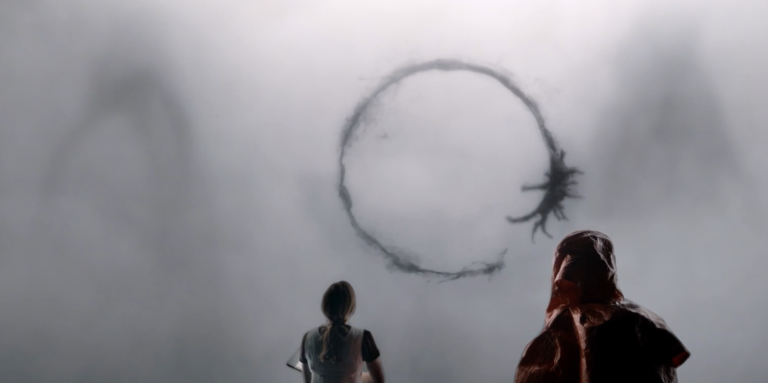
Villeneuve and screenwriter Eric Heisserer also created a fully functioning written language for the Heptapods to use in the film. They created a list of over a hundred different circular "logograms," seventy nine of which are seen in the film.

• I could easily accept Amy Adams as a professor of linguistics. Unfortunately I didn't for one minute buy Jeremy Renner as a theoretical physicist. Renner seems much too "blue collar" to play a brainy scientist. That isn't necessarily a criticism of his acting talent; he was just miscast. 

• At no time in the film do any of the Heptapods or their ships ever actually touch the Earth. The aliens never leave their ships, which all hover just a few feet above the surface.

• Kudos to the design team for the look of the Heptapods. It was nice to finally see extraterrestrials that actually looked alien, instead of like humanoids with wrinkly foreheads.

• The movie bases a big chunk of its plot on the Sapir-Whorf hypothesis. The hypothesis was created back in 1929, and there are two versions: "strong" and "weak."

The strong version states that all human thought, perceptions and actions are bound by the restraints of language. In other words an English speaker perceives the world much differently than someone who uses Mandarin. If a person learns a new language, then new areas of the brain are opened up and they begin thinking in new ways.

The weak version of the hypothesis says that language plays a much, much smaller role in shaping our minds.

Most modern linguists have discounted the strong version of the Sapir-Whorf hypothesis, citing that if it was true, instruction manuals and works of fiction would be impossible to translate from one language to another.

Unfortunately Arrival heavily utilizes the Sapir-Whorf hypothesis, as simply learning the Heptapods' language causes Louise to begin experiencing time non-linearly. Given the fact that most scientists have thoroughly discredited the theory, this puts the entire plot of the film in serious doubt.

• The 2009 Torchwood miniseries Children Of Earth featured an invasion by an advanced race of aliens called the 456, who demanded the world hand over ten percent of the planet's children to them or else. 

The 456 enclosed themselves in a special glass chamber that was filled with their toxic atmosphere. Earth representatives met with the aliens by standing in front of the glass wall of their chamber.

The scenes of Louise and Ian meeting the Heptapods in Arrival looked amazingly similar to Children Of Earth. Wait, did I say similar? I meant EXACTLY like it.

This isn't necessarily a case of plagiarism. It could be that there are only so many ways to film humans standing in front of a smoky glass box full of aliens.

• What was up with Ian's odd narration? Halfway through the movie, he suddenly begins infodumping the plot to us, telling how Louise made a breakthrough that let her decipher the alien pictograms.

Hey guys, it's a movie. You're supposed to show, not tell.

I have a feeling the narration was a studio mandate. I'm betting a nervous studio executive watched a rough cut of the film, and was worried that the dimmer members of the audience wouldn't be able to figure out what was happening, and insisted on spelling it out for them.

• Arrival kind of skates over the specifics of exactly how Louise finally cracks the Heptapods' language. 

One minute she's commenting that their circular sentence structure baffles any attempt to decipher it, then a couple scenes later she's using a Heptapod language app on her IPad, tapping out sentences with ease.

• This movie contains a perfect example of what I call The Fantastic Four Effect.

See, back in the awful 2005 Fantastic Four movie, there's a scene in which the Thing sits brooding on the Brooklyn Bridge. He sees a man about to commit suicide and saves him, but accidentally causes a huge traffic pileup that escalates into a full blown disaster. The Thing, Mr. Fantastic, Invisible Girl and the Human Torch then spring into action, each using their powers to save the city. The media dubs the team the Fantastic Four as the public celebrates them.

What no one seems to realize is the Fantastic Four became famous while cleaning up the huge mess they created. There wouldn't have been a disaster if not for them.

And so it is in Arrival. The Heptapods tell Louise they came to Earth to save humanity, because they've foreseen that three thousand years from now, humanity will somehow save them.

But we wouldn't have needed saving if they hadn't come here and freaked everyone the hell out by ominously hanging their ships over our heads. We were getting along just fine before they showed up and destabilized our society.

• These days many films count on the Chinese box office for a significant portion of their worldwide gross. In fact some studios are beginning to tailor their films to appeal to Chinese audiences.

I have a feeling Arrival probably won't be playing there. Sure, General Shang ends up saving the day, but China's the first country to threaten to destroy the alien ships. That's probably not gonna play well in the Middle Kingdom.

Arrival is a rare sight at the cineplex these days— a well-written, thoughtful hard scifi movie that contains ideas and concepts instead of explosions and CGI disaster porn. Better hurry and see it before it's nudged out of the theater by the holiday blockbusters. I give it an A-.

Saturday, January 2, 2016

BEST And WORST Movies Of 2015

Hey, it's 2016, so what better time to look backward and make a list of The Best And Worst Movies of 2015!

I saw a whopping forty two movies in the cineplex in 2015, very few of which were actually worth watching. Out of that number there were a scant two or three that I'd actually consider good, a ton of mediocre ones, and several that should immediately be shot into the sun.

2015 will go down in cinema history as The Year Of The Stealth Remake. I saw at least five of these in the cineplex last year— movies that are ostensibly sequels, but are really straight up copies of the original. It's a sneaky and underhanded trick on the part of Hollywood, but one that's proven to be very effective. Not to mention lucrative. Why knock yourself out writing a new chapter in a franchise when you can take the original story, wrap it up with a shiny new bow and sit back and watch the money roll in? The sooner this trend dies a well-deserved and horrible death, the better.

As I look back on the movies I reviewed in 2015, I realize I was far too easy on most of them. Many deserved at least a full letter grade lower than the one I gave them. This is a problem I need to work on in the coming year.

OK, on with the list. Needless to say, this is a list of the movies that I saw, so it's entirely possible there were movies even worse or better.

Worst Movie Of 2015
Dear lord, there were so many choices, I don't know where to begin. The cineplex was littered with hundreds of terrible films last year, but there were several that stood out from the pack.

Jennifer Lopez's entry in the "psychotic stalker" genre contains every possible cliche you can think of, and then some. The movie wallows and writhes in this cesspool of cliches so gleefully that part of me wonders if it's supposed to be some kind of subtle parody of the genre.

It's also incredibly choppy and incoherent, as characters appear and are immediately forgotten, and subplots are introduced and then never resolved. I'm convinced this movie was edited with a chainsaw.

I gave it a C, but looking back it deserved a D at best.

Mortdecai
Once again Johnny Depp dons a funny wig and costume along with an outrageous accent in yet another of his string of self-indulgent roles. To say he chews the scenery would be an understatement, as he devours it whole, and with gusto. Unfortunately he seems to be having much more fun playing the part than the audience does watching him.


If the idea of seeing Johnny Depp playing a pretentious English buffoon who says things such as, "I say, good show old chap!" strikes you as hilarious, then you'll likely have a good time. If not, you're in for a very long 106 minutes.

Honestly I remember very little about this film other than the fact that it had zero interest in being even slightly humorous. There's exactly one mildly amusing joke in the entire movie, and the filmmakers seemingly realize this as they repeat it about ten times.

Incredibly I gave it a C+. Why, I have no idea, as I should have given it a D- at the very least.

A tepid horror film that's part Flatliners, part Event Horizon, and far worse than either. 

This film must set some kind of record for jump scares. Practically every scene features a character unexpectedly grabbing someone by the shoulder, or lunging in from behind, or even popping up wearing a pig mask (!). It's as if the director realized the story wasn't the least bit frightening, so he ramped up the quota of jump scares in a flailing effort to shock the audience somehow.

The premise of the film is completely gutted when you realize that people's hearts stop all the time during operations, and not one of them has ever developed psychic powers or dragged a piece of Hell back with them.

It was filmed in 2013 but sat on the shelf until 2015, which is always a red flag. Amazingly I gave it a C+ but I should have given it a D- instead.

Paul Blart: Mall Cop 2
The original film was a surprise hit back in 2009, grossing $146 million against its miniscule $28 million budget. Those figures made a sequel inevitable, but why it took six long years is a mystery.

If you like your comedy bland and largely laugh-free, then this is the movie for you. It does manage to generate a couple of polite chuckles, but they're few and far between.


If you're a Paul Blart fan you'll love this sequel, since it's pretty much a rehash of everything that happened in the first film. Heck, many of the jokes and a lot of the physical comedy from the original get an encore here. I guess the studio thinks if you liked the jokes once, you'll love 'em even more the second time around.

Worst of all, in order for the sequel to work, it has to overwrite the ending of the original, rendering it useless! I gave it a C, but looking back that was far too generous a grade. It deserved at least a D.

The Gallows
Don't feel bad if you've never even heard of this film, much less seen it. I think I was one of the twenty or so people in the country who were unfortunate enough to watch this gem. 

Yet another miserable found footage film, featuring atrocious acting, non-existent production values, amateur camera work, and unlikable characters. The filmmakers practically sprain a hamstring trying to set up Charlie Grimille as the next slasher icon, ala Jason Vorhees or Freddie Krueger. I wouldn't hold my breath expecting to see him again.

If there's a Hell, this is what would play on the TV stations there, twenty four hours a day. I gave it a well-deserved D.

Hitman: Agent 47
Yet another unwanted and unasked for sequel (or remake or reboot, who knows?) to a mediocre movie based on a video game. You'd have just as good a time sitting on the edge of your bed and staring at the floor. Once again I graded a film too high, giving this one a very generous C.

AND THE WINNER FOR WORST MOVIE OF 2015:

It was a really tough choice. The Gallows was a major contender, as it's terrible in every measurable sense. But it had the excuse of an extremely low budget, reportedly just $100,000. You kind of expect a movie to be shite when it cost less than the average home.

Paul Blart: Mall Cop 2 and Mortdecai didn't have that excuse. Both were major studio releases, with $30 million and $60 million budgets, respectively, so they can't blame their awfulness on a lack of money.

Both are allegedly comedies, but you'd be hard pressed to tell as they're largely laugh-free. When a drama is bad you can at least entertain yourself by laughing at it. But when a comedy's not funny, it's beyond excruciating.

Therefore in a split decision, I award Worst Movie Of 2015 to both Paul Blart: Mall Cop 2 AND Mortdecai! Congratulations!

--------------------------------------------------------------------------------------------

MOST DISAPPOINTING MOVIE OF 2015
Again, it was tough to narrow the choices down to just a few. So many films showed promise in 2015, only to disappoint audiences as they limped across the screen and thudded to the ground sacks of sour, damp laundry.

Chappie
I had very high hopes for this film, expecting a hard sci-fi tale of artificial intelligence and sharp insight into what makes an entity human. Instead director Neil Blomkamp delivered a half-baked, extremely derivative mess.

Add to that the fact that the characters all act like brain damaged morons and there are plot holes wide enough to fly a 747 through, and you get a disappointing film that feels like it escaped from the Siffy Channel.

Blomkamp made a big splash in 2009 with District 9, but so far each of his subsequent films has been worse than the one before. If he doesn't pull out of his downward spiral soon the only thing he's going to be directing is traffic.

Talk about wasted potential! Brad Bird, who directed the amazing The Iron Giant and The Incredibles, makes an oddly dark, dreary and joyless film about hope and optimism. I wish the scientists of Tomorrowland could make a device that would let me forget I ever saw this dismal film. I gave it a C+.

Another stealth remake. Virtually everything that happens here has an analogue in the original film. Not even the presence of charismatic actor Chris Pratt can pull this one out of the dumpster. I guess there are only so many ways you can tell a story about dinosaurs attacking people on an island. 

We finally get to see the park up and running, which was the one and only good thing about this film.

I've seen the original film twenty or thirty times. I never want to see this one ever again, which should tell you everything you need to know about it. So much potential and hard work wasted...

For some insane reason I gave it a B, which is WAY too high. It deserved a C- at most.

Yet another stealth remake, as this one, through the magic of time travel,  literally revisits scenes from the first one. 

The overly complicated plot completely rewrites the first two movies, which is definitely not a good thing. There's one, and only one plot surprise, and the goddamned movie poster gives it away.

The movie also spends an inordinate amount of time trying to explain why the ageless robotic T-800, played of course by Arnold Schwarzenegger, looks like a sixty year old man. I've been a big fan of this franchise since the beginning, but even I have to admit it's time to terminate it (see what I did there?). I gave it a much too kind B-.

Guillermo del Toro's well made, moody film features amazing production design, but like all his films emphasizes style over substance.

Worst of all it billed itself as an old-school Hammer style horror film, but turned out to be a tepid Gothic romance. Talk about misleading! I felt like I'd been tricked into seeing a film I normally wouldn't have bothered with.

The plot, such as it is, is paper thin, and if you've ever seen even one movie before, you'll spot the "shocking twist" coming down the street from a mile away.

It doesn't help matters that the film isn't the least bit scary either. On the rare occasion we actually do get to see a ghost, they turn out to be helpful and protective rather than menacing! Jesus, if I want to see friendly ghosts I'll cue up a Casper cartoon. I gave it a C+.

AND THE WINNER FOR MOST DISAPPOINTING MOVIE OF 2015:

Not even close. Jurassic World and Terminator Genisys were sub-par retreads of the originals, but for true, undiluted disappointment, one film stood out from the pack.

It's Tomorrowland. The trailer showed us a bright and shiny futuristic world full of jet packs, flying cars and robots. The movie then spends a grand total of about ten minutes in that world, as the rest of the dull and dreary run time is all about the characters trying to get there. And when they finally do get to Tomorrowland, it's old, run down and deserted. Who the hell thought a depressing film about hope was a good idea? Oy.

Congratulations, Disney!

If you're a regular reader of my blog (as millions are), you may be wondering why I didn't put Star Wars: The Force Awakens on this list of disappointing films, since I found it lacking. I didn't add it to the list because I expected to be disappointed by it. Statistically speaking, it was inevitable. Of the six previous films, only two of them have actually been good. That's only 33%. That's less than an F on the grade index!

--------------------------------------------------------------------------------------------

BEST MOVIE OF 2015
Sadly, there weren't a lot of contenders for this title.

A simple, thoughtful and intelligent sci-fi film that demands your attention and actually makes you think.  It examines the nature of humanity and consciousness and springs its various traps when you least expect it.

This is the kind of movie the similarly-themed Chappie should have been. Unfortunately it was buried at the box office by the one-two punch of Furious 7 and Avengers: Age Of Ultron. I gave it an A-.

Mad Max: Fury Road
A non-stop, relentless chase film that effortlessly revitalizes the franchise, and the best time I had at the movies all year. 

The entire film is pretty much one long 120 minute action-packed chase scene, broken up by a few very brief intervals of character building. And you know what? There's nothing wrong with that! It's a thrilling piece of cinema that knows exactly what it is, and delivers on its promise. I gave it an A-.

The Martian
At long, long last, we finally get a hard sci-fi movie with actual real science in it! Imagine such a thing! The Martian never dumbs itself down, and throws scientific concepts left and right at the screen, trusting the audience to keep up. It's awesome to finally see a movie that says it's cool to be smart.

This is the movie that Gravity and Interstellar SHOULD have been. I gave it an A-.

AND THE WINNER FOR BEST MOVIE OF 2015:
Ex Machina was a very good film that was actually about something, but it didn't exactly scream "fun" and I don't feel the need to ever see it again.

It was tough to decide between the remaining two. I liked Mad Max: Fury Road very much and almost chose it as the Best Movie of 2015. But as much fun as it is, even I have to admit it doesn't have a lot of substance.

It was a very close call, but I'm giving the award for Best Movie Of 2015 to The Martian. It's the hard sci-fi film we've all been waiting for and deserve, and will hopefully start a trend of movies that are actually smart. I'm not holding my breath though.

Let's hope 2016 produces a bigger crop of good movies!

Tuesday, October 13, 2015

It Came From The Cineplex: The Martian

The Martian was written by Drew Goddard and directed by Ridley Scott. It's based on the best selling novel by Andy Weir.

Goddard previously wrote the scripts for Cloverfield, Cabin In The Woods (which he co-directed with Joss Whedon) and World War Z, all films I liked quite a bit.

Scott of course has directed many blockbusters over the years, including ALIEN, Blade Runner, Legend, Thelma And Louise, Gladiator, Hannibal and Black Hawk Down. He's been in a bit of a slump the past few years though, as he was responsible for directing Robin Hood (the Russell Crowe one), Prometheus, The Counselor and Exodus: Gods And Kings. Fortunately, The Martian is a return to form for Scott, and more than makes up for all of those.

Producer Simon Kinberg was originally set to adapt the novel into a film in March 2013. Kinberg is a very uneven writer, who's past work includes XXX: State Of The Union, X:Men: The Last Stand, Jumper, Abraham Lincoln: Vampire Hunter, Ouija and this summer's terrible, horrible, no good, very awful Fantastic Four. In May 2013, Drew Goddard was chosen to write the screenplay. Sounds like we dodged a bullet there.

Andy Weir, the author of the film, is a computer programmer who began writing the book in 2009. He studied orbital mechanics, astronomy and space flight in order to make the novel as realistic and scientifically accurate as possible. When no publishers wanted to buy the book, he put it on his website for free. At the request of his fans, he uploaded a Kindle version to Amazon (for 99¢) which sold 35,000 copies in a month. That finally got the attention of the publishing world, and Weir sold the book rights to Crown in March 2013 for $100,000.

At long, long last, we finally get a hard sci-fi movie with actual real science in it! Imagine such a thing! The Martian never dumbs itself down, and throws scientific concepts left and right at the screen, trusting the audience to keep up. It was refreshing to see a movie do that, especially in an age where films like Paul Blart: Mall Cop 2 and Pixels are considered high art. It's awesome to finally see a movie that says it's cool to be smart.

This is the movie that Gravity and Interstellar SHOULD have been. I was expecting great things from both those films, but was bitterly disappointed when they featured far more fiction than science. 

Unlike those films, The Martian strives to get as much right as possible, and features scientists doing what they do best— calmly assessing a problem and coming up with a rational solution. None of the scientists in The Martian does anything overtly stupid, none of them fight among themselves, and they all work together to solve the problems thrown their way. 

They for damn sure never act like the scientists in Scott's dreadful Prometheus, who practically invited alien creatures to leap down their throats. And thank the Maker, no scientists in The Martian ever postulate that "love" is a tangible, physical force in the universe (I'm lookin' at you, Interstellar).

Whether this scientific realism is due to Ridley Scott or the source material I can't say, but kudos nonetheless.

The movie's science isn't 100% accurate of course, but it comes closer than any film I can think of. 

Naturally the novel is much more densely packed with science and technobabble than the movie. Kudos to Drew Goddard for streamlining the science while retaining the spirit of the novel. And for making the science reasonably understandable.

The Martian is very unusual in that there's no real villain in the film. NASA Director Teddy Sanders comes close, as he seems like he's going to be the heavy at the beginning of the film. Fortunately this isn't the case, as Sanders turns out to be a real person trying to do a difficult job, who's genuinely concerned with bringing Watney back alive.

Oddly enough the film is rated PG-13, but I counted at least three uses of the word "f*ck." I was under the impression that a PG rating allowed the filmmakers only one f*ck per film. I wonder how they got away with more?

One week before the premiere, NASA announced they'd discovered the existence of water on the planet Mars, no doubt giving the film a ton of free publicity.

Lastly, there are reports out there that some audience members believe The Martian is based on a true story. You know, because of all those manned missions we've sent to Mars. Sigh... we're very near the end of civilization.

SPOILERS!

The Plot:
Sometime in the near future, the Ares III manned mission to Mars is collecting soil samples and studying the red planet. When a sudden sandstorm hits the camp, astronaut Mark Watney (played by Matt Damon) is struck by debris and presumed dead. The storm forces Mission Commander Melissa Lewis to abort the mission and blast off, leaving Watney's body behind. Lewis and the rest of the crew begin the long journey back to Earth in their ship, the Hermes.

The next day, Watney wakes up on the surface of Mars and realizes he's been left behind (I was hoping he'd put his hands on his cheeks and do the "Home Alone" yell, but alas he didn't). He makes it back to the pressurized habitat and tends to his wounds. His communication equipment was destroyed by the storm, so he can't contact NASA and let them know he's still alive. He calculates it'll take at least four years for a rescue mission to reach Mars, but he only has enough food to last one year. In a habitat designed to last three months.

Watney, who's luckily a botanist, sets up a makeshift farm inside the habitat and begins growing potatoes. He reasons that he'll need to travel halfway around the planet to the planned Ares IV mission site in order to be rescued, and begins modifying the camp's rover for a long distance journey.

Back on Earth, a NASA technician studies Martian satellite photos, and seeing activity at the Ares III site, realizes Watney is still alive. NASA Director Teddy Sanders (played by Jeff Daniels) begins planning a rescue mission, but is reluctant to tell the Hermes crew, fearing it'll distract them from their mission.

Amazingly, Watney's potato crop is successful, allowing him to stretch his rations. He then locates the Pathfinder probe, which stopped working in 1997. He repairs it and uses it to contact Earth.

Sanders finally tells the Hermes crew that Watney is alive. NASA comes up with a plan to send an unmanned supply ship to feed him until the Ares IV mission can reach Mars and rescue him. Unfortunately the ship explodes shortly after takeoff. Disaster also strikes on Mars, when the airlock on Watney's habitat fails, destroying his potato crop.

The China National Space Administration is monitoring the situation, and offers NASA one of their classified rockets to help rescue Watney. Meanwhile a NASA tech has a different plan— use the Earth's gravity to slingshot the Hermes back to Mars at top speed, where they can rescue him. While NASA debates which course is best, Commander Lewis and the Hermes crew force the issue by sending the ship into the slingshot orbit.

Watney uses the rover to travel to the Ares IV site, where NASA has already sent key equipment ahead of the mission. Among the equipment is a launch vehicle. Watney strips it down in order to reduce its weight so it'll be able to achieve a higher orbit. He blasts off in the launch vehicle to rendezvous with the rapidly approaching Hermes.

Unfortunately Watney is too far away to reach the ship, so he punctures his glove, which creates an Iron Man-like means of thrust. He somehow manages to propel himself just close enough for Commander Lewis, who's in a space suit outside the Hermes, to grab him.

The film ends with Watney safely back on earth, teaching future astronauts.

Thoughts:
• OK, we all know how I love to point out scientific inaccuracies in films, so we might as well get it out of the way.

As the film opens, the Ares III mission site is struck by a powerful windstorm that forces them to abort. Mars has an atmosphere, but it's very thin, about 1% that of Earth's. There's just no way a storm of that magnitude could ever happen. At most you'd get a slight breeze. Author Andy Weir even acknowledged this inaccuracy, saying he exaggerated the intensity of the storm because he needed some way to separate Watney from the rest of the crew.

One thing the film doesn't even attempt to portray is the lower gravity on Mars, which is about 38% that of Earth's. Watney should have been bouncing all over the place when he walked, much like the astronauts on the moon did.

Director Ridley Scott claims that the heavy space suit Watney wears in the film would bring his weight up to near normal, but even if that's true, his movements and stride would probably still look quite different. Plus he spends a good portion of the movie inside, without his spacesuit. So how to explain his seemingly normal weight in those scenes?

There were a few outdoor scenes in which it looked like they slowed down the film very slightly, to try and give it a more weightless look. It didn't work. I'm willing to overlook this one though, as it would have been difficult, if not impossible, to accurately depict low gravity for an entire movie.

The film also ignores the issue of radiation. Watney would have gotten quite a dose spending several hundred days on the surface of Mars. Since the film takes place a bit in the future, I suppose it's possible that his suit and the habitat was radiation shielded, but there's no mention of this.

• OK, now that I've dealt with two of the biggest inaccuracies, how about what it got right?

They depict the lack of gravity perfectly in the scenes on board the Hermes. The astronauts float weightlessly around the bulk of the ship, but spend a lot of time in the large central wheel, which spins to simulate gravity.

The orbital mechanics of actual space travel are dealt with in great detail. I didn't quite understand it all, but it sounded real to me and I trust that someone did all the math.

Space is big. Very big. Even our own solar system is big. In fact it takes messages between four and twelve minutes to travel from Earth to Mars (depending on the position of both planets). Amazingly the movie depicted this time lag, as Watney had to wait several minutes for a reply to his emails to NASA! Well done!

According to scientists, it really would be possible to grow crops in Martian soil, with the help of the bacteria in Watney's own personal fertilizer.

There are several outdoor scenes in which what appear to be tornadoes are visible in the sky. These are actually just dust devils, which really do form in the thin Martian atmosphere.

Watney creates water for his plants by extracting hydrogen from the habitat's supply of hydrazine and burning it. I don't quite understand that sentence, but from what I've read, it's possible.

• As the film opens, a massive Martian windstorm threatens to topple the Ares III lander, which looks like a large vertical rocket. The lander is actually forced to take off prematurely before it falls over.

I'm sure this is all scientifically accurate, but it seems like a design flaw to me. Maybe next time don't design a top heavy rocket that's in constant danger of being knocked over by wind.

• Regular readers of my blog are no doubt sick of hearing of my pet peeve about sci-fi movie dates. Very often a film will be chock full of futuristic technology, far beyond anything we have now, but will be set in the far off year of 2024. The producers then look like idiots in a few short years as their movie becomes hilariously dated.

The Martian neatly sidesteps this trap by avoiding any mention of the year. It's sometime in the future, when NASA routinely sends expeditions to Mars. That's all we need to know.

• After the disaster, Watney uses the habitat's toilet. There's a panel on the side of the toilet with the names of all the astronauts. He pushes the button with his name on it, and we hear the toilet process and seal his feces into an airtight bag. 

He then gets the bright idea to use all the accumulated feces to fertilize the Martian soil so he can grow crops. He opens a container in the side of the habitat, and it's full of individually wrapped poos, labeled with the names of the entire crew.

Um... so why were they separating and cataloging everyone's crap? At first I thought maybe he was only going to use his poop as fertilizer, since he'd be used to his own bacteria and wouldn't become sick on an alien planet. But later we see him using everyone's poo (even commenting on how bad some of it smells). 

Were they organizing everyone's crap in such detail because they planned to take it back to Earth and analyze the effect Mars had on it? 

Whatever the reason, it just seemed like an odd thing for the film to obsess over.

• Watney figures out a way to produce water by burning spare hydrazine. To do this, he needs material that will burn. Unfortunately NASA is very paranoid about fires, so everything in the habitat— even clothing and paper— are inflammable.

Fortunately for Watney, his crew mate Martinez left behind a contraband wooden crucifix, which he carves up and burns.

Good thing Watney found the wooden cross, or he'd have been screwed. Or would he? I can think of another flammable material he could have used— his own hair! He had an inexhaustible supply growing on his head and face.

• I really enjoyed the soundtrack, which consisted of 1970s disco music. Hey, I'm not ashamed to admit it, I like ABBA. 

Watney grumbles throughout the film about how the only music he has to listen to is disco, left behind by Commander Lewis.

OK, so it's kind of a funny scene, but I don't buy it for a minute. Right now we have iPods that can hold hundreds, if not thousands of different songs. Are you telling me this crew left Earth on an eight year round trip mission and only one person brought a handful of disco songs?

• China comes to the rescue! At first I thought this film was another case of Hollywood pandering to Chinese audiences, who have several billion dollars worth of ticket money in their pockets. I've been told though by my pal Ted Parsnips that the China subplot is actually in the book. OK, you're off the hook this time, Hollywood. But I'm watching you!

• There's a fun scene involving Sanders, Flight Director Mitch Henderson (played by Sean Bean), Annie Montrose (played by Kristen Wiig) and JPL employee Rich Purnell (played by Donald Glover). When discussing how best to bring Watney back to Earth, Purnell dubs the plan "Project Elrond." When Montrose doesn't understand the reference, Henderson explains that in The Lord Of The Rings, the Council Of Elrond met to discuss what to do with the One Ring.

Bean of course played Boromir in the Rings movies. Normally I'm not a fan of this kind of nudge-nudge-wink-wink joke in films, but this one was actually funny.

• As the days go by, Watney realizes he's going to need to stretch his food, and begins rationing it. I was thinking that in reality he should be losing a ton of weight, instead of consistently maintaining Matt Damon's beefy frame. Just then there was a scene in which Watney emerges from a shower and looks positively skeletal. Well done, movie!

• In the book Watney suggests puncturing his glove so the escaping oxygen will propel him through space like Iron Man, allowing him to reach the Hermes. Commander Lewis nixes the idea, listing a dozen reasons why it won't work. Watney admits it was a joke.

In the film though, he actually goes through with it and punctures his glove. Amazingly though, it works.

• The Martian features a very diverse cast, including Michael Peña, Chiwetel Ejiofor, Donald Glover, Benedict Wong, Nick Mohammed, Eddy Ko and Chen Shu. But as a sign of our out-of-control politically correct times, that's apparently still not good enough. The Media Action Network For Asian-Americans criticized the film for casting white actress Mackenzie Davis as Mindy Park, who was Korean in the novel. The group was also unhappy that black actor Chiwetel Ejiofor played the Indian character Vincent Kapoor.

Jesus Christ! I get that there aren't enough roles for minorities, I really do, but this was far from an all-white cast, and it looked pretty goddamned diverse to me. What more do people want? Stop making mountains out of molehills.

• At the end of the film we see vast crowds of concerned citizens gathered in New York, London and Beijing, all watching Watney's dramatic rescue on giant outdoor screens. Oddly enough, it appears to be nighttime in all these cities! Whoops! This is a very common mistake that happens over and over in movies.

OK, maybe it could be nighttime in New York and London, as they're six or seven hours apart. But there's about twelve hours difference between New York and Beijing, so there's no way they could both be experiencing night at the same time.

The Martian is at long last, the scientifically accurate film we deserve. It's also one of the best films I've seen all year. I give it an A-.
Related Posts with Thumbnails
 
Site Meter