Showing posts with label anniversary. Show all posts

Sunday, October 31, 2021

The Walking Deadiversary

Happy Anniversary to The Walking Dead, which premiered a whopping eleven years ago, on October 31, 2010. ELEVEN YEARS! Holy crap. How's that even possible? Over a decade of "Don't Dead, Open Inside" jokes already!

I was a fan of The Walking Dead comic long before it ever became a TV series. I first discovered the comic in 2007, when I bought several collected editions of it at a comic show in Chicago (back in the Before Time). The comic actually came out in 2003, so I got to read four years worth of it all in one go. I was immediately hooked by its dark, bloody and horrific storyline, in which mankind turns out to be far more monstrous than the zombie hordes could ever be.

So I was somewhat excited when I found out the show was being turned into a weekly TV series. I say somewhat, because I was a little concerned they'd have to tone down the gore and violence, since it was airing on television— on AMC yet! I needn't have worried though, as they managed to capture the tone of the comic quite well.

The show turned out to be amazing, and far exceeded my expectations The casting was spot on, as the characters looked like they'd stepped right off the printed page. And the storylines were fairly faithful to the comic as well.

Well, for a while anyway.

Once they got a few seasons under their belts, the producers tried their hand at creating their own original storylines on the show. The Grady Bunch and the Garbage Pail Kids were just a few of their horrible attempts at coming up with their own arcs. These efforts all fell flat, as the series worked best when it followed the road map laid out by the comic.

Sadly, as time went on, more and more cracks began showing in the series' foundation. The comic had several advantages that the series didn't. The Walking Dead comic was a singular vision created by Robert Kirkman, who wrote every single issue. Unfortunately the show wasn't as lucky, as it was produced, written and overseen by a revolving door of creators with varying levels of talent.

And unlike the comic, the series had to deal with numerous other real-world problems— mostly concerning the cast. After a few seasons, many of the actors began quitting the show for various reasons, ranging from pay disputes to simple burnout. This led to some unfortunate instances in which characters who never died in the comic were summarily killed off on the show. 

MAJOR SPOILERS FROM THIS POINT ON! YOU HAVE BEEN WARNED!

The most notorious instance of this concerned the character of Carl Grimes. For reasons that still haven't been made totally clear, the producers made the bone-headed decision to kill him off— despite the fact that he does NOT die in the comic, and is still alive and well in the final issue. 

To make things even worse, they offed him right before he was due to feature heavily in several major storylines from the comic. They definitely shot themselves in the foot here, and I'll never understand why the hell they made such a shortsighted and terrible choice.

Sadly, that was the last straw for me. I could deal with their abortive original storylines, questionable writing and idiotic season finales that ruined the flow of the plotlines. But I had to draw the line at Carl's death. I was honestly looking forward to seeing his storylines from the comic come to life on the screen, and now that was impossible.

His death killed my enthusiasm for the show, and I stopped watching and reviewing it shortly afterward, in Season 8. I haven't returned to it yet, and at this point I doubt I ever will.

But hey, that's just me. Happy Eleventh Anniversary Anyway to The Walking Dead!

Thursday, July 8, 2021

Happy 25th Anniversary To Independence Day!

I'm a couple days late here, but whatever. Happy 25th Anniversary to Independence Day (the movie, not the holiday)! Believe it or not, it premiered back on July 3rd, 1996 (although some cities just couldn't wait and began running it a day early).

The movie was written by Dean Devlin and Roland Emmerich, and was directed by Emmerich. Over the years the duo collaborated in one form or another on films such as Universal Soldier, Stargate, Godzilla (1998) and The Patriot.

Independence Day had a budget of just $75 million, but went on to gross an astonishing $817 million— in 1996 dollars! That's the equivalent of $1.4 BILLION today! Holy Crap!

ID4 (as it's often known) is one of my guiltiest of guilty pleasures. No, strike that— there's nothing guilty about it, as it's one of my all time favorite movies. I saw it in the theater back in 1996, and immediately loved it. 
I've seen it a good twenty or thirty times over the years, and I never get tired of it. Any time I see it playing on TV I have to drop everything and watch it.

I'm not exactly sure why I like it so much or what makes it so compelling to me. I freely admit it's big, dumb and loud, but damn if it isn't engaging and entertaining, and in the end, isn't that a movie's job?

Yes, many of the characters are paper thin or stereotypes. But the film allows the audience to spend time getting to know them, so we end up becoming invested in their lives and what's happening to them. Modern movies could learn a thing or two from ID4.

It's become an annual tradition in my household to watch it every July 4th!

ID4 has a huge cast, featuring a large number of actors who'd worked primarily in TV— including Will Smith. He'd just finished his stint on The Fresh Prince Of Bel-Air TV series when the film premiered in 1996. The movie catapulted his career and made him a superstar overnight. 

The FX work is top notch as well. The film premiered after the dawn of the CGI age, but still used a massive amount of practical effects. In fact it holds the record for most miniatures used in a single production. That's probably why most of the effects still hold up a quarter of a century later. It featured its fair share of digital work as well though, mostly in the fighter jet scenes. In all the film features over 3,000 effects shots.

What made the movie stand out was its "go for broke" attitude toward the alien destruction. This wasn't your typical wimpy invasion— these aliens didn't hold back, and went for the major landmarks! It's fair to say audiences had never seen carnage on such a massive scale before, which is part of what made the film so successful. The shot of them destroying the White House was totally unexpected and at the time, shocking. It ended up becoming the most iconic image of the entire movie.

The idea for the film came when Devlin and Emmerich were on a promotional tour for Stargate. When a reporter asked if he believed in aliens, Emmerich said no, as he didn't believe they'd fly all the way here just to hide in a backwoods field. He said he was fascinated by the idea of waking up one morning to see fifteen-mile wide spaceships hovering over the world's cities. He then reportedly turned to Devlin and said, "I think we have an idea for our next film!"

The pair wrote the script during a month long vacation in Mexico, and it was greenlit by Fox chairman Peter Chernin just one day later. Three days after that they began pre-production on the film!

The US military originally promised to provide personnel, vehicles and uniforms to the production, but pulled out when Devlin & Emmerich refused to remove references to Area 51!

Watch for the edit when David (played by Jeff Goldblum) warns his coworker Marty (played by Harvey Fierstein) to get to safety. Marty says, Oh, my God. I gotta call my brother! I gotta call my housekeeper! I gotta call my lawyer! Nah, forget my lawyer!" If you watch closely, he clearly says, "F*ck my lawyer," but the filmmakers dubbed the line to "forget" to avoid an R rating.

In the original ending, Russell Casse (played by real life crazy person Randy Quaid) saved the day by strapping a missile to his red biplane and flying it into the alien ship hovering above Area 51. Emmerich eventually reshot the scene with Russell piloting a fighter jet, as he thought it was too unbelievable for a biplane to keep pace with such planes. I think he made the right decision.

Something I noticed in my most recent viewing— the movie features a large and very diverse cast, consisting of numerous races, genders, religions and orientations. Everyone gets along as they all work toward the common goal of survival against insurmountable odds. Best of all, this diversity feels completely natural and not forced, as it so often does in films today. It simply exists, and no one comments on it— which is the way it should be done.

If this film were being made today, you can bet your bottom dollar that the studio would be trumpeting its diversity, representation and inclusivity and beating the audience over the head with the fact, and would sacrifice story for identity politics. Again, modern films could learn a thing or twelve from this one.

So Happy 25th to Independence Day!

Wednesday, November 27, 2019

Planes, Trains And Thirty Two Years

Happy 32nd Anniversary to Planes, Trains And Automobiles, which premiered on November 25, 1987.

Planes, Trains And Automobiles is one of my all-time favorite movies, and I try to watch it every year. It's also one of the few Thanksgiving movies out there, as that particular holiday doesn't seem to get much love from Hollywood.

As much as I love the film though, it's definitely become a period piece over the years. 98% of the problems Neal Page faces in his struggle to get home for Thanksgiving could be solved today with a simple cell phone! It was a different time in 1987.

Anyway, what better way to commemorate the movie's anniversary than by re-running a post that originally appeared back in 2012? Enjoy!

----------------------------------------------------------------------

Every Thanksgiving I make it a point to watch Planes, Trains And Automobiles. It's one of my favorite movies and even though I've probably seen it 25 times I never get tired of it.

During this year's viewing I picked up on something I never noticed before. In one of my favorite scenes, Gus' son Owen comes to pick up Neal Page and Del Griffith (Steve Martin and John Candy) and drive them to Wichita to catch a train.

Owen is a semi-sentient tobacco chewing hillbilly who can barely string two words together.

He also has a bizarre and rasping sinus condition that punctuates (and sometimes interrupts) his sentences. Owen's only onscreen for little more than a minute, but he makes a memorable impression, especially when he regales the pair about his wife who didn't scream when her first baby "came out sideways."

Imagine my surprise during this year's viewing when I realized that Owen was played by none other than character actor Dylan Baker! Baker's been in a ton of movies and TV shows, but is probably most recognized as Dr. Curt Connors in Spider-Man 2 and Spider-Man 3.

He cleans up real nice, doesn't he? Amazingly, Planes, Trains And Automobiles was Baker's feature film debut. I've watched that Owen scene dozens of times and it never once occurred to me that he was played by Baker. I just assumed they found some real life local redneck to play the part. I surely never suspected he was played by an actual Hollywood actor.

I say this without any sarcasm or irony— it's a remarkable piece of acting and Dylan Baker deserved some kind of award for throwing himself into the role and making himself completely unrecognizable.

Friday, October 11, 2019

Live From Forty Four Years Ago!

Forty four years ago today, on October 11, 1975, the very first episode of Saturday Night Live premiered on NBC. Forty four years!

Oddly enough, exactly one year later on October 11, 1976, the phrase "SNL hasn't been funny since Season 1" was first uttered. Hi-YO!!!!!

For decades now I've been hearing people say SNL is no longer funny, relevant or both, and is a pale shadow of its Early Years. The Early Years which are forever held in reverence and placed on a golden pedestal, as they're worshiped from below. Yeah, about that.

A few years ago I bought the first three seasons of SNL on DVD & watched them. I saw them all live back in the day (yeah, I'm old) but hadn't seen any of these episodes in many a moon.

It quickly became apparent that the mists of time had clouded everyone's perception of those Early Years. While there was a ton of classic material and icon characters that came out of that formative era, there were just as many misfires, fizzles and outright duds.

Don't get me wrong here— SNL was revolutionary when it came out, and changed the landscape of TV forever. But many of those early sketches are riddled with flubbed lines, missed cues and faulty props. There's also a surprising amount of dead air, as the actors paused for a gale of laughter that never came. For every sketch that landed, there were four or five that were met with icy silence from the audience.

So next time someone tries to tell you SNL was better in the good old days, tell 'em there was nothing all that good about them and the show's pretty much the same as it ever was.

Thursday, September 28, 2017

Happy Thirtieth (!) Anniversary To Star Trek: The Next Generation!

I originally wrote this post five years ago, for Star Trek: The Next Generation's 25th Anniversary. Since I have nothing new to add, I'm digging it out of mothballs and posting it again (with appropriate tweaks) for the 30th!

Believe it or not, it was exactly thirty years ago today that Star Trek: The Next Generation premiered. It first aired back on September 28, 1987. That was THIRTY YEARS AGO! What the hell's going on with the flow of time lately? 

ST:TNG was the highest rated syndicated show ever, averaging around 20 million viewers per episode. That was more than some prime time series generated at the time, and far more than any series could ever hope to achieve today (to be fair, some stations aired the show twice a week, which naturally doubled the ratings). It racked up a whopping 18 Emmys. It was also the only syndicated program to ever be nominated for an Emmy for Best Dramatic Series. Not bad for a show about people exploring outer space in their pajamas.

I was a huge fan of the series back in the day (by that of course I mean I was an avid enthusiast of the show, not that I myself was huge). After all, this was the first brand new live action Star Trek content to be aired in almost two decades! I dutifully recorded it every week on my trusty VCR (ask your parents, kids) and spent many a paycheck on Trek related merchandise.

The series featured a great cast (especially Patrick Stewart and Brent Spiner), top notch writing and for the most part, slick state of the art special effects.

ST:TNG gave us many new and memorable alien races: the greedy, capitalistic Ferengi, the Nazi-like Kardashians, er, I mean Cardassians and best of all, the relentless, unstoppable Borg.

It also took the Klingons, who were pretty much one-dimensional villains in the Original Series and greatly expanded their culture, making them one of the more interesting races on the show.

They even managed to feature a few guest appearances from Original Series characters, specifically McCoy, Spock, Sarek and Scotty.

Like the Original Series, ST:TNG used sci-fi to examine various controversial topics such as racism, terrorism, assisted suicide, child abuse, homosexuality and torture.

Despite all the accolades and my love for the show, even I have to admit that it wasn't perfect. Many of the First Season episodes are absolutely dreadful and are a chore to sit through. The Second Season was better, but was marred and cut short by a lengthy writer's strike. In fact the final episode of Season Two strayed firmly into Family Ties territory as it gave us the first ever clip show in the history of Trek! The series finally hit its stride in Season 3 and from then on gave us a shuttlecraft full of memorable episodes. 

Part of me has to wonder: If it had been a network show, would they have given the series two full seasons to get its bearings? I'm thinking probably not.

ST:TNG also suffered from a large number of just plain dull characters. Counselor Troi? Dr. Crusher? I'm dozing just typing their names. For seven seasons all Counselor Troi ever did was sit in a chair with her arms crossed and say, "I sense great anger..." Her only memorable characteristic was that she liked chocolate. How fascinating. And other than her wildly inappropriate name I don't think we ever learned anything at all about Dr. Crusher. 

Even Geordi LaForge was pretty bland when you think about it. The only interesting thing about his character was that he was blind and wore a cool vision-enhancing VISOR.

The original Star Trek had some very vibrant and distinct characters, particularly Kirl, Spock and McCoy. There extreme personalities often made for some dynamic interactions. ST:TNG's three most interesting characters— Picard, Data and Worf— paled greatly in comparison.

A good part of the blame for the dull characters has to lie with series creator Gene Roddenberry. "The Great Bird Of The Galaxy" had the lofty notion that by the 24th Century, humanity will have advanced to the point where everyone will get along. That's a very nice sentiment, but... it ain't ever gonna happen. If humans haven't learned to live together in the past 5,000 years, there's no reason to think it'll happen in the next 300.

Nevertheless, Roddenberry was adamant that there be no conflict between crew members on the Enterprise. Apparently he never took any creative writing courses through the mail like I did or he'd have known that conflict is the basis of all drama. Without it, all you've got is a bunch of people sitting around holding hands, smiling and singing Kumbaya. Pleasant enough I suppose, but it sure makes for dull TV.

That wasn't the only peculiar idea he had for the show. For some reason he didn't want any of the alien races from the Original Series to appear on ST:TNG. That meant no Vulcans, Klingons or Romulans; fan-favorites the audience would be expecting to see. Luckily he was overruled on that one, else Lt. Worf would never have been a part of the crew.

He also toyed with the idea of not having a ship in the new series at all. He thought that by the 24th Century technology would have advanced to the point in which the crew would use some sort of "super transporter" to just teleport anywhere in the galaxy. He was outvoted on that one as well (no doubt by studio lawyers who'd happened to see the movie Stargate).

Some of his ideas were just downright... kinky. He supposedly wanted the males of the newly created Ferengi race to be incredibly well-endowed, sporting enormous schlongs up to two feet long (!), and covered by gigantic codpieces. Fortunately one of the producers took him aside and pointed out that the series was airing on regular TV, not HBO or Cinemax.  

The series also relied much too heavily on the ship breaking down every week in order to create tension. In practically every episode the B-plot involved some piece of the Enterprise-D's technology malfunctioning and putting the crew in danger. Sure, Kirk's ship broke down now and then, but Picard's was worse than an old used car. It became a crutch for the writers whenever they couldn't think of any other way to fill the time slot.

ST:TNG provided me with many memorable and sometimes shocking moments over the years. Remember that the series aired before the internet cropped up, in an era in which you didn't have to work at avoiding spoilers. Back then the only way to find out what was going to happen was to just sit down and watch the show.

The third season finale— in which Captain Picard is captured and assimilated by the Borg and Commander Riker gives the order to fire on him as the screen faded to black— absolutely floored me. I was not expecting that and had no idea such a shocking denouement was coming. I spent a long and anxious summer waiting for the follow-up to air in the fall. 

The problem with the show's cliffhanger episodes though was that the setups were always way better than their lackluster resolutions the next season. To paraphrase Jerry Seinfeld, "You know how to set up the cliffhanger, you just don't know how to resolve the cliffhanger."

As much as I loved the show, watching it (or rather trying to watch it) was a grueling chore, due to my local TV station. It was just plain hard work to even find the show where I lived. In my hometown ST:TNG was usually relegated to the wee hours of Sunday morning, in time slots normally occupied by Aerosol Toupee and Psychic Hotline infomercials.

One week it might be on Saturday night at 11 pm, the next at 1:30 am Sunday morning. Sometimes it would even pop up in the afternoon! You just never knew when it might air. I used to record the show every week but I couldn't just set the timer on the VCR and forget it, because there was no guarantee as to when it might start. Many's the night I would stay up until 1 or even 2 am waiting for the show to begin so I could hit the record button (and then I'd have to go to work at 6 am the next day!).

I never understood the local station's attitude toward the show. This wasn't some execrable drivel like Mama's Family, this was an award winning, critically acclaimed series that regularly got higher ratings than some network shows. Plus it had a built in audience of rabid fans. So why the shabby treatment?

Sometimes I wonder if the station's programming director secretly hated the show and deliberately aired it at such a dismal hour in hope that the ratings would sag and he could justify canceling it. Why else would you pay for an no-doubt expensive syndicated program and then air it when no one was awake?

Ah well, that's all in the past now. Thirty years in the past, to be exact. Thanks to home video and streaming I can now watch the show anytime I want.

So Happy Birthday, Star Trek: The Next Generation. I'll close with a joke: What did Captain Picard say when he took his sewing machine to the repair shop? Make it sew! Haw!

Wednesday, October 21, 2015

Happy Back To The Future Part 2 Day!

Happy Back To The Future Part 2 Day! Yep, today's the day-- the future date that Marty McFly time traveled thirty years to in the classic movie Back To The Future 2! Can you believe it? 

I can still remember seeing the movie when it came out in 1989. Back then the year 2015 seemed so far away. And yet here it is.

Everyone and their dog is spending the day listing all the movie predicted and got wrong. I already did that way back in 2009, so I won't subject you to more of the same. 

Instead, let's try something different and talk about Three Things Back To The Future 2 Predicted That No Longer Exist In 2015.

• After arriving in 2015, Doc fears Jennifer is asking too many questions for her own good, so he knocks her out with a futuristic doodad. He and Marty then store her unconscious body in an alley until they complete their mission.

Note that they stash Jennifer behind what appear to be large trash bales made up of CDs and LaserDiscs.

The movie correctly predicted that LaserDiscs would become obsolete, but vastly overestimated their longevity. The last LaserDisc rolled off the production line around 2001. It's impossible to find even one LD in a store here in 2015, much less a whole bale's worth.

By the way, most people snicker when they hear the word LaserDisc, thinking it was a failed format. This is not true. Although LaserDiscs never caught on quite the way DVDs and Blu Rays did, they were around from 1978 until 2001. That's twenty three years! Hardly a failure in my book. 

LaserDiscs actually introduced many of the features found on DVDs. Multiple soundtracks and languages, director commentary, deleted scenes, closed captioning, behind the scenes documentaries, blooper reels and special editions were all first introduced on LaserDisc. DVDs owe a huge debt of gratitude to LaserDiscs.

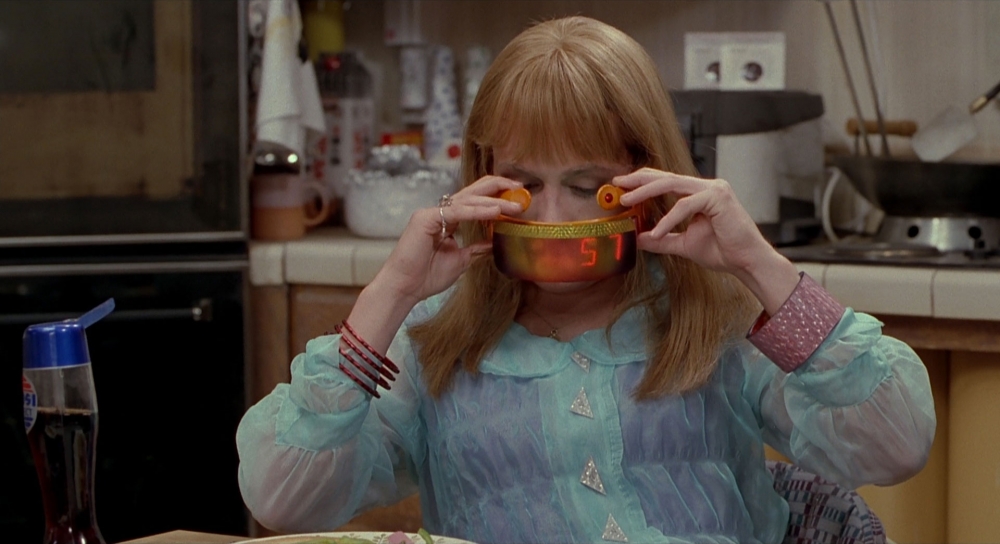
• Doc, Marty Jr. and Marlene all wear some sort of futuristic goggles that apparently display video images, information, phone calls and text messages.

These have already come and gone in our world. A couple years ago Google Glass was being shoved down our collective throats as the next big thing. The glasses allowed the wearer to take photos, send messages and view constant news and weather updates.

Then suddenly, POOF! They disappeared without a trace. I've not heard a peep about them since. Did Google scrap their plans? Are they being retooled? Will they reappear? Apparently the world wasn't quite ready to walk around with a computer screen in front of their eyes 24/7.

• Marty's home contained a fax machine in virtually every room. I'm sure that back in 1989 the concept of faxing in the comfort of your own home seemed very futuristic, but here in the real 2015 faxes have gone the way of the dinosaur. Oh sure, there are still a few fax machines out there, but I can't remember the last time I had to send one. And I for damn sure have never sent one from my home.

Now if you'll excuse me, I'm going to loosen my clear plastic double necktie, grab a piece of fruit from my retractable ceiling garden, hydrate a pizza and watch my LaserDisc of Back To The Future 2 on my wall-sized TV screen.

Saturday, June 20, 2015

Happy Fortieth (!) Anniversary To Jaws!

Happy 40th Anniversary to the grandaddy of all summer movies, Jaws!

Forty years! Can you believe it? I vividly remember seeing Jaws in the theater as a lad. First run, even! It was THE movie to see that year— nothing else even came close. I remember the audience shrieking out loud every time the shark appeared. And they actually cheered when it blew up at the end (sorry, SPOILER ALERT!)! When's the last time you heard that happen in a theater?

Jaws was the only topic of discussion that entire summer. Johnny Carson talked about it practically every night, it was in the newspaper, dozens of political cartoons referenced it, and even TV shows of the day got in the act. It was definitely a pop culture phenomenon.

The film also traumatized an entire generation, making them literally afraid to so much as dip a toe into the ocean.

People actually went to see the movie dozens of times, like it was some kind of roller coaster or thrill ride. Even I saw it twice (once in a theater, and once in a drive-in), which was unusual for me.

If you enjoyed seeing Star Wars, Jurassic Park or The Avengers (and countless others) in the theater during the summer months, then you owe a debt of gratitude to Jaws, which ushered in the age of the Summer Blockbuster Movie. Before it premiered, summer was just another season for movie studios. It's hard to believe, but back then studio executives thought that in the summer, people were too busy swimming, tanning and vacationing to go see a movie. Once Jaws hit and hit big, they realized there was an audience out there who actually wanted to see movies during the summer. And not just any movies, but big, expensive, action packed ones. 

Jaws opened on June 20, 1975 in 464 theaters in the US and Canada, which was the biggest simultaneous opening at that time. Before Jaws, movies generally premiered in theaters in major cities, then once they completed their runs there, the prints (which were by then beat up and full of splices) would slowly make their way across the rest of the country.

Due to the film's unprecedented success, the number of theaters was increased to 700 on July 25 and later 950 on August 15.

It made $7 million in its opening weekend, which doesn't sound like a lot now, but was huge at the time. It was the first movie to ever gross $100 million, earning $121 million in its initial release. It was the highest grossing film of all time until it was defeated by Star Wars in 1977.

There was an unprecedented avalanche of Jaws merchandise released as well. T-shirts, books, records, board games, coloring books, trading cards, bedspreads, posters— you name it. If it would hold still long enough to slap a shark on it, someone made it.

Jaws was of course based on Peter Benchley's massively popular novel. In fact Universal Pictures bought the movie rights to the novel before it was even published!

The screenplay was written by Benchley and Carl Gottlieb, and directed by Steven Spielberg. It was Spileberg's second time at directing a big screen film, his previous being The Sugarland Express.

Jaws was a very troubled production, running over budget and over schedule. Shooting on the open ocean caused a few of the delays, but the vast majority of them were caused by the malfunctioning mechanical shark created for the film.

It's an oddly structured film, almost like two movies in one. The first half takes place on land and features a large cast, but once the trio sets out in search of the shark, it becomes a completely different movie— a tense "man vs. nature" film with just three characters.

Of course the success of Jaws spawned a cottage industry of copycat films featuring various animals— sometimes aquatic, sometimes not— attacking humanity.

A few Jaws facts:

• Bantam Publishing artist Roger Kastel painted both the book cover and the movie poster.

• Steven Spielberg said when he read the novel he rooted for the shark, as the human characters were all so unlikable.

I read the book before I saw the movie, and he's right. Everyone in the book is a miserable asshole. For example: in the novel, Matt Hooper has an affair with Chief Brody's wife, which seemingly comes out of nowhere. It has absolutely nothing to do with the plot, and I'm convinced it exists solely to up the page count and inject some sex into an otherwise sexless tale.

Hooper also dies at the end of the novel, I suppose as some sort of comeuppance.

Fortunately Spielberg threw out this superfluous subplot, made everyone more likable and allowed Hooper to survive. Screenwriter Carl Gottlieb was hired to inject some much-needed humor into the script, to great effect.

• Author Peter Benchley wanted to cast Robert Redford, Paul Newman and Steve McQueen in the film, presumably as Brody, Hooper and Quint. Yawn. Pretty much every writer & director in the 1970s wanted those three guys in their movie.

Robert Duvall was considered for the part of Chief Brody. Lee Marvin and Sterling Hayden were suggested for Quint. Timothy Bottoms, Joel Grey and Jeff Bridges were considered for Hooper. Once Richard Dreyfuss was cast, the role of Hooper was rewritten to better suit him.

Charlton Heston desperately wanted the Chief Brody part, but lost out to Roy Scheider. Heston was reported so angry over losing the part that he vowed to never work with Spielberg. He even turned down the part of General Stilwell in Spielberg's 1941. If you've ever seen that particular film, you'll know that Heston did himself a favor.

Peter Benchley appears in the film as a TV reported in the beach attack scene.

• Author Peter Benchley later regretted writing the book, which he said paints sharks as evil creatures that target humans. He became an ocean conservationist, and spent much of the rest of his career trying to convince people that real sharks don't act like the one in his book.

• In the scene in which Chrissie's remains are found, that's a real hand sticking out of the sand. Spielberg thought the prosthetic appendage originally used in the scene was too fake looking, so he had a crew member buried in the sand with just her hand sticking out.

During the entire summer of '75, anytime I was in any body of water, be it a lake or a pool, I'd pretend I was being attacked by a shark. I'd paddle around serenely for a while, then suddenly start thrashing about and pulling my head under water as if I was being dragged down by a shark. Yes, I was quite hilarious, and I'm sure a joy to be around.

• During the shark attack on the beach, Spielberg uses the famous "Hitchcock Zoom" effect to highlight Chief Brody's spine-tingling terror. The camera zooms in on Brody's face, while the background seemingly recedes from him.

It's an interesting, but simple effect. It's created by zooming in on a subject, while the camera is simultaneously being moved away. You can recreate yourself it if you have a camera with a zoom feature.

• Robert Shaw absolutely hated Richard Dreyfuss, and the two argued off-screen constantly. This may have actually helped the film, as it created a palpable tension between the two characters.

• After Alex Kintner's death by shark, his mother slaps Chief Brody in the face. Lee Fierro, who played Mrs. Kintner, couldn't convincingly fake a slap, so she actually hit Scheider in the face. Unfortunately for Scheider, the scene required multiple takes, and he says it was one of the most painful of his career.

• One of the biggest scares in the film is when Ben Gardner's severed head tumbles out of the boat, terrifying Hooper (and the audience as well). The head's appearance was one of the last scenes filmed. Spielberg decided he needed one more big scare in the movie, so he shot the head in film editor Verna Fields' swimming pool, paying for the shoot out of his own pocket.

This was the other big scare in the film, in which the shark pops up to say "hi" when Brody's not looking. That scened caused much screaming and soiling of garments in the theater the day I saw the film.

• According to Spielberg, the shooting star that appears during the scene where Brody loads his revolver was real, not an optical effect.

There's a second shooting star that appears over a long shot of the Orca though, that is most definitely fake. It looks like it's either been animated or filmed in slow motion.

• The mechanical shark, nicknamed "Bruce," was a complete and utter disaster. The harsh saltwater messed with its electronics, causing it to constantly malfunction. In fact, the first time it was lowered into the water it promptly sunk to the ocean floor!

Spielberg then had to figure out how to film a shark movie without a shark. He solved the problem by asking himself, "What would Alfred Hitchcock do?" Hitchcock believed that what the audience doesn't see is infinitely scarier than what they do see. Spielberg decided to shoot many of the shark scenes from the shark's point of view, which ratcheted up the tension. The shark was also suggested by the yellow barrels that were attached to it.

Thank the film gods for the malfunctioning shark! By "hiding" the shark, the audience never quite knows where it is, which makes it that much more frightening. Just think, if the film was made today, the shark would no doubt be lovingly rendered in CGI and would be splashing away in every scene.

• Chief Brody's famous line, "You're gonna need a bigger boat," was ad libbed.

• During their little pissing contest, Quint displays his manliness by crushing a beer can in his bare hand. Hooper counters by crushing a paper cup.

It's a funny scene, but I wonder if much of the humor is lost on modern audiences, as beer and soda cans are extremely flimsy these days. Back in the 1970s cans were much, much thicker, and really were a lot harder to crush.

• Near the end of the film, the shark attacks Hooper, who's inside a submerged cage. For these scenes, shark experts Ron and Valerie Taylor shot underwater footage of real sharks. To make the sharks look bigger, they filmed them swimming around a scaled-down cage with a little person inside.

• The first time Spielberg heard John Williams play the Jaws theme, he thought it was a joke. He was eventually convinced to use it, and of course it's gone on to become one of the most famous themes in movie history.

Spielberg later said that without the score, the film would have been only half as successful. He's right.

Other notable movies celebrating their 30th Anniversary this year: The Rocky Horror Picture Show, One Flew Over The Cuckoo's Nest, Monty Python And The Holy Grail, Dog Day Afternoon, A Boy And His Dog, Tommy, Death Race 2000, Rollerball, The Stepford Wives, The Land That Time Forgot, The Devil's Rain, Dolemite and The Hindenburg.
Related Posts with Thumbnails
 
Site Meter