Showing posts with label blockbuster. Show all posts

Thursday, December 29, 2016

1986: Another Great Year For Blockbusters

1986. One of the greatest blockbuster seasons ever at the cineplex. There were an amazing number of big budget, high grossing films released during that period, many of which have gone on to classic or cult film status. Influential films we're still watching and talking about today.

Some of the most important directors of our time released their best work during this incredible period. Whether it was a fortuitous alignment of stars in the cosmos or just a random confluence of studio schedules, the Summer of 1986 was a great time to be a movie lover!

It just doesn't seem possible that it's been a whopping THIRTY years since these films were released.

By 1986 the Golden Age Of Videotape was in full swing, so I saw the vast majority of these films at home on our trusty VCR rather than in the theater. Whether I'd have enjoyed them more on the big screen, I can't say.

Note that of all the films on this list, five are sequels and there's only one remake. You hear that Hollywood? Audiences like new ideas and stories.

It seems silly to issue a Spoiler Warning for a bunch of three decade old movies, but... consider yourself warned!

ALIENS

Released July 18, 1986
Budget: $17,000,000
Grossed: $131,000,000

Starring Sigourney Weaver, Michael Biehn, Bill Paxton, Lance Henriksen and Paul Reiser (!).

The Plot:
Decades after the events of the first film, Ellen Ripley is found in suspended animation. She joins a platoon of Space Marines and returns to LV-426 to wipe out the aliens who've overrun the colony there.

Thoughts:
• Sigourney Weaver was hesitant to reprise her role as Ripley, fearing a sequel would be subpar and poorly written. When she finally read writer/director James Cameron's script, Weaver was pleased with the way Ripley was handled, especially the mother/daughter bond with Newt, and finally agreed to do the film.

• Actor Bill Paxton improvised most of his lines, such as the iconic, "Game over, man. Game over!"

• Bishop the android says he's incapable of hurting a person or letting anyone come to harm. This is a paraphrase of Isaac Asimov's famous Three Laws Of Robotics (1: A robot may not injure a human nor allow a human to come to harm, 2: A robot must obey orders given by a human except where it would conflict with the First Law, 3: A robot must protect its own existence except where it would conflict with the First and Second Laws).

• Hicks was originally played by actor James Remar, who was fired a few days after shooting began and replaced by Michael Biehn. Remar says he was fired due to the debilitating drug habit he had in those days.

Remar can still be seen (from behind) in the finished film, when the marines first enter the alien nest.

Biehn says he received a call from his agent on a Friday, and was in London shooting the film the following Monday.

• ALIENS was the only film that actress Carrie Henn, aka Newt, ever starred in. She grew up to become a teacher. She occasionally does sci-fi and comic conventions, where she no doubt gets sick of people coming up to her and saying, "They mowstly come out at night. Mowstly."

• Steven Lang auditioned for the role of Carter Burke, which eventually went to Paul Reiser. Lang went on to star as Colonel Miles Quaritch in director James Cameron's Avatar.

• After the film premiered, many businesses inquired about buying Power Loaders to use as forklifts. They were disappointed to find out that the Power Loader was just a special effect, and sadly not a real piece of equipment.

• Even though I'm a big fan of ALIENS, somehow I never managed to see it in the theater. I saw it on home video about a year after the film was released.

Despite the fact that I watched it on a tiny thirteen inch TV with a single tinny speaker, I was still on the edge of my seat all through the third act. That's how awesome the movie is!

Big Trouble In Little China
Released July 1, 1986
Budget: $20,000,000
Grossed: $11,000,000

Starring Kurt Russell, Kim Catrall, Victor Wong and James Hong.

The Plot:
An American truck driver is drawn into a dangerous and mysterious world inside Chinatown, which is ruled by an immortal wizard.

Thoughts:
• Director John Carpenter and star Kurt Russell expected the film to be a huge success, but due to a lack of promotion on the part of 20th Century Fox, it was a box office bomb. ALIENS stole a lot of its grosses as well. Fortunately it became a cult hit through the power of home video.

• Carpenter said the movie was originally supposed to be a Western, but that concept was scrapped and it was set in the present day (present being 1986, of course).

• John Carpenter and Kurt Russell worked together on four other movies: Elvis, Escape From New York, The Thing, and Escape From L.A.

• Kurt Russell was Carpenter's first choice to play Jack Burton. 20th Century Fox wanted either Jack Nicholson (!) or Clint Eastwood (!!) for the part, proving that studio executives have always been morons.

Russell turned down the lead role in Highlander to appear in this film.

• In the film, the Brides of Lo Pan must all have green eyes. Actresses Kim Catrall and Suzee Pai both have brown eyes in real life, so they wore very obvious green contact lenses in the movie.

• The film was originally going to be a sequel to 1984's Buckaroo Banzai Across The 8th Dimension, but was heavily rewritten to be a standalone story.

• If you watch the film closely, it becomes obvious that Jack Burton is a bumbling clod, and his pal Wang Chi is actually the hero. I freely admit this flew completely over my head when I first saw the film in the theater in 1986. Hey, what can I say, I was a stupid kid.

Crocodile Dundee

Released September 26, 1986
Budget: $8,000,000
Grossed: $174,000,000

Starring Paul Hogan and Linda Kozlowski.

The Plot:
A reporter meets a colorful bushman in the Australian Outback, and introduces him to New York society.

Thoughts:
• The second highest grossing film of 1986.

• The American poster features quotation marks around "Crocodile," because the studio feared audiences would think the movie was a kids' film about an actual crocodile (!).

• Paul Hogan insisted that the character of Crocodile Dundee was his own creation. Later it was discovered the character was based on real-life Australian bushman Rod Ansell. Ansell became famous down under when his boat capsized on a solo hunting trip, forcing him to spend two months in the outback before reaching civilization.

Unfortunately Ansell never saw a cent from the movie based on his life. His life took a tragic turn when his wife left him, he developed a drug habit and was involved in a police shootout. Some believe his exclusion from the film's profits drove him to his erratic behavior. And that's one to grow on!

Ferris Bueller's Day Off

Released June 11 1986
Budget: $5,800,000
Grossed: $70,000,000

Starring Matthew Broderick, Mia Sara, Alan Ruck and Jeffrey Jones.

The Plot:
A high school student skips school, and he and his friends experience an adventure-filled day in Chicago.

Thoughts:
• Rob Lowe, John Cusack, Jim Carrey (!), Johnny Depp, Tom Cruise, Robert Downey Jr. and Michael J. Fox were all considered for the role of Ferris.

Anthony Michael Hall turned down the role because he didn't want to be typecast as a perennial teen.

Amazingly, John Candy auditioned for the role of Cameron Frye, but was turned down because the producers thought he was too old (at thirty six!) to play a teenager. Oddly enough, Alan Ruck, who ended up playing Cameron, was actually twenty nine (but somehow looked eighteen)!

• The first cut of the film clocked in at two hours and forty five minutes. That seems to be typical of John Hughes movies, as the first cut of Planes, Trains And Automobiles was reportedly around three hours long!

• Actor Charlie Sheen supposedly stayed up for forty eight hours straight to achieve his character's drugged-out look. Riiiiight. He "stayed up" to look like he was on drugs.

• Apparently there was a lot of romance on the set of Ferris Bueller. Cindy Picket and Lyman Ward, who played Ferris' parents, married in real life shortly after filming. Unfortunately they divorced in 1992.

Mathew Broderick and Jennifer Grey also became engaged after shooting the movie (despite the fact they play siblings!). Sadly, a year later Broderick and Grey were involved in a car crash in Ireland, which killed a mother and daughter.

• During the parade scene, Ferris passes a theater playing Godzilla 1985. Years later in 1998, Matthew Broderick starred in the American version of Godzilla.

• There've been many attempts at a sequel, but star Matthew Broderick says the film's perfect as is and doesn't need a follow-up.

• There's a fan theory rattling around the interwebs that suggests Ferris Bueller doesn't actually exist, and is a figment of Cameron's imagination, sort of an idealized, outgoing version of himself. Sort of like Fight Club. It's an interesting theory, I guess, but I know darned good and well that's not what writer/director John Hughes had in mind.

• Full disclosure: I never saw Ferris Bueller's Day Off until 2016 (!!!), so it hasn't resonated with me over the years the way it has with the rest of the population. Nothing against the film, mind you– I wasn't actively avoiding it, it's just one of those movies that I never got around to seeing until way, way after everyone else did.

Flight Of The Navigator

Released August 1, 1986
Budget: $9,000,000
Grossed: $18,000,000

Starring Joey Cramer, Paul Reubens, Cliff DeYoung, Veronica Cartwright, Sarah Jessica Parker and Howard Hesseman.

The Plot:
A young boy is abducted by an alien ship in 1978 and returned, un-aged, to Earth in 1986. When it's discovered his mind is full of alien info and he can control an advanced spaceship, the military wants to capture him for study.

Thoughts:
• As you're no doubt aware, Paul Reubens, aka Pee-Wee Herman, was the voice of MAX the alien spaceship (although he's credited as "Paul Mall").

• This is the second ever Disney film to contain profanity. The word "shit" is used twice, and Mr. Freeman calls Dr. Faraday a bastard.

The Fly

Released August 15, 1986
Budget: $9,000,000
Grossed: $60,000,000

Starring Geena Davis and Jeff Goldblum.

The Plot:
A scientist invents a transporter and tests it on himself with unfortunate and gruesome results.

Thoughts:
• Michael Keaton and John Lithgow auditioned for the lead role of Seth Brundle.

• Mel Brooks (yep, that Mel Brooks) was one of the film's producers. He kept this fact a secret though, fearing the public would think it was a comedy if they saw his name attached to the film.

Brooks came up with the film's tag line: "Be afraid. Be very afraid."

• When the film premiered, Jeff Goldblum wrote a letter to actor Vincent Price (who starred in the 1958 version of The Fly), saying, "I hope you like it as much as I liked yours." No kidding, Vincent!

Highlander

Released March 7, 1986
Budget: $19,000,000
Grossed: $12,000,000

Starring Christopher Lambert, Clancy Brown and Sean Connery.

The Plot:
An immortal swordsman living in New York City is being hunted down by another of his kind. "There can be only ONE!"

Thoughts:
• Highlander's another film that wasn't a big hit at the time, but has gone on to cult status.

• Kurt Russell was originally cast as lead character Connor MacLeod, but dropped out to star in Big Trouble In Little China.

Marc Singer, Michael Douglas (!), Richard Gere, Harrison Ford, Michael Nouri, Peter Weller, Ron Perlman, Liam Neeson (!!), Christopher Reeve, Kevin Costner, Sting (!!!), Mickey Rourke, Ed Harris and Mel Gibson were also considered for the role.

• Christopher Lambert barely spoke English when he landed the role of Connor MacLeod. His only other English-speaking film at that point was Greystoke: The Legend Of Tarzan, Lord Of The Apes, in which he uttered just a few words.

• Due to scheduling problems, all of Sean Connery's scenes had to be filmed in one week.

• Full disclosure again: This is another film I didn't see until many, many years after the fact. Again, I wasn't avoiding it, it's just one I somehow never got around to watching. Naturally, thirty years of hype couldn't help but set me up for disappointment, as I thought the film was just OK.
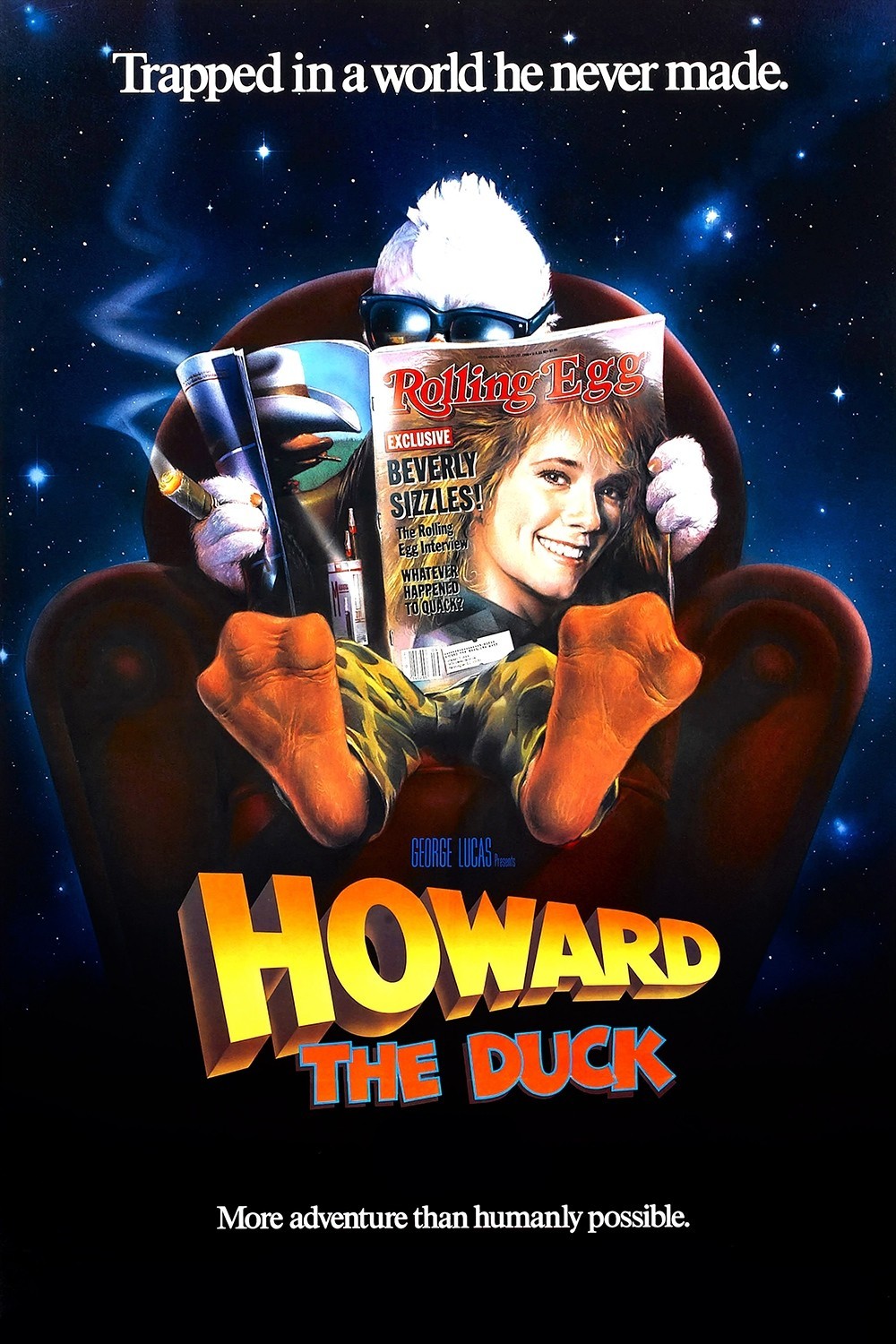
Howard The Duck

Released August 1, 1986
Budget: $37,000,000
Grossed: $38,000,000

Starring Lea Thompson, Tim Robbins and Jeffrey Jones.

The Plot:
A sentient, talking duck from another dimension is accidentally brought to Earth, where he has to cope with our society.

Thoughts:
• Believe it or not, Howard The Duck was the first major motion picture based on a Marvel comic! My, how times have changed.

It's widely considered to be one of the worst movies ever made. Eh, it's by no means great, but believe me, I've seen far, far worse (heck, I've seen worse films this year!).

• Jay Leno was considered for the role of Phil Blumburtt before it ultimately went to Tim Robbins. Man, the world dodged a bullet that day. 

Amazingly there was a time in the 1980s when Jay Leno was being groomed as a film actor (!).

• In 1986, George Lucas was heavily in debt after constructing his $50 million Skywalker Ranch film studio. Lucas produced Howard The Duck, hoping the film would be a huge box office hit and get him out of debt.

When that didn't happen, he began selling off Lucasfilm assets, including his newly formed CGI animation division. Steve Jobs bought Lucas' animation department, which later morphed into a little business called Pixar!

• The Howard suit cost a reported $2 million ($4.5 million today!). There were eight different actors who portrayed Howard in various scenes. Ed Gale was the one used most often, and the only one who received a film credit.

• Lea Thompson actually did all her own singing in the movie.

• The movie was such a flop that Frank Price, head of Universal Studios, quit his job shortly after it premiered. The next day the Variety headline read, "Duck Cooks Price's Goose."

The Karate Kid Part II
Released June 20, 1986
Budget: $13,000,000
Grossed: $115,000,000

Starring Ralph Macchi and Noriyuki Pat Morita.

The Plot:
Daniel LaRusso and his pal Mr. Miyagi travel to Okinawa, where they struggle to save a local village from evil land developers.

Thoughts:
• The movie started filming just ten days after the release of The Karate Kid.

• Although much of the movie's set in Okinawa, it was actually filmed in Hawaii, due to the similar landscape and the ease of filming on U.S. soil.

• The Karate Kid Part II earned more than the original film— $115 million vs. $90 million.

• After filming The Karate Kid, actress Elisabeth Shue (who played Daniel's girlfriend Ali) enrolled at Harvard. She was supposed to have a minor role in Part II, in which she and Daniel break up. However, the writers scrapped this plan, and Daniel makes a brief mention of her and then she's never seen or heard from again.

Labyrinth

Released June 27, 1986
Budget: $25,000,000
Grossed: $13,000,000

Starring David Bowie and Jennifer Connelly.

The Plot:
Have you seen The Wizard Of Oz? It's pretty much that, but with more creepy sexual undertones.

Thoughts:
• Mick Jagger, Prince (!), Sting and Michael Jackson (!!) were all considered for the role of Jareth, before the producers decided on David Bowie.

• One of the film's choreographers is Cheryl McFadden. You may know here better as Gates McFadden, who played Dr. Crusher on Star Trek: The Next Generation.

• All through the film, Jareth juggles a set of crystal balls. The juggling scenes were one hundred percent real, with no camera tricks or special effects used. Michael Moschen performed all the juggling by crouching behind David Bowie and sticking his arms out in front of him. As a result he couldn't see what he was doing and had to juggle blind.

• The sources of most of the characters Sarah meets inside the Labyrinth can be found in her room in the real world (very much like the way Dorothy incorporated things from her world into Oz). She has a stuffed animals that look like Sir Didymus and Ludo on her shelves, a doll that resembles Hoggle, and even a figure that looks a lot like Jareth on her dresser.

She also has a music box containing a figure wearing a dress identical to the one she wears in the ballroom scene. There's even a wooden maze on her dresser that looks suspiciously labyrinth-like.

There's also an M.C. Escher print on her wall, which is very much like the "crazy perspective" environment in which she confronts Jareth.

Little Shop Of Horrors

Released December 19, 1986
Budget: $25,000,000
Grossed: $34,000,000

Starring Rick Moranis, Ellen Greene, Vincent Gardenia, Steve Martin, James Belushi, John Candy, Christopher Guest and Bill Murray.

The Plot:
A nerdy florist discovers a talking, man-eating plant that threatens to take over the world.

Thoughts:
• Little Shop Of Horrors was directed by Frank Oz, who's best known as the voice and puppeteer of Yoda in the original Star Wars films.

Although Oz is primarily a puppeteer and voice artists, he's had a decent career as a director. He helmed The Dark Crystal (with Jim Henson), The Muppets Take Manhattan, Dirty Rotten Scoundrels, What About Bob?, The Indian In The Cupboard, In & Out, Bowfinger, The Stepford Wives (2004) and Death At A Funeral.

By the way, Oz's real name is Frank Oznowicz.

• Ellen Greene, who plays Audrey, is the only member of the off-Broadway cast to appear in the film.

The role of Audrey was originally offered to Cyndi Lauper and Madonna (!!!). Yikes.

• When I first saw the film, I was impressed with the articulation of the massive Audrey puppet's gigantic mouth, and wondered how they got it to move so fast.

Turns out they undercranked the camera, and then played the footage at the normal twenty four frames per second, which sped up Audrey's movements considerably. Of course this meant that the actors had to move and lip sync slower than normal as well.

• The film originally ended with Seymour and Audrey being eaten by Audrey II. Director Frank Oz reluctantly changed it after negative reaction from test audiences. This is why we can't have nice things.

Platoon

Released December 19, 1986
Budget: $6,000,000
Grossed: $138,000,000

Starring Charlie Sheen, Tom Berenger, Willem Dafoe, John C. McGinley, Keith David, Forest Whitaker, Tony Todd and Johnny Depp.

The Plot:
A young man drops out of college and joins the Army during the Vietnam War, where he experiences the horrors of combat.

Thoughts:
• Oliver Stone was the first Vietnam veteran to direct a movie about the Vietnam War. Many events in the film were drawn from Stone's personal experiences in the war.

• Platoon took a long time to make it to the big screen, as Stone wrote the first draft back in 1971.

• Stone sent a copy of the script to Jim Morrison of The Doors in 1971, hoping to get him to play Chris (the part ultimately went to Charlie Sheen). Morrison reportedly had a copy of the script with him when he was found dead in Paris a few weeks later.

• Stone deliberately cast his two main actors against type. Tom Berenger was famous for playing good guys, but was cast as the sadistic Sgt. Barnes in Platoon. Willem Dafoe had mostly played villains up to that point, but was cast as the heroic Sgt. Elias.

Apparently the tactic worked, as both actors received Oscar nominations for the film.

• Charlie Sheen narrates the movie, which echoes his father Martin Sheen, who narrated Apocalypse Now, an earlier Vietnamese War movie.

Pretty In Pink

Released February 28, 1986
Budget: $9,000,000
Grossed: $40,000,000

Starring Molly Ringwald, Harry Dean Stanton, Jon Cryer, Annie Potts, James Spader and Andrew McCarthy.

The Plot:
A working class girl and a rich guy fall in love and try to date, but their various social circles get in the way of their happiness.

Thoughts:
• Supposedly the film came about when actress Molly Ringwald asked director John Hughes to write a film based on the song Pretty In Pink by The Psychedelic Furs (and yes, the song appears in the movie).

• Jon Cryer, who plays Ducky, claims that despite what it looks like onscreen, both Molly Ringwald and Andrew McCarthy thought he was "irritating."

Have you ever seen Cryer on Two And A Half Men? Who could blame them?

Short Circuit

Released May 9, 1986
Budget: $9,000,000
Grossed: $40,000,000

Starring Steve Guttenberg, Ally Sheedy, Fisher Stevens, Austin Pendleton and G.W. Bailey.

The Plot:
A military robot is hit by lightning and becomes sentient, deciding it would rather learn and explore the world rather than kill.

Thoughts:
• Sign of the times: Fisher Stevens plays Ben in the film, an Indian character with a broad, exaggerated Hindu accent. Just one thing— Stevens isn't Indian. There's no way in hell something like that would ever be allowed today.

Stand By Me

Released August 8, 1986
Budget: $8,000,000
Grossed: $52,000,000

Starring Wil Wheaton, River Phoenix, Corey Feldman, Jerry O'Connell and Kiefer Sutherland.

The Plot:
In 1959, four young boys explore the local woods to try and find the body of a missing teen.

Thoughts:
• Based on the short story The Body, part of the anthology book Different Seasons by Stephen King. The Shawshank Redemption (under the name Rita Hayworth And Shawshank Redemption) and Apt Pupil are also in the book, and were both turned into film as well.

That must be some book!

• Columbia Pictures was concerned that the story's original title The Body was misleading, thinking it sounded too much like a horror film. Director Rob Reiner came up with Stand By Me, from the Ben E. King song of the same name.

After the film premiered, there was renewed interest in the song, and the Stand By Me soundtrack made the Top Ten in 1986.

• King claims the "leech incident" in the story and film (you'll now it if you've seen the film) actually happened to him as a child.

• Actor Corey Feldman, who plays Teddy, claims the character was very close to his actual personality and personal life at the time. Yikes!

• Actor Jerry O'Connell was eleven during filming, and was amazed that he was allowed to swear in the movie.

• The scene in which the train bears down on Gordie and Vern on the bridge was filmed with old fashioned movie magic. The train was actually several hundred feet away, but the scene was shot head on with a telephoto lens, that compressed the image, making it look like the train was right behind them.

Hey, we didn't have fancy CGI in the 80s!

• When the boys pool their money, it adds up to $2.37. The number 237 appears in many Stephen King stories (such as Room 237 in The Shining).

• Art imitating life: In the film, the character of Chris, who's played by River Phoenix, is said to have died relatively young while trying to break up a fight. In reality, River Phoenix died young (from a drug overdose in 1993), while the other three main actors are still alive and working.

Star Trek IV: The Voyage Home
Released November 26, 1986
Budget: $21,000,000
Grossed: $133,000,000

Starring William Shatner, Leonard Nimoy, DeForest Kelly, James Doohan, Nichelle Nichols, George Takei, Walter Koenig, Robin Curtis and Catherine Hicks.

The Plot:
When an alien probe threatens Earth, the crew of the Enterprise goes back in time to retrieve two humpback whales in order to communicate with it.

Thoughts:
• In the opening scene showing the shrieking alien probe approaching Earth, there were originally subtitles explaining what it was supposed to be saying. Things like, "Where are you?" and "Can you hear us?"

Thankfully director Leonard Nimoy came to his senses and dropped the subtitles from the final cut.

• Ever wonder why Lt. Saavik stays on Vulcan and doesn't accompany the crew on their little romp? Supposedly there's a deleted scene that explains she became pregnant while helping Young Spock through his pon far (it's a Star Trek thing) in Star Trek III: The Search For Spock.

I'm not sure I care for that explanation, but at least it's better than the big fat non-reason we got in the final film.

• This film contains the one and ONLY instance in any movie or TV episode in which Kirk actually says, "Scotty, beam me up.

• Many underwater shots of the humpback whales were filmed with four foot long animatronic models. Apparently they were pretty convincing, because many animal rights groups criticized the film for getting too close to whales in the wild and pestering them just for a film!

• The movie was originally going to feature Eddie Murphy (!!!) as a UFO buff who spots the crew's Klingon Bird Of Prey decloaking at the Super Bowl. Everyone else in the audience thinks it's a special effect, but Murphy's character is convinced it's real, and he eventually discovers Kirk and his crew.

This storyline was fortunately scrapped when Murphy chose to star in The Golden Child instead. Praise the Movie Gods!

What can I say? It was the 80s, and the cocaine flowed thick and freely.

• There's another subplot that never made it into the film. After the crew travels back to 1986 San Francisco, Sulu wanders into Chinatown. He runs into a young boy named Hikaru, who he realizes is his great-great-great (and so on) grandfather).

Supposedly the kid they hired for the part started crying and wouldn't stop, and the scene was ultimately dumped. Oh myyyyyyyyyyy!

• James Doohan, who played Scotty, was a war hero in real life and lost the middle finger on his right hand in battle. He was pretty good at hiding his missing digit on the TV show and the previous films, but you can see it here in the scene where he picks up the computer mouse and tries talking into it.

• During the probe's attack, a technician lists the various cities that are being affected, including Leningrad. Whoops! Leningrad changed its name to St. Petersberg in 1991, five years after this movie premiered (maybe they changed it back again in the 23rd Century?).

• After time traveling to 1986, Kirk and Spock ride a bus through San Francisco. A punk rocker angrily blares his boom box at them, until Spock casually reaches over and knocks him out with the Vulcan neck pinch.

The punker was played by Kirk Thatcher, an associate producer on the film. He actually made himself up in full punk attire and haircut, and even wrote the I Hate You song playing on his boombox.

• Star Trek IV: The Voyage Home is the only one of the films in which no one dies.

Top Gun

Released May 16, 1986
Budget: $15,000,000
Grossed: $176,000,000

Starring Tom Cruise, Kelly McGillis, Val Kilmer, Anthony Edwards and Tom Skerritt.

The Plot:
Is there a plot? A pilot code-named Maverck attends the Top Gun Naval Flying School, is determined to prove himself and rise to the top, while wooing a beautiful civilian instructor.

Thoughts:
• Matthew Modine, Patrick Swayze, Emilio Estevez, Nicolas Cage, John Cusack, Matthew Broderick, Sean Penn, Michael J. Fox (!), Scott Baio (!!), Rob Lowe, Kevin Bacon, Eric Stoltz and Robert Downey Jr. (!!!) were all considered for the part of Maverick.

• The Navy set up recruiting booths in theater lobbies across the country, hoping to recruit pumped-up young hotheads exiting the theaters. Believe it or not their plan worked, and recruitment rates that summer were the highest in years.

• Top Gun star Tom Cruise had to wear lifts in his shoes when acting opposite Kelly McGillis.

• Val Kilmer didn't want anything to do with the film, but was contractually obligated to appear in it. The role of "Iceman" turned out to be the most iconic of his entire career.

• Kelly McGillis' character Charlie is based on an actual person. Christine Fox was a civilian flight instructor, who rose through the ranks of the Pentagon and became Acting Deputy Secretary Of Defense, the highest office ever held by a woman at the DOD.

• An early draft of the film had Maverick and his squad squaring off against North Korean planes. Ultimately the nationalities of the enemy were kept vague, so as not to offend our enemies, I guess.

Other notable movies that premiered in 1986:

• Solarbabies
• SpaceCamp
• The Texas Chainsaw Massacre 2
• Blue Velvet
• Manhunter
• The Color Of Money
• Hoosiers
• Three Amigos
• Heartbreak Ridge
• Troll
• Critters
• The Hitcher
• From Beyond
• F/X
• Henry, Portrait Of A Serial Killer
• Night Of The Creeps
• Chopping Mall
• Deadly Friend
• Iron Eagle
• Children Of A Lesser God
• Gung Ho
• King Kong Lives
• Invaders From Mars

Saturday, June 20, 2015

Happy Fortieth (!) Anniversary To Jaws!

Happy 40th Anniversary to the grandaddy of all summer movies, Jaws!

Forty years! Can you believe it? I vividly remember seeing Jaws in the theater as a lad. First run, even! It was THE movie to see that year— nothing else even came close. I remember the audience shrieking out loud every time the shark appeared. And they actually cheered when it blew up at the end (sorry, SPOILER ALERT!)! When's the last time you heard that happen in a theater?

Jaws was the only topic of discussion that entire summer. Johnny Carson talked about it practically every night, it was in the newspaper, dozens of political cartoons referenced it, and even TV shows of the day got in the act. It was definitely a pop culture phenomenon.

The film also traumatized an entire generation, making them literally afraid to so much as dip a toe into the ocean.

People actually went to see the movie dozens of times, like it was some kind of roller coaster or thrill ride. Even I saw it twice (once in a theater, and once in a drive-in), which was unusual for me.

If you enjoyed seeing Star Wars, Jurassic Park or The Avengers (and countless others) in the theater during the summer months, then you owe a debt of gratitude to Jaws, which ushered in the age of the Summer Blockbuster Movie. Before it premiered, summer was just another season for movie studios. It's hard to believe, but back then studio executives thought that in the summer, people were too busy swimming, tanning and vacationing to go see a movie. Once Jaws hit and hit big, they realized there was an audience out there who actually wanted to see movies during the summer. And not just any movies, but big, expensive, action packed ones. 

Jaws opened on June 20, 1975 in 464 theaters in the US and Canada, which was the biggest simultaneous opening at that time. Before Jaws, movies generally premiered in theaters in major cities, then once they completed their runs there, the prints (which were by then beat up and full of splices) would slowly make their way across the rest of the country.

Due to the film's unprecedented success, the number of theaters was increased to 700 on July 25 and later 950 on August 15.

It made $7 million in its opening weekend, which doesn't sound like a lot now, but was huge at the time. It was the first movie to ever gross $100 million, earning $121 million in its initial release. It was the highest grossing film of all time until it was defeated by Star Wars in 1977.

There was an unprecedented avalanche of Jaws merchandise released as well. T-shirts, books, records, board games, coloring books, trading cards, bedspreads, posters— you name it. If it would hold still long enough to slap a shark on it, someone made it.

Jaws was of course based on Peter Benchley's massively popular novel. In fact Universal Pictures bought the movie rights to the novel before it was even published!

The screenplay was written by Benchley and Carl Gottlieb, and directed by Steven Spielberg. It was Spileberg's second time at directing a big screen film, his previous being The Sugarland Express.

Jaws was a very troubled production, running over budget and over schedule. Shooting on the open ocean caused a few of the delays, but the vast majority of them were caused by the malfunctioning mechanical shark created for the film.

It's an oddly structured film, almost like two movies in one. The first half takes place on land and features a large cast, but once the trio sets out in search of the shark, it becomes a completely different movie— a tense "man vs. nature" film with just three characters.

Of course the success of Jaws spawned a cottage industry of copycat films featuring various animals— sometimes aquatic, sometimes not— attacking humanity.

A few Jaws facts:

• Bantam Publishing artist Roger Kastel painted both the book cover and the movie poster.

• Steven Spielberg said when he read the novel he rooted for the shark, as the human characters were all so unlikable.

I read the book before I saw the movie, and he's right. Everyone in the book is a miserable asshole. For example: in the novel, Matt Hooper has an affair with Chief Brody's wife, which seemingly comes out of nowhere. It has absolutely nothing to do with the plot, and I'm convinced it exists solely to up the page count and inject some sex into an otherwise sexless tale.

Hooper also dies at the end of the novel, I suppose as some sort of comeuppance.

Fortunately Spielberg threw out this superfluous subplot, made everyone more likable and allowed Hooper to survive. Screenwriter Carl Gottlieb was hired to inject some much-needed humor into the script, to great effect.

• Author Peter Benchley wanted to cast Robert Redford, Paul Newman and Steve McQueen in the film, presumably as Brody, Hooper and Quint. Yawn. Pretty much every writer & director in the 1970s wanted those three guys in their movie.

Robert Duvall was considered for the part of Chief Brody. Lee Marvin and Sterling Hayden were suggested for Quint. Timothy Bottoms, Joel Grey and Jeff Bridges were considered for Hooper. Once Richard Dreyfuss was cast, the role of Hooper was rewritten to better suit him.

Charlton Heston desperately wanted the Chief Brody part, but lost out to Roy Scheider. Heston was reported so angry over losing the part that he vowed to never work with Spielberg. He even turned down the part of General Stilwell in Spielberg's 1941. If you've ever seen that particular film, you'll know that Heston did himself a favor.

Peter Benchley appears in the film as a TV reported in the beach attack scene.

• Author Peter Benchley later regretted writing the book, which he said paints sharks as evil creatures that target humans. He became an ocean conservationist, and spent much of the rest of his career trying to convince people that real sharks don't act like the one in his book.

• In the scene in which Chrissie's remains are found, that's a real hand sticking out of the sand. Spielberg thought the prosthetic appendage originally used in the scene was too fake looking, so he had a crew member buried in the sand with just her hand sticking out.

During the entire summer of '75, anytime I was in any body of water, be it a lake or a pool, I'd pretend I was being attacked by a shark. I'd paddle around serenely for a while, then suddenly start thrashing about and pulling my head under water as if I was being dragged down by a shark. Yes, I was quite hilarious, and I'm sure a joy to be around.

• During the shark attack on the beach, Spielberg uses the famous "Hitchcock Zoom" effect to highlight Chief Brody's spine-tingling terror. The camera zooms in on Brody's face, while the background seemingly recedes from him.

It's an interesting, but simple effect. It's created by zooming in on a subject, while the camera is simultaneously being moved away. You can recreate yourself it if you have a camera with a zoom feature.

• Robert Shaw absolutely hated Richard Dreyfuss, and the two argued off-screen constantly. This may have actually helped the film, as it created a palpable tension between the two characters.

• After Alex Kintner's death by shark, his mother slaps Chief Brody in the face. Lee Fierro, who played Mrs. Kintner, couldn't convincingly fake a slap, so she actually hit Scheider in the face. Unfortunately for Scheider, the scene required multiple takes, and he says it was one of the most painful of his career.

• One of the biggest scares in the film is when Ben Gardner's severed head tumbles out of the boat, terrifying Hooper (and the audience as well). The head's appearance was one of the last scenes filmed. Spielberg decided he needed one more big scare in the movie, so he shot the head in film editor Verna Fields' swimming pool, paying for the shoot out of his own pocket.

This was the other big scare in the film, in which the shark pops up to say "hi" when Brody's not looking. That scened caused much screaming and soiling of garments in the theater the day I saw the film.

• According to Spielberg, the shooting star that appears during the scene where Brody loads his revolver was real, not an optical effect.

There's a second shooting star that appears over a long shot of the Orca though, that is most definitely fake. It looks like it's either been animated or filmed in slow motion.

• The mechanical shark, nicknamed "Bruce," was a complete and utter disaster. The harsh saltwater messed with its electronics, causing it to constantly malfunction. In fact, the first time it was lowered into the water it promptly sunk to the ocean floor!

Spielberg then had to figure out how to film a shark movie without a shark. He solved the problem by asking himself, "What would Alfred Hitchcock do?" Hitchcock believed that what the audience doesn't see is infinitely scarier than what they do see. Spielberg decided to shoot many of the shark scenes from the shark's point of view, which ratcheted up the tension. The shark was also suggested by the yellow barrels that were attached to it.

Thank the film gods for the malfunctioning shark! By "hiding" the shark, the audience never quite knows where it is, which makes it that much more frightening. Just think, if the film was made today, the shark would no doubt be lovingly rendered in CGI and would be splashing away in every scene.

• Chief Brody's famous line, "You're gonna need a bigger boat," was ad libbed.

• During their little pissing contest, Quint displays his manliness by crushing a beer can in his bare hand. Hooper counters by crushing a paper cup.

It's a funny scene, but I wonder if much of the humor is lost on modern audiences, as beer and soda cans are extremely flimsy these days. Back in the 1970s cans were much, much thicker, and really were a lot harder to crush.

• Near the end of the film, the shark attacks Hooper, who's inside a submerged cage. For these scenes, shark experts Ron and Valerie Taylor shot underwater footage of real sharks. To make the sharks look bigger, they filmed them swimming around a scaled-down cage with a little person inside.

• The first time Spielberg heard John Williams play the Jaws theme, he thought it was a joke. He was eventually convinced to use it, and of course it's gone on to become one of the most famous themes in movie history.

Spielberg later said that without the score, the film would have been only half as successful. He's right.

Other notable movies celebrating their 30th Anniversary this year: The Rocky Horror Picture Show, One Flew Over The Cuckoo's Nest, Monty Python And The Holy Grail, Dog Day Afternoon, A Boy And His Dog, Tommy, Death Race 2000, Rollerball, The Stepford Wives, The Land That Time Forgot, The Devil's Rain, Dolemite and The Hindenburg.

Saturday, November 29, 2014

1984: Another Great Year For Blockbuster Movies!

Summer, 1984. One of the greatest blockbuster seasons ever at the cineplex. There were an amazing number of big budget, high grossing films released during that period, many of which have gone on to classic or cult film status. Influential films we're still watching and talking about today. 

Some of the most important directors of our time released their best work during this incredible period. Whether it was a fortuitous alignment of stars in the cosmos or just a random confluence of studio schedules, the Summer of 1984 was a great time to be a movie lover!

It just doesn't seem possible that it's been a whopping thirty years since these films were released.

Note that of all the films on this list, only two are sequels. And there's not a single remake to be found. You hear that Hollywood? Audiences like new ideas and stories. 

It seems silly to issue a Spoiler Warning for a bunch of three decade old movies, but... consider yourself warned!


Beverly Hills Cop

Released December 5, 1984
Budget $15,000,000
Grossed: $234,000,000

Starring Eddie Murphy, Judge Reinhold, John Ashton, Ronny Cox and Bronson Pinchot.


The Plot:
Axel Foley (Eddie Murphy) is a young police detective in Detroit. When his best friend Mikey is killed, he's determined to investigate and solve his murder. The trail of clues take him to Beverly Hills, where he teams up with a couple of local detectives to solve the crime. Hijinx ensue.

Thoughts:
• Saturday Night Live may have made Eddie Murphy a household name, but it was Beverly Hills Cop that made him a superstar. 

• The role of Axel Foley was first offered to Mickey Rourke (!), but numerous delays caused him to leave the film. No offense to Mr. Rourke, but if he'd taken the part I doubt we'd still be discussing the film today. 

The role was then offered to Sylvester Stallone, who rewrote the script into an epic, over the top action film. The studio balked, saying his script would be too costly to film. This caused Stallone to leave just two weeks before filming began (Sly took some of his more action-y ideas and incorporated them into the movie Cobra). 

Richard Pryor, Al Pacino and James Caan were all considered for the Axel Foley part but turned it down.

The film was finally offered to Eddie Murphy, who accepted. This required a quick and massive overhaul of the script though, to pump up the laugh quotient and play to Murphy's comedic strengths.

• Martin Scorsese and David Cronenberg (!) were asked to direct, but declined. Martin Brest supposedly took the director job based on the results of a coin toss. Always nice to see an artist with a passion for his projects.

• Much of the between Murphy and co-stars Judge Reinhold and John Ashton was improvised. Many takes were ruined due to cast and crew alike laughing at the ad-libbed lines. Reinhold's "five pounds of red meat in your bowels" monologue came from an off the cuff line he performed during his audition.

• In addition to catapulting Eddie Murphy to superstardom, the film gave quite a boost to Bronson Pinchot's career as well. He practically stole the show as the odd art dealer Serge, and used a variation of the character (as well as his accent) as Balki in his Perfect Strangers sitcom.

• Amazingly the film received an Academy Award nomination for Best Writing (Original Screenplay). Really? An Oscar nom? It's a decent film and I like it, but c'mon, it ain't that good.

• The Beverly Hills Cop soundtrack, including the iconic Axel F instrumental, is almost as famous as the film itself. It won a Grammy for Best Score Soundtrack.


• The film spawned two sequels, also starring Eddie Murphy and Judge Reinhold. In 2013 there were rumors that CBS was interested in a television series based on the films, featuring Axel Foley's son, but nothing ever came of it. That's probably just as well.

Dune

December 14, 1984
Budget: $40,000,000
Gross: $30,000,000

Starring Kyle MacLachlan, Max Von Sydow, Jose Ferrer, Patrick Stewart, Sean Young, Brad Dourif and Sting.

The Plot:
In the far future, various political houses fight over a planet that produces a drug that makes space travel possible (how's that for distilling such a complicated story into one sentence!).

Thoughts:
• David Lynch's adaptation of Frank Herbert's scifi novel is a glorious train wreck of a film. It was labeled a bomb in 1984, but as often happens, it's since become regarded as a cult classic.

• There were many failed attempts to film Dune before it finally came to the big screen. In 1971 Arthur P. Jacobs (producer of the Planet Of The Apes films) bought the film rights and wanted David Lean (of Lawrence Of Arabia fame, no less) to direct. 

Next a French consortium bought the rights and hired Alejandro Jodorowsky to direct. Jodorowsky had a lot of screwball ideas that would have no doubt made for an even weirder and crazier version than what we ended up with. In fact there's even a documentary about his vaporware film! 


Jodorowsky planned to make a ten hour long movie (!) starring artist Salvador Dali as the Emperor (!!!). Dali agreed to start in the film, but demanded $100,000 an hour. Jodorowsky accepted his terms, planning to film all of Dali's scenes in one hour (how he realistically thought such a thing was possible, I have no idea). 

Jodorowsky spent $2 million of the films $9.5 million budget on pre-production alone. Around this time the French investors' money dried up and the project was cancelled.

In 1981, Dino De Laurentiis (of the 1976 King Kong fame) bought the film rights. He hired Ridley Scott (ALIEN) to direct. Scott planned on making two films, but the project stalled yet again and he went on to direct Blade Runner.

Finally De Laurentiis hired David Lynch to direct. Lynch spent six months working on the script before filming finally began on March 30, 1983. Lynch's first cut of the film was over four hours long, which, all things considered, wasn't bad for a movie based on such a massive book. Universal wanted a two hour film (so it could play in theaters more times per day, raking in more money) and forced him to cut it down. Lynch claims Universal Pictures denied him final cut of the picture, and has distanced himself from the production, refusing to even talk about it in interviews.

• The film boasts an amazing international cast, but everyone acts in a dreamlike, languid style, as if they're either hypnotized by the complexity of the script or there was a gas leak in the studio.

• Rob Lowe and Val Kilmer turned down the part of Paul Atreides. Paul was ultimately played by Kyle MacLachlan, in his film debut. I wonder if Val Kilmer passed on the role because he was busy shooting Top Secret!, which also premiered in 1984?

• Patrick Stewart, who plays Gurney Halleck in the film, said the film's "stillsuit" was the most uncomfortable costume he's ever worn. He also said the same thing about the first season uniforms in Star Trek: The Next Generation. Maybe Sir Patrick just isn't comfortable in any kind of uniform. 

Although the musical instrument played by Patrick Stewart looks suitably futuristic, it was a real type of electric guitar called a Chapman Stick.

• At the time, much was made of Feyd-Rautha, played by Police frontman Sting, and his tiny winged g-string. Originally he agreed to film the scene in the nude, but the studio became nervous and demanded he cover up his "little sting."


• Universal saw how much money Star Wars toys were raking in and decided they wanted in on some of that sweet, sweet merchandising pie. To that end they released a whole line of ill-advised Dune action figures and accessories.

Never mind that the film is a complex tale of political intrigue and ecology and offers very little for a child to appreciate. Sure, there are a few action set pieces (mostly involving the sandworms), but they're bracketed by endless scenes of dry, bureaucratic machination.

Needless to say few kids wanted a figure of a five hundred pound sexually perverted dictator or a middle aged man with a photographic memory who inexplicably had a house cat and a rat hooked up to his bloodstream, and they were quickly clearanced from the nation's toy shelves.

• David Lynch makes a cameo appearance as a mining ship radio operator. For some unfathomable reason, new age saxophonist Kenny G. also makes an appearance as a drummer during Feyd and Paul's duel.


• Dune has a very odd production design. Take a look at the object above. What does that look like to you? Some sort of futuristic wall clock? Nope, believe it or not it's a ray gun. 

Was the production designer simply trying to get away from the traditional pistol-like weapon? Or did he have six weeks to design one, but goofed off until the day he was supposed to present it and came up with this idea at a stop light on the way to the studio meeting? I'm betting the latter.


• Watch the end of the film carefully, because this is the only time in motion picture history that you'll ever see the credit "Music by Toto." Because who better to write the score for your sprawling, epic scifi adventure than an 80s prog-rock keyboard band?


• Dune is the only film I can think of that's ever passed out "cheat sheets" to the audience. The plot was so complicated and filled with alien words and names that the studio printed up handouts featuring a glossary of terms for confused moviegoers. Can you imagine sitting in a darkened theater, squinting while trying to read your handout to find out what "mentat" means? 

If you have to resort to such drastic measures to explain what the hell's going on, then you've failed as a screenwriter and director.

• David Lynch was signed to direct two sequels to the film, but the poor box office squelched those plans.


Ghostbusters

Released June 8, 1984
Budget: $30,000,000
Grossed: $291,000,000

Starring Bill Murray, Dan Aykroyd, Harold Ramis, Ernie Hudson, Sigourney Weaver, Annie Potts and Rick Moranis.

The Plot:
Three parapsychologists lose their positions at Columbia University. After noticing increased supernatural activity in New York City, they form a successful small business called Ghostbusters. 

The paranormal activity continues to grow, culminating in the arrival of an ancient god named Gozer who wants to bring about Armageddon Naturally, the Ghostbusters are the only ones who can save the world.

Thoughts:
• Ghostbusters was my favorite movie of 1984 and I still love it to this day. I vividly remember seeing it in a crowded theater while on a trip to St. Louis. This was way before the advent of the internet and spoiler sites, so everyone was totally surprised by the appearance of the Stay-Puft Marshmallow Man. The entire audience roared with laughter for many minutes afterward, a reaction I've not seen since. Sometimes I miss those days.

• Dan Aykroyd wrote the film, intending to star in it alongside his friend John Belushi. The original script was quite different, featuring "Ghostsmashers" who traveled through time, space and other dimensions as they hunted an entire race of giant ghosts (one of which the Stay-Puft Marshmallow Man!). The Ghostsmashers wore SWAT-type uniforms and used wands (?) to battle the ghosts.

Director Ivan Reitman liked the concept, but worried that the film would cost at least $200 million (in 1984 dollars). He suggested Harold Ramis help Ackroyd rewrite the script and make it cheaper to shoot.

• Ramis and Aykroyd wrote roles specifically for John Belushi and Eddie Murphy, who would play two of the Ghostbusters, and for John Candy as Louis Tully. Unfortunately Belushi died before filming began, and Murphy and Candy wouldn't commit to the film.

Eventually Bill Murray was offered the role of Peter Venkman. Most of Bill Murray's lines were ad-libbed.

• Christopher Walken, John Lithgow, Christopher Lloyd and Jeff Goldblum were all considered for the role of Dr. Egon Spengler before it was given to Harold Ramis. Although they all would have made interesting Egons, in the end I can't imagine anyone else in the role.

• Louis Tully was originally written as a conservative businessman. The part was given to Rick Moranis, who played the character as a geeky milquetoast and wrote most of his own highly technical tax law dialog!

• Gozer the Gozarian was originally going to be a man in a business suit played by Paul Ruebens (better known as Pee Wee Herman), but was replaced by scantily-clad Yugoslavian model Slavitza Jovan. Good move!

• William Atherton starred as the irritating EPA agent Walter Peck. Atherton claims that the film ruined his life, as to this day people yell at him on the street and even attempt to pick fights with him. The mark of a good actor!

• 1970s porn star Ron Jeremy makes a brief and puzzling camera appearance near the end of the film. Years later, in 2011, he starred in a porn parody called This Ain't Ghostbusters XXX. I hope that those triple Xs refer to the pornographic nature of the film and don't mean it's Part 30.


• Throughout most of the shooting the film didn't have a name. They actually considered Ghoststoppers before finally settling on the far more satisfying Ghostbusters. The producers then discovered that there had been a 1975 live action Saturday morning show called The Ghost Busters, produced by Filmation Studios. Fortunately Columbia worked out a deal with Filmation.

After the film became a huge hit, Filmation produced an animated version of The Ghost Busters with the incredibly inventive new title of Filmation's Ghostbusters. Not to be outdone, in 1986 Columbia countered with their own animated version of the film called The Real Ghostbusters. Confusing!

• The Stay-Puft Marshmallow Man actually makes a couple of appearances before his big scene in the final act. The eggs which fry themselves on Dana's kitchen counter are sitting next to a package of Stay-Puft marshmallows. Later as the Ghostbusters roar out of their
headquarters in the Ecto-1, there's an ad for Stay-Puft marshmallows on a building behind them.

The Stay-Puft Marshmallow Man suits cost approximately $20,000 apiece. Three were made and all were destroyed during filming.

• So what's up with that bizarre "ghostly sex" dream sequence in the middle of the film?

As originally filmed, Ray and Winston go on a ghost busting call to an old Civil War fort, which has been converted into a museum. They split up and start hunting for the ghost. Ray wanders into a bedroom and tries on one of the old Civil War uniforms. He then either becomes really sleepy, or perhaps is lulled to sleep by the resident ghost. He lies down on the bed and instantly falls asleep. He's then awakened by a female ghost who gives him a taste of supernatural sex. 

This scene was ultimately cut from the film, but part of it was used in a clumsily edited and out of place dream sequence in the middle of the "hard working Ghostbusters" montage (look closely and you can see Ray's inexplicably wearing the Civil War uniform).


• Did you know Bill Murray and Dan Aykroyd played dual roles in the first cut
of Ghostbusters? The two played homeless men who witness Louis being chased through Central Park by one of the terror dogs. This scene was removed from the final cut because little was done to disguise their identities, and the filmmakers feared the audience would be confused by seeing Murray and Aykroyd playing other characters.

• If you're a Ghostbusters fan, you owe a debt of gratitude to the film The Razor's Edge. According to Dan Aykroyd, Bill Murray was on the fence about starring as Peter Venkman, and only committed to the project after Columbia agreed to let him film The Razor's Edge, which was a passion project of his.

The film was released after Ghostbusters and tanked hard at the box office. Audiences no doubt had little interest in seeing Murray spouting philosophy in a serious and introspective film.

• Ghostbusters was another film with a hugely successful soundtrack. Ray Parker Jr. wrote and performed the catchy theme song, which became an incredibly huge hit. Amazingly it won an Oscar for Best Original Song (!). Seriously? I'm starting to think it's not all that hard to win an Oscar.

Not everyone was pleased with Parker's success though. In the fall of 1984 Huey Lewis sued Ray Parker Jr. for plagiarism, claiming the Ghostbusters theme copied the melody from his 1983 song I Want A New Drug. So was it true? Did the Ghostbusters theme copy New Drug? Well, the two settled out of court, so that means the answer is yes. Yes it did.

Veteran film composer Elmer Bernstein wrote the film's musical score.

• Reitman knew he had a hit on their hands when a test screening of the film-- without most of the ghostly special effects-- still met with thunderous applause from the audience.

The film spawned a less successful sequel, and the long running cartoon series. Aykroyd has been trying to get a third film off the ground for decades now, but has so far been unsuccessful. With the untimely death of Harold Ramis and Bill Murray's disinterest in the project, I say why bother? Better to have one good and one OK film to enjoy over and over, than to release a disastrous third film and sully the memory of the franchise.


In recent months a new Ghostbusters film with an all female team has been announced.

Gremlins

Released June 8, 1984
Budget: $11,000,000
Grossed: $153,000,000

Starring Zach Galligan, Phoebe Cates, Hoyt Axton, Polly Holiday, with Frank Welker and Howie Mandel as the voices of Stripe and Gizmo.

The Plot:
An unsuccessful inventor buys his son Billy a strange creature in a Chinatown shop. The creature, called a Mogwai, comes with three strict instructions: Keep it out of bright light, never get it wet, and never, ever feed it after midnight.

Of course it doesn't take long for Billy to violate all three rules, and the cute and cuddly Mogwai mutates and grows into an army of destructive monsters that wreak havoc in the peaceful town of Bedford Falls, er, I mean Kingston Falls.

Thoughts:
• Gremlins, along with Indiana Jones And The Temple Of Doom, are the two films directly responsible for the creation of the PG-13 rating. Parents took their children to see Gremlins assuming it was harmless family fare, only to be outraged when their precious snowflakes were traumatized by the violence and gore on display. Executive producer Steven Spielberg called the MPAA and suggested a rating between PG and R, and the rest is history.

• The term "gremlin" supposedly originated in WWII, as pilots blamed mechanical failures on the unseen, mischievous creatures.

• I'm told that "Mogwai" is Cantonese for "hairy monster."

• Written by Chris Columbus, who also wrote The Goonies, Home Alone, Mrs. Doubtfire and three of the Harry Potter films.

• Spielberg handpicked Joe Dante to direct, based on his work on The Howling.

• The first draft of the script was even darker than the finished product, and included scenes of the gremlins eating Billy's dog (!) and decapitating his mother and tossing her head down the stairs (!!!). 

Also in the original script, it was Gizmo himself who mutated into the lead gremlin and caused much mayhem. Speilberg vetoed this idea, feeling that audiences would embrace the cute Gizmo and would be upset at his transformation. The script was then rewritten so that Stripe becomes leader of the gremlins.

This was probably a wise move on Spielberg's part, as the film birthed an onslaught of Gizmo-centric merchandise.

• Phoebe Cates plays Kate, Billy's girlfriend. Her speech about her father dressing as Santa Claus and breaking his neck while coming down the chimney was supposedly inspired by a famous urban legend. Spielberg didn't like the scene and wanted it cut, but Dante refused to take it out.

• Veteran actor Keye Luke played Mr. Wing, the shopkeeper who sells Gizmo to Billy's father. Even though Luke was 80 at the time of filming, he looked much younger and needed old age makeup in order to play the role.

• The backlot set used for Kingston Falls was the same one used for Hill Valley in Back To The Future.

• There are many similarities between Gremlins and It's A Wonderful Life, which I'm sure was intentional.

• The effects team tried dressing monkeys in gremlin costumes, with predictably disastrous results. That idea was quickly scrapped and most of the gremlins were sophisticated hand puppets. Certain puppets were built at a larger scale in order to be capable of more sophisticated expressions.

• Some critics with way too much time on their hands have accused the film of racism, saying the gremlins represent "negative African American stereotypes," as they're seen "devouring fried chicken, listening to black music, breakdancing and wearing sunglasses after dark." Jesus wept!

These are the same types of people who insist that the TV series The Munsters was really about ethnic groups moving into "nice" neighborhoods, and that Bewitched was really about interracial marriage. In other words, nut jobs. Sure those suppositions fit, but I can guarantee you that's not what the producers had in mind. You can read pretty much anything into any property if you try hard enough.

• As generally happens when a film connects with the general public, Gremlins spawned an entire cottage industry of copycat films in which small creatures cause lots of property damage and mayhem, including Critters, Ghoulies, Troll, Hobgoblin and Munchies.

The Last Starfighter

Released July 13, 1984
Budget: $15,000,000
Grossed: $28,000,000

Starring Lance Guest, Robert Preston, Catherine Mary Stewart, Dan O'Herlihy.

The Plot:
A teenaged videogame wiz named Alex Rogan is recruited by an alien to fight in an intergalactic war. It turns out that Alex's favorite game Starfighter was really a testing unit to seek out space pilots. Alex agrees and saves the Star League from the threat of the Xur and the Ko-Dan Armada.

Thoughts:
• The Last Starfighter wasn't the first film to feature cgi, but it was the first to use such detailed and complex spaceship designs. The special effects look dated now of course, but at the time they were nothing short of jaw-dropping.

• Robert Preston's role as Centauri was very reminiscent of his Professor Harold Hill in The Music Man, and the part was written with him in mind. Sadly, this was Preston's final film role.

• A large number of the film's cast starred in the various Star Trek TV series, including Wil Wheaton, Marc Alaimo, Barbara Bosson, Meg Wyllie and Kay E. Kuter.

Wil Wheaton's small part was virtually eliminated from the film during editing. He would go on to play Wesley Crusher in Star Trek: The Next Generation.

Meg Wyllie, who plays Granny Gordon in the film, is probably best known as the Keeper in the first Star Trek pilot!

Dan O'Herlihy, who plays the alien Grig, went on to star as The Old Man in 1987's Robocop.

• In 2004, the film was adapted into an off-Broadway musical. We live in strange times.

• A sequel to the film was announced in 2008, but never materialized. Although it would be nice to return to the world of the film and see it rendered with modern cgi, it's probably just as well it's not happening. Sequels that are made decades after the original rarely if ever work.

Indiana Jones And The Temple Of Doom

Released May 23, 1984
Budget: $28,000,000
Grossed: $333,000,000

Starring Harrison Ford, Kate Capshaw, Amrish Puri and Jonathan Ke Quan.

The Plot:
In 1935, Indiana Jones, his sidekick Short Round and nightclub singer Wille Scott crash-land near a village in India. The inhabitants believe their village is cursed, and beg Indy to retrieve their sacred stones, along with their children, from the sinister Pankot Palace.

Thoughts:
• As mentioned above, this is one of the films directly responsible for the creation of the PG-13 rating. Apparently the scenes of villain Mola Ram reaching into the chests of his victims and pulling out their still-beating hearts caused much soiling of garments of the children in the audience.

• Most people don't realize that Temple Of Doom is actually a prequel, taking place a year prior to Raiders Of The Lost Ark. Why? Because George Lucas, that's why. He didn't want the villains to be Nazis again, and apparently felt the only way to solve this perplexing conundrum was to set the film even farther in the past. Or something.

This actually causes a continuity error in the film. In Raiders, Indy was confronted by a sword-swinging villain, and rather than engage in a lengthy battle, pulled out a pistol and shot him

In this film Indy's menaced by two swordsmen. He reaches for his gun, but finds it's not in its holster and runs. 

Even though this is supposed to be a cutesy callback to the scene in Raiders, chronologically it's happening before, and thus makes absolutely no sense. It's like Indy's answering a question before it's asked.

• Director Steven Spielberg wanted to bring back Marion Ravenwood for the film, but George Lucas vetoed the idea. Lucas wanted each film to feature a different love interest for Indy, ala the James Bond films. Thanks a lot, George. See? He was upsetting fans as far back as 1984.

At least Spielberg benefitted from the deal. He ended up marrying star Kate Capshaw.

• Spielberg blames the film's darker tone on the fact that both he and Lucas were going through messy breakups at the time.

• Note at the beginning of the film, Indy meets Lao Che at Club Obi Wan. Wakka wakka!

• Indy hands over the cremated remains of Nurhachi to Lao Che. Nurhachi was an actual emperor of China in 1916 and founded the Manchu Qing dynasty.

• The "running from machine gun fire while using a rolling gong" gag was originally written for Raiders Of The Lost Ark, but was cut from the film. It resurfaced in this film.

• Look for Dan Aykroyd's uncredited cameo as the official who arranges Indy's flight out of China.

• Even though the film is set in India, it was filmed in Sri Lanka. Indian officials supposedly refused permission to film there because they found the script "racist and offensive." 

They had a point, as the film bears little or no resemblance to actual Indian culture. It portrays the goddess Kali as evil, when she is in fact the Goddess Of Energy. The "dinner of horrors" was especially ridiculous as eels, beetles, eyeball soup and chilled monkey brains are most definitely not examples of delicious Indian cuisine.

• During filming Harrison Ford suffered a severe spinal injury while riding an elephant, and had to rest on a hospital bed between takes. His pain worsened until Lucas shut down production for three weeks to allow him to recover. 

Many of Indy's more strenuous scenes were actually performed by stuntman Vic Armstrong (which is an absolutely perfect name for a stuntman).

• The rope bridge in the film was real; it was built by a group of British engineers over a two hundred foot deep gorge. Spieberg was terrified of it and would drive a couple of miles out of his way in order not to cross it. Ford had no such misgivings, and would run across it at full speed.

• Amrish Puri, who played Mola Ram, shaved his head for the role and kept it shaved afterward, as he then went on to quite a successful career playing villains in Indian films.

• Jonathan Ke Quan accompanied his brother to the audition for Short Round in order to provide moral support. Spielberg saw Quan bossing his brother around before the audition and cast him on the spot.

• All three main characters are named after dogs. Indy is named after George Lucas' dog, Willie after Spielberg's and Short Round after screenwriter Willard Huyck's. Who the hell names a dog Short Round?

The Terminator

Released October 26, 1984
Budget: $6.400,000
Grossed: $78,000,000

Starring Arnold Schwarzenegger, Linda Hamilton, Michael Biehn and Lance Henriksen.

The Plot:
An intelligent computer called Skynet sends a murderous cyborg back in time to 1984, to kill a woman named Sara Conner. Skynet knows that Conner will one day give birth to a freedom fighter who will lead a revolution that will destroy it. Wibbly wobbly, timey whimey.

Thoughts:
• Writer-director James Cameron's original script included two Terminators being sent back in time. One was a humanoid cyborg, while the other was made of liquid metal.

There was no way to realistically film the liquid metal Terminator in 1984, so the idea was scrapped. It was of course reused in the 1991 sequel Terminator 2: Judgement Day.

• Lance Henriksen was originally cast as the Terminator, because Cameron thought he should be able to blend into a crowd. When that concept was changed, he gave Henriksen the part of Detective Vukovich.

Arnold Schwarzenegger was originally going to play human time traveller Kyle Reese, while O.J. Simpson was to play the Terminator (!). Ultimately Simpson was dropped as Cameron thought he was too nice to be believable as a merciless killing machine (!!!). I think the Irony-O-Meter just exploded.

• Arnold has a total of 18 lines in the film, amounting to less than 100 words.

• Police frontman Sting was considered for the role of Kyle Reese.

• Geena Davis, Debra Winger, Michelle Pfeiffer, Diane Lane and Carrie Fisher (among many, many others) all auditioned for the part of Sarah Conner.

• The iconic line "I'll be back!" almost didn't make it into the film. Schwarzenegger didn't want to say it, because he had difficulty pronouncing the word "I'll." He wanted to say the more formal, "I will be back," but Cameron refused. It's amazing when you read things like this to think how different film history could be.

• The low budget, unassuming little film created a franchise and merchandising empire. To date there have been three sequels or prequels or whatever the hell they were, with a fifth film scheduled for 2015.

• Sci-fi writer Harlan Ellison claimed that The Terminator stole his screenplay for Soldier, an episode of The Outer Limits. This was nothing new, as Ellison has made a second career out of suing anything that moves for plagiarism. Ellison must have had better lawyers than Orion Studios though, because they ended up paying him a cash settlement, and all subsequent prints of the film include a "Story by Harlan Ellison" credit.

The Karate Kid

Released June 22, 1984
Budget: $8,000,000
Grossed: $90,000,000

Starring Ralph Macchio, Noriyuki "Pat" Morita, Elizabeth Shue, William Zaba

The Plot:
Skinny kid Daniel LaRusso and his mother move from New Jersey to Reseda, California. Daniel gets sand kicked in his face by a local martial arts asshole. Mr. Miyagi, the handyman of Daniel's building, takes pity on him and teaches him to defend himself.

Thoughts:
• Like many of the movies that came out in 1984, this one spawned a film franchise and a ton of merchandise. There are four films in the series, plus a remake that apparently didn't understand its own title, as it's set in China, where Kung Fu originated.

• The studio originally wanted Mr. Miyagi to be played by Toshiro Mifune or Mako. They were leery of casting Pat Morita, because they saw him as a comedic actor (having played Arnold on the Happy Days TV series) and felt he wouldn't be able to handle a dramatic role. Morita ended up being nominated for an Oscar for his role in the film. So suck on that, studio execs! 

Why is it that studio executives seem to be so consistently wrong about everything? How do they manage to rise to such positions of power?

• Mr. Miyagi is named after Chogun Miyagi, an Okinawan who created his own style of karate. 

Morita's based his portrayal of Miyagi on karate master Fumio Demura, copying his attitude, mannerisms and speech. Demura doubled Morita in many of the fight scenes.

• In true Hollywood fashion, the teenaged Daniel LaRusso was played by the 22 year old Ralph Macchio (although Macchio did look much younger). Charlie Sheen was considered for the role but turned it down (thank the Maker!).

• In the film Mr. Miyagi gets drunk and reminisces about serving in the 442nd regimental Combat Team in WWII. This was a real regiment, composed of mostly Japanese-Americans (many of whom had been in internment camps) who fought in Europe and became the most highly decorated unit in the history of America's military.

During this scene Daniel sees Mr. Miyagi's Medal Of Honor. Unfortunately that's a mistake. Due to racism among the Army upper brass, no Japanese-Americans were awarded the Medal Of Honor in WWII, instead receiving lesser awards. This unfortunate oversight was finally corrected after an investigation in 2000. Whoops!

• Columbia Pictures had to get special permission from DC Comics to use the name "Karate Kid," as their Legion Of Superheroes comic book featured a character with that name.

A Nightmare On Elm Street

Released November 9, 1984
Budget: $1,800,000
Grossed: $28,000,000

Starring Heather Langenkamp, Robert Englund, John Saxon & Johnny Depp.

The Plot:
A teen-aged girl is plagued by nightmares of a sinister child killer named Freddy Krueger. She eventually discovers that Freddy is all too real, and if he kills her in her dreams, she'll die for real.

Thoughts:
• Yet another film on the list that launched a franchise, consisting of seven sequels and a remake.

• Screenwriter/Director Wes Craven claims to have based the film on an article he read about "Asian Death Syndrome." According to the article, Khmer refugees from Cambodia began suffering terrifying nightmares, and some actually even died in their sleep. Doctors could find no physical cause for their deaths, which led to rumors and superstition that some thing in their nightmares was killing them.

• The film's villain, Freddy Krueger, was originally written as a child molester. Craven eventually changed this to the apparently more acceptable child murderer. Ah, that's much better!

Craven named the character after Fred Kruger, a childhood bully who regularly beat him as a youth. So chew on that, bullies of the world! Think twice before beating future filmmakers.

Freddy's red and green sweater came about after Craven read that that color combination was the most jarring to the human eye.

Despite Freddy's seemingly massive presence in the film, in reality he appears for less than seven minutes.

• Jennifer Grey, Demi Moore, Courntey Cox and Tracey Gold all auditioned for the part of Nancy Thompson, which ultimately went to Heather Langenkemp.

• Nightmare was actor Johnny Depp's first feature film. He accompanied his friend Jackie Earle Haley to an audition for the movie. Haley was passed over, but Craven asked Depp to read for a part and ultimately cast him as Glen. 

Ironically, Haley ended up playing Freddy Krueger 26 years later in the remake of the film.

• Nightmare was the first feature film released by New Line Cinema, prompting one executive to call the studio "The House That Freddy Built" (they produced a previous film, but it went direct to home video).

Star Trek III: The Search For Spock

Released June 1, 1984
Budget: $16,000,000
Grossed: $87,000,000

Starring William Shatner, Leonard Nimoy, DeForest Kelly, James Doohan, Nichelle Nichols, George Takei, Walter Koenig, Robin Curtis and Christopher Lloyd.

The Plot:
After the death of Spock in the previous film, Kirk and crew risk everything to find his body and bring him back to life through an unholy Vulcan ritual.

Thoughts:
• Before the previous film Star Trek II: The Wrath Of Khan began shooting, Leonard Nimoy had grown weary of playing Spock. He only agreed to star in the film if they promised to kill off Spock at the end.

However, Nimoy enjoyed filming Wrath so much that he decided he wanted to return, paving the way for this film and no doubt causing studio executives to wish he'd make up his damned mind.

• This was Nimoy's first stint as a director. He went on to direct Star Trek IV: The Voyage Home and Three Men And A Baby, among others.

• The original script cast the underused Romulans as the villains, but Nimoy insisted they be changed to Klingons. 

Apparently someone forgot to do a search and replace on the script, because the "Bird Of Prey" class of ship, which had always been a Romulan thing, remained unchanged and was now also assigned to the Klingons. The design of the Bird Of Prey also looks more Romulan than Klingon, complete with stylized feathers on the ship's "wings."

• Kirstie Alley, who played Lt. Saavik in The Wrath Of Khan, reportedly demanded an excessive salary increase to appear in this film. She was promptly replaced by Robin Curtis.

• In traditional Hollywood fashion, Mark Leonard, who plays Spock's father Sarek, is only seven years older than Leonard Nimoy.

• Nimoy didn't want the Klingons to spout alien gibberish, so he hired linguist Mark Okrand to come up with a language for them. 

And boy did he! Klingon proved immensely popular, and has gone on to become a fully realized, if fictional, language, spawning dictionaries, classes and books completely written in the language. There's even a Klingon Language Institute!

• One thing I never understood– in the film, a Klingon female named Valkris is traveling on a human freighter. She's stolen top secret information about the Federation's Genesis Project. She's met by her boyfriend, Klingon Commander Kruge (played by Christopher Lloyd). She transmits the Genesis info to him, and when he asks if she's seen it, she says yes. He replies, "Bummer!" and destroys her and the freighter.

Why'd Kruge kill his girlfriend? So she saw the Genesis document, big deal. Heck, even the mush-mouthed alien McCoy talks to in the bar knows about it. How big a secret could it be?

It just doesn't make any sense to me. Beam her off the ship & throw her in the brig for a month if that violates some Klingon regulation, but don't kill her. Maybe Kruge was tired of her crap and looking for an excuse to get rid of her? At least he didn't say, "Consida dis a divorce!" as he blew her to kingdom come.

By the way, as Kruge says goodbye to Valkris, it looks like he sheds a single tear. All good trekkies know that Klingons have no tear ducts. Whoops!

• Several new ship models were built for the film, including the Exclesior, the Grissom, the Klingon Bird Of Prey, and the space dock.

• The Enterprise's self destruct codes used here are the exact same ones the crew uttered way back in the original series episode Let That Be Your Last Battlefield.

Seems like they'd want to update such important codes once in a while, but what do I know?

Other notable movies that premiered in 1984:

• The NeverEnding Story
• Amadeus
• Footloose
• Children Of The Corn
• Red Dawn
• This Is Spinal Tap!
• Top Secret!
• Splash
• Conan The Destroyer
• The Adventures Of Buckaroo Banzai Across The 8th Dimension
• 2010
• Supergirl
• Repo Man
• The Toxic Avenger
• Night Of The Comet
• Starman
• Firestarter
• C.H.U.D.
• Runaway
• Greystoke: The Legend Of Tarzan, Lord Of The Apes
• Sheena, Queen Of The Jungle
• Birdy
• The Ice Pirates
• Silent Night, Deadly Night
• Dreamscape
Related Posts with Thumbnails
 
Site Meter