
 |
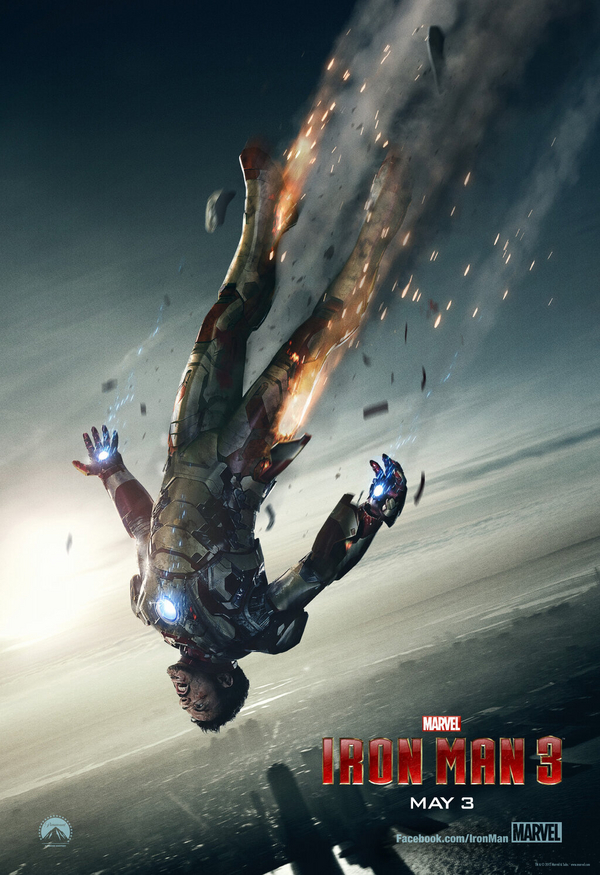
| Another incredibly accurate visual metaphor for the state of the franchise. |
Iron Man 3 was written by Drew Pearce and Shane Black. It was directed by Black, who also helmed Kiss Kiss Bang Bang.
It's the third installment in the series and the first to not be directed by John Favreau.
Black does an OK job with the material right up to his baffling, ill-advised and disappointing take on the Mandarin. I enjoyed the film up to that point, but alas, after that it lost me for good.
I will never understand why filmmakers take a well-loved property and then proceed to change or remove everything about it that made it popular. I suppose it's all part of the "This is great, but I want to leave my mark on it" attitude that I encounter on a daily basis in the graphic design field.
It's the third installment in the series and the first to not be directed by John Favreau.
Black does an OK job with the material right up to his baffling, ill-advised and disappointing take on the Mandarin. I enjoyed the film up to that point, but alas, after that it lost me for good.
I will never understand why filmmakers take a well-loved property and then proceed to change or remove everything about it that made it popular. I suppose it's all part of the "This is great, but I want to leave my mark on it" attitude that I encounter on a daily basis in the graphic design field.
The main plot of the film is based largely on the Extremis storyline that played out in the Iron Man comic book a few years ago. In the comic though, Tony Stark is injected with the Extremis compound and discovers that his armor is now part of his body. He's able to will it to the surface or something when needed. Kind of glad they didn't go that route in the film.
The end of the film seemingly wraps up Tony Stark's storyline for good and suggests this is the last installment of a trilogy. I wouldn't worry too much about it though. Once this entry grosses around a billion dollars the Disney bean counters will demand another film, regardless of how this one ended.
Speaking of dollars, the media is reporting that Iron Man 3 is currently the fifth highest grossing film of all time. So what? Movie tickets are higher than they've ever been. Of course it made a crap ton of money! And this film was in 3D to boot, which artificially pumped up the gross even more. And next year tickets will be even higher and there'll be a movie that surpasses this one. Such stats may be important to accountants, but they're meaningless in the real world.
Count the number of goddamned tickets you sell! THAT'S how you should be gauging a movie's popularity.
Something I thought was kind of funny— in the film Tony Stark fills his time by building dozens of specialized Iron Man suits. You might even say he's "collecting" them. His girlfriend Pepper Potts isn't happy with this collection and orders him to get rid of them.
As an avid action figure collector, this scenario sounds very, very familiar.
The end of the film seemingly wraps up Tony Stark's storyline for good and suggests this is the last installment of a trilogy. I wouldn't worry too much about it though. Once this entry grosses around a billion dollars the Disney bean counters will demand another film, regardless of how this one ended.
Speaking of dollars, the media is reporting that Iron Man 3 is currently the fifth highest grossing film of all time. So what? Movie tickets are higher than they've ever been. Of course it made a crap ton of money! And this film was in 3D to boot, which artificially pumped up the gross even more. And next year tickets will be even higher and there'll be a movie that surpasses this one. Such stats may be important to accountants, but they're meaningless in the real world.
Count the number of goddamned tickets you sell! THAT'S how you should be gauging a movie's popularity.
Something I thought was kind of funny— in the film Tony Stark fills his time by building dozens of specialized Iron Man suits. You might even say he's "collecting" them. His girlfriend Pepper Potts isn't happy with this collection and orders him to get rid of them.
As an avid action figure collector, this scenario sounds very, very familiar.
SPOILERS, OBVIOUSLY! INCLUDING ONE WHOPPER ABOUT THE MANDARIN!
The Plot:
After the events of The Avengers, Tony Stark is suffering from insomnia and panic attacks. He fills his free time by building a squadron of Iron Man suits with various abilities, which upsets his girlfriend Pepper Potts. Meanwhile a terrorist called the Mandarin begins attacking cities throughout the country, while the authorities are seemingly powerless to stop him. Tony challenges the Mandarin, who retaliates by destroying his home, nearly killing him and Pepper in the process.
Tony investigates and discovers the Mandarin is actually a befuddled British actor hired by Aldrich Killian, a rival scientist who has invented a regenerative treatment called Extremis. Killian kidnaps Pepper and injects her with the unstable Extremis formula, hoping to force Stark to perfect it.
Stark confronts the Mandarin with his army of Iron Man armors and eventually defeats him. He then destroys the armors to prove his devotion to Pepper and even has the shrapnel removed from his chest, eliminating the need for the arc reactor in his chest.
Pros:
• The film starts out with a flashback to 1999, when Tony Stark is attending a science conference in Bern, Switzerland. While there he's introduced to Professor Yinsen. If you recall, he was Stark's fellow captive in the first film who helped him build his very first Iron Man armor. A nice little callback.
• In the film Tony Stark is suffering from post-traumatic stress syndrome. I don't ever remember ever seeing a comic book character suffer from this condition before, so kudos I guess for showing the down side of being a super hero.
However, I'm wondering why he's suffering? He claims it's because of what happened in New York, obviously referring to the events of The Avengers movie. What happened during that film that was so traumatic? The fact that he encountered aliens? That he met a real life god? That he briefly went into space and kind of into a wormhole? All of the above?
And why weren't any of the other superheroes similarly traumatized?
Cons:
• During the 1999 Bern flashback, Tony Stark is introduced to a Chinese man named Dr. Wu. The camera lingers on him a bit longer than necessary, making one think there's a point to his introduction, but nothing ever comes of it.
In the American version, that is.

Brandt's presence is also sort of an Easter Egg: In the comics, she was romantically involved with a scientist named Ted Sallis, who became the swamp creature known as Man-Thing. Yeah, I said Man-Thing. Get yer mind outta the gutter.
• The various Iron Man armors are all very cool looking... I think. Unfortunately my eyes could only register the vaguest impressions of them as they zoomed around the screen at Mach 4, in the background, at night. I can't believe they went to the trouble of designing all those armors and then shunted them to the background (and yes, I know there are closeup photos of most of them online, but I shouldn't have to hunt for them after the film's over).
After the events of The Avengers, Tony Stark is suffering from insomnia and panic attacks. He fills his free time by building a squadron of Iron Man suits with various abilities, which upsets his girlfriend Pepper Potts. Meanwhile a terrorist called the Mandarin begins attacking cities throughout the country, while the authorities are seemingly powerless to stop him. Tony challenges the Mandarin, who retaliates by destroying his home, nearly killing him and Pepper in the process.
Tony investigates and discovers the Mandarin is actually a befuddled British actor hired by Aldrich Killian, a rival scientist who has invented a regenerative treatment called Extremis. Killian kidnaps Pepper and injects her with the unstable Extremis formula, hoping to force Stark to perfect it.
Stark confronts the Mandarin with his army of Iron Man armors and eventually defeats him. He then destroys the armors to prove his devotion to Pepper and even has the shrapnel removed from his chest, eliminating the need for the arc reactor in his chest.
Pros:
• The film starts out with a flashback to 1999, when Tony Stark is attending a science conference in Bern, Switzerland. While there he's introduced to Professor Yinsen. If you recall, he was Stark's fellow captive in the first film who helped him build his very first Iron Man armor. A nice little callback.
• In the film Tony Stark is suffering from post-traumatic stress syndrome. I don't ever remember ever seeing a comic book character suffer from this condition before, so kudos I guess for showing the down side of being a super hero.
However, I'm wondering why he's suffering? He claims it's because of what happened in New York, obviously referring to the events of The Avengers movie. What happened during that film that was so traumatic? The fact that he encountered aliens? That he met a real life god? That he briefly went into space and kind of into a wormhole? All of the above?
And why weren't any of the other superheroes similarly traumatized?
Cons:
• During the 1999 Bern flashback, Tony Stark is introduced to a Chinese man named Dr. Wu. The camera lingers on him a bit longer than necessary, making one think there's a point to his introduction, but nothing ever comes of it.
In the American version, that is.

Chinese audiences are treated to a few extra minutes of Iron Man interacting with Dr. Wu in scenes shot specifically for that country. Why? Because there are over a billion Chinese movie-goers with ticket money in their pockets, that's why. Tailoring a special version of the film to them increases the chance they'll go see it. The same thing happened last year with Looper.
I'm not particularly a fan of this practice, but there's precious little I can do about it.
• Whoops! The filmmakers forgot to put Iron Man in their Iron Man movie! They'd have been better off calling this installment Tony Stark. I bet if you added up all the time he actually appears as Iron Man it would be about ten minutes. Fifteen tops.
I'm not particularly a fan of this practice, but there's precious little I can do about it.
• Whoops! The filmmakers forgot to put Iron Man in their Iron Man movie! They'd have been better off calling this installment Tony Stark. I bet if you added up all the time he actually appears as Iron Man it would be about ten minutes. Fifteen tops.
 |
Just one of the thrilling scenes from Iron Man 3. Watch as Iron Man battles the Deadly Barcalounger!
|
The same thing happened in the The Dark Knight Rises movie— Batman barely appeared in his own film. This is a trend I hope suffers a quick death. This is a superhero movie after all. That means I wanna see some superheroes! If I want to see normal people sitting around in their street clothes talking about their feelings I'll go watch something starring Meryl Streep.
• This is the third time Tony Stark has somehow humiliated a rival scientist who's gone on to become a super villain who attacks him. At least Killian wasn't yet another foe in an armored suit, as we've seen in the previous two films.
Just once I'd like to see a villain who's a plain old evil bastard and doesn't have some deep-seated psychological reason for hating and attacking the hero.
 • One of the Extremis agents who attacks Tony Stark is a war veteran named Ellen Brandt, who has a prominent scar on one side of her face. In a flashback sequence we see that she lost an arm due to a war injury. She's injected with the Extremis formula which magically regrows her missing limb in a matter of seconds. Curiously though her facial scar remains unchanged. So for the record: Extremis can regrow a goddamned arm but can't erase a scar. Got it.
Just once I'd like to see a villain who's a plain old evil bastard and doesn't have some deep-seated psychological reason for hating and attacking the hero.

Brandt's presence is also sort of an Easter Egg: In the comics, she was romantically involved with a scientist named Ted Sallis, who became the swamp creature known as Man-Thing. Yeah, I said Man-Thing. Get yer mind outta the gutter.
• I'm confused. In the previous films I was under the impression that in addition to keeping Tony Stark alive, the arc reactor in his chest also powered his armor. But here he's got an entire squadron of suits that can act autonomously. Obviously the suits no longer need him to power them (if they ever did). When did all this change? Between The Avengers and now? Or has it always been this way and I got the "what powers the suit" thing wrong?
• Just how rich is Tony Stark? In the film Tony suffers from insomnia and has been spending his nights tinkering together various new armors. The latest, and the one he wears most during the movie, is the Mark 42.
He wore the Mark 7 armor when we last saw him in The Avengers, so he's made 35 new armors since then. Let's be conservative and say each of these suits, with all their sophisticated electronics and advanced materials, costs $50 million. That means his little hobby cost him at least $1,750,000,000. Pretty darn close to $2 billion dollars. Now THAT'S an expensive hobby!
Did he use his own money for these armors or charge it to Stark Enterprises?
• Tony Stark really is a mechanical genius. Not only can he wear the Mark 42 like a suit of armor, it also contains mechanisms that allow it to move independently when he's not inside it (like a robot). As if that wasn't enough, each individual piece also contains a propulsion system so it can fly through the air to his present location (often hundreds of miles away!) and assemble itself in the proper place on his body. Best of all the suit still fits him like a glove! Now that's some impressive engineering!
• Tony publicly challenges the Mandarin to a fight, giving out his home address in a TV news interview. The Mandarin accepts his challenge and bombs his home to smithereens, almost killing Tony and Pepper Potts.
Many fans have called out the stupidity of revealing your address to your archenemy. Eh, that didn't bother me. It's not like Tony's home was hidden by some kind of stealth technology— it was a pretty distinctive-looking structure located right out in the open on the ocean front. Not to mention he's a world famous public figure whose secret identity is well known. The Mandarin could have found the address with about thirty seconds of Googling.
Besides, I think the fans are missing the point— the Mandarin wasn't sitting around waiting for someone to tell him the address before he attacked. He attacked because Stark challenged him. That was the stupid part.
 • At one point in the film the Mandarin sets off a bomb in Air Force One. Several passengers are sucked out of the plane before it explodes. Iron Man flies out of the doomed plane to rescue them. Jarvis tells him there are thirteen people falling, but that he can only carry four.

Of course Iron Man, hero that he is, refuses to let the laws of physics boss him around! He begins plucking the falling victims out of the sky one by one. When he can carry no more, he instructs the ones he's holding to grab the hands of the other plummeting civilians. Eventually he's holding a daisy chain of all thirteen survivors and lowers them safely into the ocean.
It's a well done, nail-biting sequence full of action and suspense. Too bad it doesn't make a lick of sense though. The screenwriter seems to believe that Iron Man can carry an indefinite number of people as long as they're not directly touching him. He's told he can only carry four, so he grabs a couple and then lets them hold onto the rest. That doesn't make any difference!
If he can only carry four people, then he can't suddenly support nine more just because they're not physically touching him. Even if the other nine are being held by the civilians, they're still indirectly attached to him and are weighing him down.
It's like they're saying Iron Man can't hold a semi truck over his head, but he can hold a person holding a semi truck over his head. It just don't add up!
• And then we come to the character of the Mandarin, undoubtably the most divisive part of the film.
For many months before the film premiered the trailers introduced the Mandarin as a dangerous terrorist of vague ethnic origin with an odd, pseudo-Southern drawl. The trailers showed us that he was the one foe who could actually destroy Iron Man.
The first half of the film backed up these assumptions, depicting the Mandarin as a calculating and ruthless force to be reckoned with, who attacked with impunity and was seemingly untouchable.
Then halfway through the movie the plot does a 180º turn (you can almost hear the tires squealing) as we find out the Mandarin is all part of a big lie. He's nothing but an illusion. A front performed by a British actor who's simply playing a part. He's a distraction to draw attention away from Aldrich Killian, who is in reality the real Mandarin.
I must admit that this plot twist was definitely a surprise. Unfortunately it wasn't a pleasant one.
Director Shane Black tried to justify his decision with a lot of politically correct bushwah. In the comic book the Mandarin is, not surprisingly, a Chinese warlord who wields super-powered magic rings. Black stated that such a character was an unfortunate and outdated Fu Manchu stereotype and just would not fly in today's more enlightened world, so something had to be done.
To that end he decided to change the Mandarin from a Chinese super villain to a terrorist with no super powers who likes to surround himself with Chinese motifs and trappings.
Oy gevalt.
So let me see if I have this straight: If the Mandarin is Chinese that's offensive, but a British man who looks vaguely Arabic posing as the Mandarin while a white man hides behind the scenes and is the actual villain is somehow OK. I must be missing a very subtle point of logic here.
The worst part about it is they took Iron Man's only real nemesis and absolutely wasted him. Wasted, I tell you. Iron Man doesn't have much of a rogue's gallery to start with, as most of his foes are just people wearing armored suits similar to his. The Mandarin, politically correct or not, was the most interesting of his villains. And now they've ruined him for good.
Don't believe me? Think of it this way: Imagine you're watching The Dark Knight movie. You're enjoying Heath Ledger's brilliant performance as the Joker, then halfway through the film you find out he's really an out of work actor, while a normal looking man, sans makeup, is pulling the strings from behind the scenes as the real Joker. What would you do? You'd start a riot in the theater, that's what. Just like I wanted to do during this film.
Surely there was some way to make the comic book version of the Mandarin work, even in our hyper-sensitive, easily offended politically correct excuse for a society. If this ersatz version was the best they could do then it would have been better if they'd dropped the character completely and concentrated on Killian as the villain. I'd have enjoyed the film much more had they done so.
 • Pitting the real Mandarin against Iron Man could have been something truly epic. In the comic, the Mandarin wears ten magic rings on his fingers. Each of the rings has a different power; one shoots fire, one fires a disintegration beam, one controls minds, etc. Imagine a battle between that version of the Mandarin and Iron Man! Magic versus Technology in a fight to the death!
Instead we got a fight with a villain who can, um... raise his body temperature and melt stuff and regrow arms and sort of breathe fire or something. It was all kind of vague.
There's no reason we couldn't have had a Mandarin with magic rings. They've already established that there's magic in the Marvel Cinematic Universe with Thor and Loki, so it wouldn't have been too jarring a concept.
Somewhere in a parallel universe there's a much better version of Iron Man 3 featuring a proper magic-powered Mandarin.
• Does the whole "Villain who's really a front for someone worse who's wielding the real power from behind the scenes" plot sound familiar? It should. The exact same thing happened in this summer's Star Trek Into Darkness. In that film Khan appears to be the villain, but he's secretly being manipulated by the evil Admiral Marcus.Great minds Bad screenwriters think alike, I suppose.
• In addition to botching the Mandarin, Iron Man 3 opens an industrial sized can of worms in regards to Tony's suit technology. In the film Tony rigs up a way to remotely control his armor. Now he can his send his suit into battle while he stays safely home on the couch. In fact he's remotely controlling his suit during the whole "mid-air rescue" scene mentioned earlier.
There's now no logical reason for him to ever leave his house to do battle from this point on. It's gonna be tough to write any suspenseful scenes or place him into danger in any future films.

 |
Not to be outdone, the Mandarin also poses on furniture. Thrilling!
|
For many months before the film premiered the trailers introduced the Mandarin as a dangerous terrorist of vague ethnic origin with an odd, pseudo-Southern drawl. The trailers showed us that he was the one foe who could actually destroy Iron Man.
The first half of the film backed up these assumptions, depicting the Mandarin as a calculating and ruthless force to be reckoned with, who attacked with impunity and was seemingly untouchable.
Then halfway through the movie the plot does a 180º turn (you can almost hear the tires squealing) as we find out the Mandarin is all part of a big lie. He's nothing but an illusion. A front performed by a British actor who's simply playing a part. He's a distraction to draw attention away from Aldrich Killian, who is in reality the real Mandarin.
I must admit that this plot twist was definitely a surprise. Unfortunately it wasn't a pleasant one.
Director Shane Black tried to justify his decision with a lot of politically correct bushwah. In the comic book the Mandarin is, not surprisingly, a Chinese warlord who wields super-powered magic rings. Black stated that such a character was an unfortunate and outdated Fu Manchu stereotype and just would not fly in today's more enlightened world, so something had to be done.
To that end he decided to change the Mandarin from a Chinese super villain to a terrorist with no super powers who likes to surround himself with Chinese motifs and trappings.
Oy gevalt.
So let me see if I have this straight: If the Mandarin is Chinese that's offensive, but a British man who looks vaguely Arabic posing as the Mandarin while a white man hides behind the scenes and is the actual villain is somehow OK. I must be missing a very subtle point of logic here.
The worst part about it is they took Iron Man's only real nemesis and absolutely wasted him. Wasted, I tell you. Iron Man doesn't have much of a rogue's gallery to start with, as most of his foes are just people wearing armored suits similar to his. The Mandarin, politically correct or not, was the most interesting of his villains. And now they've ruined him for good.
Don't believe me? Think of it this way: Imagine you're watching The Dark Knight movie. You're enjoying Heath Ledger's brilliant performance as the Joker, then halfway through the film you find out he's really an out of work actor, while a normal looking man, sans makeup, is pulling the strings from behind the scenes as the real Joker. What would you do? You'd start a riot in the theater, that's what. Just like I wanted to do during this film.
Surely there was some way to make the comic book version of the Mandarin work, even in our hyper-sensitive, easily offended politically correct excuse for a society. If this ersatz version was the best they could do then it would have been better if they'd dropped the character completely and concentrated on Killian as the villain. I'd have enjoyed the film much more had they done so.

Instead we got a fight with a villain who can, um... raise his body temperature and melt stuff and regrow arms and sort of breathe fire or something. It was all kind of vague.
There's no reason we couldn't have had a Mandarin with magic rings. They've already established that there's magic in the Marvel Cinematic Universe with Thor and Loki, so it wouldn't have been too jarring a concept.
Somewhere in a parallel universe there's a much better version of Iron Man 3 featuring a proper magic-powered Mandarin.
• Does the whole "Villain who's really a front for someone worse who's wielding the real power from behind the scenes" plot sound familiar? It should. The exact same thing happened in this summer's Star Trek Into Darkness. In that film Khan appears to be the villain, but he's secretly being manipulated by the evil Admiral Marcus.
• In addition to botching the Mandarin, Iron Man 3 opens an industrial sized can of worms in regards to Tony's suit technology. In the film Tony rigs up a way to remotely control his armor. Now he can his send his suit into battle while he stays safely home on the couch. In fact he's remotely controlling his suit during the whole "mid-air rescue" scene mentioned earlier.
There's now no logical reason for him to ever leave his house to do battle from this point on. It's gonna be tough to write any suspenseful scenes or place him into danger in any future films.

• I very much enjoyed the scene in which the squadron of various Iron Man armors flew to the rescue. I can only imagine how much more I'd have enjoyed it if I hadn't watched the scene in the trailer every week for six months prior to the premiere. Why would they do that? Think how much more awesome that sequence would have been if was a total surprise.
• The various Iron Man armors are all very cool looking... I think. Unfortunately my eyes could only register the vaguest impressions of them as they zoomed around the screen at Mach 4, in the background, at night. I can't believe they went to the trouble of designing all those armors and then shunted them to the background (and yes, I know there are closeup photos of most of them online, but I shouldn't have to hunt for them after the film's over).
• Like all Marvel movies, this one has a post credits scene. Unfortunately, this one's pretty lame. At the end we see Tony Stark has been telling the whole story of the film to a dozing Bruce Banner, aka the Hulk. Note to the filmmakers— it's probably not a good idea to show characters falling asleep in response to your story, even as a joke.
Not as good as the second movie, and miles away from the near-perfect first one. I would give it a B, but the botched Mandarin plot twist just pissed me off so much I couldn't enjoy it after that. I hate to do it, but I've got to give it a C+.


