Saturday, June 15, 2013

Out Of Context Family Affair Moment

So a couple days ago I'm watching the first season of Family Affair and this happened:

Whaddya think? Too easy?

HAW, HAW! Making fun of the past and the way language changes over time is hilarious!

Under WHERE?

For good or ill, the new Superman er, Man Of Steel movie opened today. It definitely looks good, but there are several things in the trailer that are raising red flags in my mind. I'm trying my best to not let my hopes get too awfully high for any movie, lest they be dashed on the rocks again (I'm lookin' at you, Iron Man 3 and Star Trek Into Darkness).

One thing I already absolutely, positively can't stand before I even see a frame of the film is the disturbing new Superman costume.

I hate everything about it. The dirty, dingy colors, the weird Art Deco flourishes, the arrows pointing toward his ample package (as if we could miss it!) and the scaly reptilian texture covering every inch of it. The whole thing is just downright ugly and very off-putting.

The worst part about though it is the lack of Superman's iconic red underpants. I don't know whose boneheaded idea it was to get rid of them, but they need a good firin,' and fast. Yes, I know that the "no underwear look" is how he currently appears in the comics, but that doesn't make it right. 

No matter how good the movie may turn out to be, I'm never going to be able to get over his lack of drawers. He looks positively naked without them. Something about the solid blue suit makes me very uncomfortable, like I should avert my eyes. "Hey Superman! Go put some damn pants on! There's kids over here!"

So to remedy this dire situation, I'm thinking of starting up a new Kickstarter project. I want to design some kind of computer app that will automatically superimpose a pair of red underwear over Superman's body, wherever he appears. Theaters, TV, DVD, cereal boxes, print, you name it. If you can see him, my new app will cover up his nether regions. 

Never again will you feel uncomfortable watching Superman parade around half nude in a disturbing scaly suit. With my new app you'll see him the way he was meant to be.

I figure the results of the app will look something like this. See? That's better already!

Now all I need is several hundred thousand bucks, someone who knows programming inside and out and a couple of theoretical scientists who can figure out how to project the image of a pair of red underwear over any piece of Superman merchandise that anyone anywhere happens to be looking at, worldwide, any time of the day or night. Sounds pretty simple to me.

Who's with me? Together we can change Superman back to the way he was meant to be! Fully clothed!

Friday, June 14, 2013

Family Circumspect


Take a look at this recent Family Circus comic. When I was a kid and I'd see these drawings I really did think that Bil Keane's son Billy actually filled in and drew his comic for a week. 

Nothing could be further from the truth.

Lie #1: Bil Keane allegedly based the strip on the antics of his family, but he never had a son named Billy. He did have a son named Jeff who was the inspiration for the Jeffy character in the comic. The Mommy character was based on Keane's real-life wife Thel. 

Lie #2: Even if there was a little Billy, the strip started in 1960 so he'd be close to 60 by now, and would hopefully be able to draw a little better than this.

Lie #3: Bil Keane died in 2011. His son Jeff is now writing and drawing the strip.

As I said, this entire scenario is nothing but a filthy pack of lies!

DVD Covers In Which One Or More Of The Characters Appears To Be Pregnant, But Isn't

I'm starting a new feature here on Bob Canada's BlogWorld-- It's called DVD Covers In Which One Or More Of The Characters Appears To Be Pregnant, But Isn't. I think it's really gonna take off!

Up first is the 2012 made-for-cable movie Strawberry Summer. I'm pretty sure that's not Shelly Long there on the right, so I have to assume it's Julie Mond, a name I don't recognize. If you give this cover a sideways glance it looks like she's at least eleven months pregnant, until you realize it's just an awkwardly placed guitar. 

What's that? Hold on... I'm being told that the normal human gestation period is only nine months. OK fine, she looks like she's at least nine months pregnant. You're sure it's only nine? There's never been some world record where they went for eleven? No? That would be something though, wouldn't it?

Hold on a second-- I'm on the Google right now and it seems that in 1945 there was a case in which a human woman gave birth after 375 days. That's over twelve months! So suck on that, Mr. Editor!

Next up is the 2004 horror movie Taxi, starring Queen Latifah and Jimmy Fallon. Sadly, I recognize both those names. What's that? Now I'm being told that this isn't a horror movie. With a cast like that you could've fooled me!

Here both characters appear to be at least nine months pregnant (especially Mr. Fallon), but it turns out it's just the unfortunate placement of the car behind them.

I seriously thought Fallon was pregnant in the film for the first thirty or forty times I saw this cover. Let me tell you, that idea severely distorted my idea of what the movie was about. One day I finally realized what I was actually seeing on the cover and it all made more sense. It still wasn't enough to get me to watch it though.

Next is... well, that's about it for now. I kind of thought there'd be more DVD Covers In Which One Or More Of The Characters Appears To Be Pregnant, But Isn't. Maybe this wasn't such a good idea for a new feature after all. Let's forget the whole thing. Sorry I wasted everyone's time. Please go back to diddling with your phones.

Wednesday, June 12, 2013

Extreme Christmas Creep

I went to Hobby Lobby yesterday to stock up on quiltin' supplies (soon to replace Speed Stacking and X-Treme Puzzling as America's favorite pass time) and while there I noticed they were selling Christmas decorations.*

Christmas decorations. In June.

They didn't yet have an entire corner of the store devoted to Christmas as they usually do; for now it was just one small display of decorations that look like giant lollys or candy canes. Doesn't matter how small the display was, it's still too damned soon. Putting Christmas crap out any earlier than the second week in December is too early if you ask me.

Mark my words: If this Christmas Creep isn't stopped and soon, stores are gonna keep putting their holiday crap out earlier and earlier until we finally loop back around to December and we'll be buying our Christmas 2014 stuff during Christmas 2013.

*Sorry for the lack of photographic proof, but unlike the other 99.9% of the population I don't constantly carry a combination phone, camera, communication and multimedia system with me at all times.

Tuesday, June 11, 2013

This Is Why Your MuuMuu Doesn't Fit: Krispy Kreme Sloppy Joe

This week in Horrifying Food News: it's the release of the Krispy Kreme Sloppy Joe.

The appalling sandwich consists of a glazed Krispy Kreme donut that's split in half, slathered with sloppy joe, drowned in a tomato-based sauce and topped with cheddar cheese.

Oddly enough, Krispy Kreme officials were adamant in pointing out that they had nothing whatsoever to do with the ghastly concoction. It's the brainchild of Chicken Charlie's, a purveyor of deep-fried, tallow-based novelty foods at the San Diego County fair. They seem to specialize in ruining other companies' products, as their menu includes Deep-Fried Twinkies, Deep-Fried Oreos, Bacon-Wrapped Pickles and Fried Kool-Aid.

The company's Facebook page has this to say about the pants-splitting new sandwich: "Your stomach will thank you!" If by "thank you" they mean "shut down and refuse to function again," then I would have to agree. Just looking at that thing makes me feel like I need to go for a brisk walk.

Frankly I'm at a loss to understand why Krispy Kreme isn't putting the kibosh on this thing. They say there's no such thing as bad publicity, but what about when their product's being used in a way that makes me never want to eat anything ever again?

I can practically feel the North American continent growing heavier as we speak.

Sunday, June 9, 2013

It Came From The Cineplex: After Earth

After Earth is the latest from king of the sci-fi summer blockbusters Will Smith and director M. Night Shyamalan.

Smith gets a "story by" credit in the film. Impressed? Well, don't be. His contribution consisted of seeing an episode of the TV series I Shouldn't Be Alive (in which a father and son crashed their car in a remote area and the son had to walk a hundred miles to find help), and commissioning a script based on the episode. So he basically got a writing credit for lying on the couch and watching TV.

Come to think of it, a film based on that original car crash premise might have more interesting than what we got.

Many are saying that the film is nothing more than a vanity project for Smith, designed to jump start his son's acting career. I have no doubt that's true. But so what? Non-actors do this all the time and no one cares. If a plumber brings his son into the business, no one looks at the kid and says, "You only got this job because of your old man." So why is it bad when actors do the same with their kids?

That said, I think it should only be done when the kid shows some true talent, which is most definitely not the case here. I feel like a heel for picking on a kid, but Jaden Smith doesn't have even a fraction of the talent or easy-going charm his father had at his age.

I had absolutely no idea this was an M. Night Shyamalan movie until I saw the opening credits. I'm positive this was a deliberate move by the Columbia Pictures marketing department. Shyamalan hasn't exactly been pumping out the blockbusters lately, so they apparently wanted to keep his involvment on the QT, lest his presence chase away potential ticket buyers. 

Actually Mr. Shyamalan probably deserves some kind of award. Not every director can take a magnetic and charismatic actor like Will Smith and turn him into a soulless, unemotional automaton like he is in this film. Congratulations, M. Night!

Some of the philosophy and pop psychology spouted by Will Smith's character sounds a lot like Scientology, which isn't really a surprise. At least no one in the film was named Xenu.

Lastly, Will Smith was hopeful this film would be the first leg of a trilogy. Based on its poor performance at the box office, that seems unlikely.

SPOILERS AHEAD!

The Plot:
After permanently befouling the Earth, humanity leaves and settles on a new planet called Nova Prime. One thousand years later, aliens called Skrels attack the new colony with specially bred monsters (called Ursas) that can smell fear. A ranger named Cypher Raige (Will Smith) discovers the only way to beat them is to not feel fear, rendering yourself invisible to the monsters. This technique is called "ghosting."

Cypher's son Kitai (Jaden Smith) desperately seeks his father's approval and wants to become a ranger like him. The two take a trip on a spaceship as a bonding experience, but the ship crashes on the most dangerous planet in the galaxy: Earth.

With Cypher seriously injured with two broken legs, Kitai must travel through several hundred miles of dangerous wilderness, locate the tail section of the ship and activate the rescue beacon, all while avoiding the deadly prowling Ursa or both men will die.
 
Pros:
• Kudos to the filmmakers for setting the story a thousand years from now (give or take). It always bugs me when a sci-fi movie features warp drive and other super advanced technology and then takes place in the far-off year of 2030.

That said, according to the official back story, humans were forced to leave the poisoned Earth in 2071. Sigh...

• Everyone in the film speaks with a weird faux Southern accent, which is an odd choice on the part of the filmmakers. On the other hand people living on another planet a thousand years from now probably would speak differently than we're used to.

Cons:
• Everyone in this movie acts in a very stiff, stilted and stylized manner, almost like they've all been sedated. Was this a conscious choice? Again, people a thousand years from now would likely act quite differently than we do. Is it possible they did this on purpose to create a futuristic feel? If so I applaud the effort, even if it did fail miserably.

• Will Smith's character is named "Cypher Raige." Yow. Who came up with that name, George Lucas?

Shyamalan needs to look up the word "cypher" in the dictionary. It means "a person or thing of no importance; nonentity." That's actually pretty apt considering Smith's emotional range in this film.

Cypher is supposed to be a battle-hardened military officer who's emotionally distant with his son. I get that. But it's taken to ridiculous, sometimes hilarious, extremes. His success at killing Ursas is due to his not being able to feel fear. Apparently he divested himself of all other emotions while he was at it.

• If you're going to populate your film with basically two characters then you'd better make damn sure they're interesting. These two aren't. 

Kitai's late sister, who we glimpse briefly in flashback, is ten times more interesting than either main character.

• During the space trip, Cypher feels something's not quite right with the ship. He takes off his wedding ring and holds it against the inner hull of the ship, where it somehow amplifies vibrations from outside. Cypher interprets these vibrations as an oncoming space storm. Nope!

Space is called that for a reason. There ain't nothing in it. Vibrations need air or land or something to travel through.

• We're told that Earth is the most dangerous planet in the galaxy because everything there has evolved to specifically kill man. Um... humans left the planet a thousand years ago. Why would animals evolve to kill prey that no longer exists? 

Now if they want to say all the animals have evolved to the point in which they just happen to be deadly to man, that would be OK. But implying that they're revenge-evolving is just silly.

I was a bit underwhelmed by Earth's so-called "danger." We're beaten about the head with the fact that Earth is such a treacherous place you'd likely die a minute after stepping foot on open ground. Yet a gawky fourteen year old walks a hundred miles or so and survives.

I was expecting Kitai's trek to be a lot more dangerous. Instead it was just kind of... dull. We get just a light sprinkling of mutated animals every now and then that don't seem all that hard to avoid or defeat.

Dullness is a problem with most "quest" movies like this. The character has to get from Point A to Point B, so you know there'll be a lot of dangerous but easily beatable obstacles thrown in his way to pad out the run time, until we get to the inevitable Level Boss. Which is exactly what happens here.

I suppose if it had been more dangerous then it would have been too unrealistic to believe a kid like Kitai could survive the trip.

• One example of Earth's abundant dangers: The temperature drops to deadly levels every night, with the exception of a few conveniently located "hot spots."

Everywhere Kitai travels he's surrounded by abundant verdant green foliage. Wouldn't such freezing temperatures kill the plant life? Yes, they show the leaves folding up as the temperature drops, but… it all seemed a bit sketchy.

Oddly enough, all the newly evolved animal species seem vulnerable to the cold as well. Several times we see animals instinctively heading for hot spots as the temperature drops. So they've evolved to kill humans who aren't even on the planet anymore, but they haven't evolved a resistance to the variable temperatures. Got it. 
 
• At one point Kitai is stung by a venomous leech (!). His father calmly and dispassionately (how else?) instructs him to inject himself with an antidote or he'll die. I could swear he says the cure comes in three parts, but we only see Kitai administer two.


I will admit it's possible I'm wrong on this; I'd need to see the film again to make sure, and that ain't happenin.'

• It's the After Earth drinking game! Take a shot every time Cypher Raige says, "Take a knee!"

• One of the many features of the magic survival suit Kitai wears: It changes color when it senses danger. It's never explained if the suit is somehow sensing danger (like Peter Parker and his spider-sense) or if it's sensing the emotional state of the wearer. Unfortunately it seems to work at random, only when the screenwriters remember it. 

Even when it does work it acts strangely. At one point some mutated baboons attack Kitai and the suit turns black. Why black? Who knows? He's in the middle of a green jungle. The black suit actually makes him more visible. Maybe it's just a warning to the wearer and not camouflage? Later on when he's freezing it turns white, which makes a bit more sense.

Eventually Kitai comes to a cliff and discovers he can't make it to the tail section because he doesn't have enough of the magic lung juice that allows him to breathe Earth's tainted air. Back in the ship, Cypher's computer shows him that if Kitai flies to the tail section he'll make it. He sighs and tells him to come back. 

That seems a bit out of character for an old war horse who's survived dozens of campaigns. Yes, the flying thing is dangerous and Kitai could die trying it, but they're both going to die anyway if he aborts the mission. Why not have the kid give it a shot?

Kitai refuses his father's order and rages against him for not being around as he grew up. Hey kid, it's not like your dad went out to get a pack of smokes and never came back-- he was protecting your world and your selfish little ass from aliens! Credit where credit's due-- Jaden Smith actually does a decent job of acting in this scene. I said in this scene!

Anyway, Kitai defies his father and flings himself off the cliff and his magic suit instantly sprouts a pair of wings, like those of a flying squirrel. At no point did Cypher ever tell him flying was an option. So did Kitai know he could fly? Or was he just petulantly throwing himself off the cliff out of spite and lucked out because he was wearing a flying suit?

While flying (or I guess gliding), Kitai attracts the attention of some giant eagle thing which attacks him. He wakes up in its nest, which is full of baby eagle things. I'm pretty sure the mama brought him there as food for her youngins. Suddenly the nest is attacked by a pack of mutated tigers. Kitai fights them off but all the babies are killed. He escapes the nest in the confusion and continues on foot as the eagle thing follows him from the air. 

That night the temperature plunges as he remembers he was supposed to look for a hot spot. He passes into blissful oblivion as he begins to freeze to death. Then he wakes up the next morning to find that the eagle thing dragged him into a hole and sacrificed itself by lying on top of him to keep him warm. Huh?

I don't understand why it saved him when a few hours earlier it was trying to feed him to its kids. My movie-going pal KW Monster suggested the eagle thing took a liking to Kitai because it thought he was another bird (what with the wings and the flying and the soaring). I guess that's as good an explanation as any in a movie like this, but... it still doesn't make a lot of sense to me.

• The alien Skrels deliberately designed the Ursas so they're blind and can only sense their prey "by fear." Wouldn't eyes and a heightened sense of smell work just as well, if not better? If the filmmakers wanted the Ursas to have strange alien senses, how about giving them eyes that see infra-red?

And how do Ursas navigate when they're not smelling fear? How do they avoid walking into walls or off cliffs?

• Kitai finally reaches the tail section and finds the emergency beacon. It won't work though (man, all the technology in this movie seems very glitchy and prone to malfunction) because of something in the air that's blocking the signal. Never mind that this thing can send out what appears to be a powerful visible Death Star-like beam, it can't poke through a few clouds. 

So Kitai climbs up the side of a volcano to reach higher ground. An active volcano mind you, one that features flowing rivers of lava. Seems like the intense heat ougtta affect him, maybe even kill him, but no. He doesn't even break a sweat. Must be his magic suit protecting him from the heat. Shouldn't it have turned red or something?

After Earth is by no means a good movie, but despite its many problems I couldn't bring myself to hate it. It's like some clumsy kid with no athletic talent who's trying to make the basketball team-- you just feel kind of sorry for it. With a competent director and a better child star it might have actually been good. I give it a B-.

Saturday, June 8, 2013

Out Of Context Family Affair Moment

So the other day I'm watching Family Affair and I see this scene.

This entire teaser sequence is an absolute goldmine of bone-headed awesomeness.

First of all, take a close look at the incredibly realistic New York skyline in the background (complete with what appears to be brush strokes in the "sky" on the left hand side). I have a feeling those buildings didn't look real even on 1960s era televisions with their 250 scan lines. It also looks suspiciously identical to the skyline outside Uncle Bill's luxury Manhattan apartment.

And where's the horizon? No matter how high up you go you can still see the horizon line, especially with the camera pointing down as it is. The only explanation is that Uncle Bill's constructing a five thousand foot tall building and the curvature of the earth is hiding the horizon..

In the teaser the man in the blue shirt climbs all the way to the top of the building to deliver an important message to Uncle Bill. No convenient cell phones or even walkie-talkies back in 1967!

Uncle Bill can't hear the messenger over the din of the riveters in the background, so he throws his pen at them to get their attention and tell them to knock it off. His pen hits one of the men in the head and bounces off into the void, where I'm sure it couldn't possibly have shattered a windshield or embedded itself into someone's skull several thousand feet below.

Once it's quiet, Blue Shirt delivers his important message: It seems that Uncle Bill's niece Buffy has "torn her tutu." Blue Shirt seems genuinely concerned by this dire news and asks if that's "real bad." Uncle Bill chuckles at his underling's naivete. He tells him that a tutu is a short skirt girls wear in the ballet. Blue Shirt then gives him the uncomprehending look you see above. You can practically see the computer tape reels spinning fitfully inside his meaty head as he desperately searches his inadequate memory banks. 

Yes folks, Blue Shirt here has never before encountered the word "ballet." Never gone to one, sure. Couldn't name the title of one, who could? But to not even know what the word means? Apparently Uncle Bill found out he could get government grant money if he hired the "differently abled" on his construction crew.

The message delivered, Blue Shirt climbs the thousands of feet back to the ground and Uncle Bill and the riveters return to work. 

Apparently they didn't have OSHA back in the 1960s. Take a closer look at this amazing scene. The riveters in the background are both squatting on a sheet of plywood that stradles two girders with nothing between them and the ground but several thousand feet of empty space.

Not to be outdone, Uncle Bill laughs in the face of death as well. Look where he's standing. He's on some kind of makeshift platform made from several planks. With that table in front of him he's got about six inches of space in which to stand. If his mind wanders for a second and he takes even one step backward, Mr. French is gonna be raising the kids alone.

And how the hell are those blueprints lying flat instead of being blown to New Jersey by the strong high-altitude winds?

I told you it's the most awesome teaser in the history of television!

Wednesday, June 5, 2013

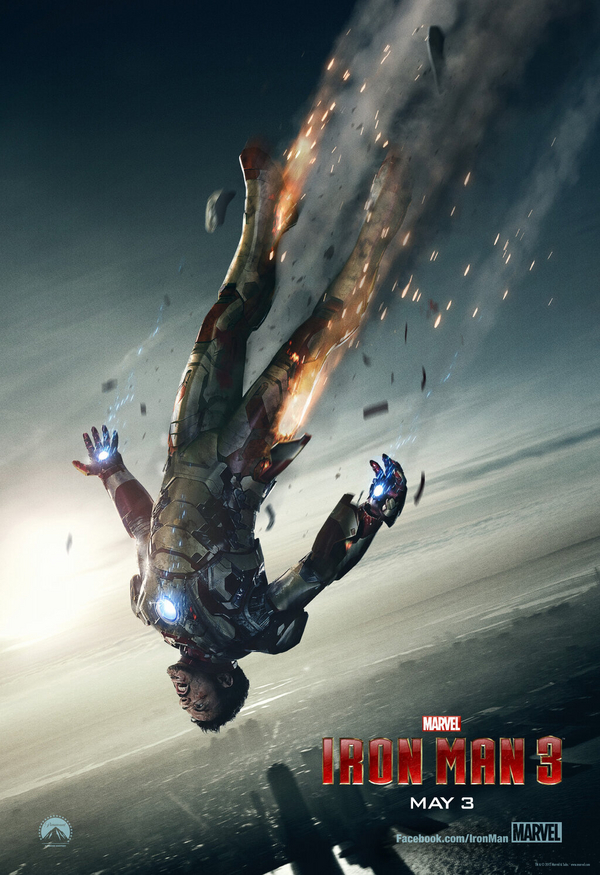
It Came From The Cineplex: Iron Man 3

Another incredibly accurate visual metaphor for the state of the franchise.
Iron Man 3 was written by Drew Pearce and Shane Black. It was directed by Black, who also helmed Kiss Kiss Bang Bang.

It's the third installment in the series and the first to not be directed by John Favreau.

Black does an OK job with the material right up to his baffling, ill-advised and disappointing take on the Mandarin. I enjoyed the film up to that point, but alas, after that it lost me for good.

I will never understand why filmmakers take a well-loved property and then proceed to change or remove everything about it that made it popular. I suppose it's all part of the "This is great, but I want to leave my mark on it" attitude that I encounter on a daily basis in the graphic design field.
 
The main plot of the film is based largely on the Extremis storyline that played out in the Iron Man comic book a few years ago. In the comic though, Tony Stark is injected with the Extremis compound and discovers that his armor is now part of his body. He's able to will it to the surface or something when needed. Kind of glad they didn't go that route in the film.

The end of the film seemingly wraps up Tony Stark's storyline for good and suggests this is the last installment of a trilogy. I wouldn't worry too much about it though. Once this entry grosses around a billion dollars the Disney bean counters will demand another film, regardless of how this one ended.

Speaking of dollars, the media is reporting that Iron Man 3 is currently the fifth highest grossing film of all time. So what? Movie tickets are higher than they've ever been. Of course it made a crap ton of money! And this film was in 3D to boot, which artificially pumped up the gross even more. And next year tickets will be even higher and there'll be a movie that surpasses this one. Such stats may be important to accountants, but they're meaningless in the real world.

Count the number of goddamned tickets you sell! THAT'S how you should be gauging a movie's popularity.

Something I thought was kind of funny— in the film Tony Stark fills his time by building dozens of specialized Iron Man suits. You might even say he's "collecting" them. His girlfriend Pepper Potts isn't happy with this collection and orders him to get rid of them.

As an avid action figure collector, this scenario sounds very, very familiar.
 
SPOILERS, OBVIOUSLY! INCLUDING ONE WHOPPER ABOUT THE MANDARIN!
 
The Plot:
After the events of The Avengers, Tony Stark is suffering from insomnia and panic attacks. He fills his free time by building a squadron of Iron Man suits with various abilities, which upsets his girlfriend Pepper Potts. Meanwhile a terrorist called the Mandarin begins attacking cities throughout the country, while the authorities are seemingly powerless to stop him. Tony challenges the Mandarin, who retaliates by destroying his home, nearly killing him and Pepper in the process.

Tony investigates and discovers the Mandarin is actually a befuddled British actor hired by Aldrich Killian, a rival scientist who has invented a regenerative treatment called Extremis. Killian kidnaps Pepper and injects her with the unstable Extremis formula, hoping to force Stark to perfect it.

Stark confronts the Mandarin with his army of Iron Man armors and eventually defeats him. He then destroys the armors to prove his devotion to Pepper and even has the shrapnel removed from his chest, eliminating the need for the arc reactor in his chest.

Pros:
• The film starts out with a flashback to 1999, when Tony Stark is attending a science conference in Bern, Switzerland. While there he's introduced to Professor Yinsen. If you recall, he was Stark's fellow captive in the first film who helped him build his very first Iron Man armor. A nice little callback.

• In the film Tony Stark is suffering from post-traumatic stress syndrome. I don't ever remember ever seeing a comic book character suffer from this condition before, so kudos I guess for showing the down side of being a super hero.

However, I'm wondering why he's suffering? He claims it's because of what happened in New York, obviously referring to the events of The Avengers movie. What happened during that film that was so traumatic? The fact that he encountered aliens? That he met a real life god? That he briefly went into space and kind of into a wormhole? All of the above?

And why weren't any of the other superheroes similarly traumatized?

Cons:
• During the 1999 Bern flashback, Tony Stark is introduced to a Chinese man named Dr. Wu. The camera lingers on him a bit longer than necessary, making one think there's a point to his introduction, but nothing ever comes of it.

In the American version, that is.


Chinese audiences are treated to a few extra minutes of Iron Man interacting with Dr. Wu in scenes shot specifically for that country. Why? Because there are over a billion Chinese movie-goers with ticket money in their pockets, that's why. Tailoring a special version of the film to them increases the chance they'll go see it. The same thing happened last year with Looper.

I'm not particularly a fan of this practice, but there's precious little I can do about it.

• Whoops! The filmmakers forgot to put Iron Man in their Iron Man movie! They'd have been better off calling this installment Tony Stark. I bet if you added up all the time he actually appears as Iron Man it would be about ten minutes. Fifteen tops.

Just one of the thrilling scenes from Iron Man 3. Watch as Iron Man battles the Deadly Barcalounger!
The same thing happened in the The Dark Knight Rises movie— Batman barely appeared in his own film. This is a trend I hope suffers a quick death. This is a superhero movie after all. That means I wanna see some superheroes! If I want to see normal people sitting around in their street clothes talking about their feelings I'll go watch something starring Meryl Streep.

• This is the third time Tony Stark has somehow humiliated a rival scientist who's gone on to become a super villain who attacks him. At least Killian wasn't yet another foe in an armored suit, as we've seen in the previous two films. 

Just once I'd like to see a villain who's a plain old evil bastard and doesn't have some deep-seated psychological reason for hating and attacking the hero.

• One of the Extremis agents who attacks Tony Stark is a war veteran named Ellen Brandt, who has a prominent scar on one side of her face. In a flashback sequence we see that she lost an arm due to a war injury. She's injected with the Extremis formula which magically regrows her missing limb in a matter of seconds. Curiously though her facial scar remains unchanged. So for the record: Extremis can regrow a goddamned arm but can't erase a scar. Got it.

Brandt's presence is also sort of an Easter Egg: In the comics, she was romantically involved with a scientist named Ted Sallis, who became the swamp creature known as Man-Thing. Yeah, I said Man-Thing. Get yer mind outta the gutter.

• I'm confused. In the previous films I was under the impression that in addition to keeping Tony Stark alive, the arc reactor in his chest also powered his armor. But here he's got an entire squadron of suits that can act autonomously. Obviously the suits no longer need him to power them (if they ever did). When did all this change? Between The Avengers and now? Or has it always been this way and I got the "what powers the suit" thing wrong?

• Just how rich is Tony Stark? In the film Tony suffers from insomnia and has been spending his nights tinkering together various new armors. The latest, and the one he wears most during the movie, is the Mark 42. 

He wore the Mark 7 armor when we last saw him in The Avengers, so he's made 35 new armors since then. Let's be conservative and say each of these suits, with all their sophisticated electronics and advanced materials, costs $50 million. That means his little hobby cost him at least $1,750,000,000. Pretty darn close to $2 billion dollars. Now THAT'S an expensive hobby!

Did he use his own money for these armors or charge it to Stark Enterprises?

• Tony Stark really is a mechanical genius. Not only can he wear the Mark 42 like a suit of armor, it also contains mechanisms that allow it to move independently when he's not inside it (like a robot). As if that wasn't enough, each individual piece also contains a propulsion system so it can fly through the air to his present location (often hundreds of miles away!) and assemble itself in the proper place on his body. Best of all the suit still fits him like a glove! Now that's some impressive engineering!

• Tony publicly challenges the Mandarin to a fight, giving out his home address in a TV news interview. The Mandarin accepts his challenge and bombs his home to smithereens, almost killing Tony and Pepper Potts. 

Many fans have called out the stupidity of revealing your address to your archenemy. Eh, that didn't bother me. It's not like Tony's home was hidden by some kind of stealth technology— it was a pretty distinctive-looking structure located right out in the open on the ocean front. Not to mention he's a world famous public figure whose secret identity is well known. The Mandarin could have found the address with about thirty seconds of Googling.

Besides, I think the fans are missing the point— the Mandarin wasn't sitting around waiting for someone to tell him the address before he attacked. He attacked because Stark challenged him. That was the stupid part.

• At one point in the film the Mandarin sets off a bomb in Air Force One. Several passengers are sucked out of the plane before it explodes. Iron Man flies out of the doomed plane to rescue them. Jarvis tells him there are thirteen people falling, but that he can only carry four.

Of course Iron Man, hero that he is, refuses to let the laws of physics boss him around! He begins plucking the falling victims out of the sky one by one. When he can carry no more, he instructs the ones he's holding to grab the hands of the other plummeting civilians. Eventually he's holding a daisy chain of all thirteen survivors and lowers them safely into the ocean.

It's a well done, nail-biting sequence full of action and suspense. Too bad it doesn't make a lick of sense though. The screenwriter seems to believe that Iron Man can carry an indefinite number of people as long as they're not directly touching him. He's told he can only carry four, so he grabs a couple and then lets them hold onto the rest. That doesn't make any difference! 

If he can only carry four people, then he can't suddenly support nine more just because they're not physically touching him. Even if the other nine are being held by the civilians, they're still indirectly attached to him and are weighing him down.

It's like they're saying Iron Man can't hold a semi truck over his head, but he can hold a person holding a semi truck over his head. It just don't add up!

Not to be outdone, the Mandarin also poses on furniture. Thrilling!
 • And then we come to the character of the Mandarin, undoubtably the most divisive part of the film.

For many months before the film premiered the trailers introduced the Mandarin as a dangerous terrorist of vague ethnic origin with an odd, pseudo-Southern drawl. The trailers showed us that he was the one foe who could actually destroy Iron Man.

The first half of the film backed up these assumptions, depicting the Mandarin as a calculating and ruthless force to be reckoned with, who attacked with impunity and was seemingly untouchable. 

Then halfway through the movie the plot does a 180º turn (you can almost hear the tires squealing) as we find out the Mandarin is all part of a big lie. He's nothing but an illusion. A front performed by a British actor who's simply playing a part. He's a distraction to draw attention away from Aldrich Killian, who is in reality the real Mandarin.

I must admit that this plot twist was definitely a surprise. Unfortunately it wasn't a pleasant one.

Director Shane Black tried to justify his decision with a lot of politically correct bushwah. In the comic book the Mandarin is, not surprisingly, a Chinese warlord who wields super-powered magic rings. Black stated that such a character was an unfortunate and outdated Fu Manchu stereotype and just would not fly in today's more enlightened world, so something had to be done.

To that end he decided to change the Mandarin from a Chinese super villain to a terrorist with no super powers who likes to surround himself with Chinese motifs and trappings.

Oy gevalt.

So let me see if I have this straight: If the Mandarin is Chinese that's offensive, but a British man who looks vaguely Arabic posing as the Mandarin while a white man hides behind the scenes and is the actual villain is somehow OK. I must be missing a very subtle point of logic here.

The worst part about it is they took Iron Man's only real nemesis and absolutely wasted him. Wasted, I tell you. Iron Man doesn't have much of a rogue's gallery to start with, as most of his foes are just people wearing armored suits similar to his. The Mandarin, politically correct or not, was the most interesting of his villains. And now they've ruined him for good.

Don't believe me? Think of it this way: Imagine you're watching The Dark Knight movie. You're enjoying Heath Ledger's brilliant performance as the Joker, then halfway through the film you find out he's really an out of work actor, while a normal looking man, sans makeup, is pulling the strings from behind the scenes as the real Joker. What would you do? You'd start a riot in the theater, that's what. Just like I wanted to do during this film.

Surely there was some way to make the comic book version of the Mandarin work, even in our hyper-sensitive, easily offended politically correct excuse for a society. If this ersatz version was the best they could do then it would have been better if they'd dropped the character completely and concentrated on Killian as the villain. I'd have enjoyed the film much more had they done so.


• Pitting the real Mandarin against Iron Man could have been something truly epic. In the comic, the Mandarin wears ten magic rings on his fingers. Each of the rings has a different power; one shoots fire, one fires a disintegration beam, one controls minds, etc. Imagine a battle between that version of the Mandarin and Iron Man! Magic versus Technology in a fight to the death!

Instead we got a fight with a villain who can, um... raise his body temperature and melt stuff and regrow arms and sort of breathe fire or something. It was all kind of vague.

There's no reason we couldn't have had a Mandarin with magic rings. They've already established that there's magic in the Marvel Cinematic Universe with Thor and Loki, so it wouldn't have been too jarring a concept.

Somewhere in a parallel universe there's a much better version of Iron Man 3 featuring a proper magic-powered Mandarin.

• Does the whole "Villain who's really a front for someone worse who's wielding the real power from behind the scenes" plot sound familiar? It should. The exact same thing happened in this summer's Star Trek Into Darkness. In that film Khan appears to be the villain, but he's secretly being manipulated by the evil Admiral Marcus. Great minds Bad screenwriters think alike, I suppose.


•  In addition to botching the Mandarin, Iron Man 3 opens an industrial sized can of worms in regards to Tony's suit technology. In the film Tony rigs up a way to remotely control his armor. Now he can his send his suit into battle while he stays safely home on the couch. In fact he's remotely controlling his suit during the whole "mid-air rescue" scene mentioned earlier.


There's now no logical reason for him to ever leave his house to do battle from this point on. It's gonna be tough to write any suspenseful scenes or place him into danger in any future films.


• I very much enjoyed the scene in which the squadron of various Iron Man armors flew to the rescue. I can only imagine how much more I'd have enjoyed it if I hadn't watched the scene in the trailer every week for six months prior to the premiere. Why would they do that? Think how much more awesome that sequence would have been if was a total surprise.

• The various Iron Man armors are all very cool looking... I think. Unfortunately my eyes could only register the vaguest impressions of them as they zoomed around the screen at Mach 4, in the background, at night. I can't believe they went to the trouble of designing all those armors and then shunted them to the background (and yes, I know there are closeup photos of most of them online, but I shouldn't have to hunt for them after the film's over).

• Like all Marvel movies, this one has a post credits scene. Unfortunately, this one's pretty lame. At the end we see Tony Stark has been telling the whole story of the film to a dozing Bruce Banner, aka the Hulk. Note to the filmmakers— it's probably not a good idea to show characters falling asleep in response to your story, even as a joke.

Not as good as the second movie, and miles away from the near-perfect first one. I would give it a B, but the botched Mandarin plot twist just pissed me off so much I couldn't enjoy it after that. I hate to do it, but I've got to give it a C+.

Tuesday, June 4, 2013

Oh Funky, You've Done It Again!

Glanced at the newspaper today and saw this in the "comics" section.

Oh, Funky Winkerbean, you are hilarious! Ain't nothin' funnier than a person whose speech is slurred by a debilitating stroke!

That is the punch line, right? I'm not just imagining it? There's nothing in any of the other characters' dry responses that's the least bit amusing, correct? So they're all acting as setup for poor Fred Fairgood's final comment, which apparently is meant to be funny because it's unintelligible. 

Jesus, the funny pages have become a dark and brutal place these days. I can't wait to read The Family Circus and see little Billy asking the neighbor kids if they want to see a dead body.

Sunday, June 2, 2013

Geroni-NO!

Well, crap. Matt Smith has just announced he's leaving Doctor Who.

We all knew this day would eventually come. After all, Doctors have been coming and going for fifty years now. I'm going to miss him though.

I was a big fan of previous Doctor David Tennant and when he announced he was leaving I was honestly depressed about it for a week. I didn't see any way that anyone could possibly replace him. Fortunately Matt Smith came on board and won me over before the end of his first episode.

Smith has the amazing ability to portray a genuinely old soul; even though he looks young, there's something about him that gives the impression he's incredibly ancient. That's not an easy thing to pull off.

Smith will star in the upcoming Doctor Who 50th Anniversary Special this November and then will regenerate into his new form in the annual Christmas Special in, of course, December. 

As far as I know, that's all we're going to see of him from this point on. There were previous reports that he'd be back for Season 8 but it looks like those plans have changed. Due to the cockamamie way the BBC runs the show, they probably won't begin filming Season 8 until the end of the year or in early 2014.

Now that Smith's announced his departure, it's time for the crazy town rumor mill to start up again. Look for lots of stories in the upcoming months about how the next Doctor will be a woman, or black, or a black woman, or old, young, gay, twins, a donkey, etc. 

I hate to see Matt Smith leave the show, but it's just par for the course. If you don't like change, then Doctor Who is not the show for you.

Saturday, June 1, 2013

It Came From The Cineplex: Star Trek Into Darkness

The perfect visual metaphor for the state of the Star Trek franchise.
I've been a Star Trek fan since I was fourteen years old, and I have the books, DVDs, toys and prop replicas to prove it. So when J.J. Abrams decided to reboot the franchise back in 2009, I was skeptical to say the least. 

I was very pleasantly surprised though by the 2009 Star Trek. Somehow Abrams managed to re-energize a franchise that was crumbling under the weight of nearly fifty years of continuity. The casing was perfect, the special effects amazing and I liked the fresh new feel. It wasn't perfect of course (I could have done without all the time-travel and altered timeline bushwah), but overall I felt it did more right than wrong. I eagerly anticipated more adventures set in this new universe.

Even though I had a generally positive view of the Star Trek film, I did have a few reservations about the inevitable sequel. Way back in 2009 I said this in my review: 
Bring on the sequels! I just have one request to J.J. Abrams-- you've created a new timeline and as a result you have an entirely new universe to explore. Please give us some new stories, and don't recycle any old plots. We don't need Nestor Carbonell or Wilmer Valderrama as Khan, thanks.
Wow. How frighteningly prescient. I totally called the fact that Abrams and Co. would be so creatively bankrupt that they wouldn't be able to think of anything better to do than dredge up Khan in the next movie. Silly me though, for suggesting a couple of more ethnic actors instead of using the whitest thespian possible.

When the first full trailer for Star Trek Into Darkness debuted back in December 2012, Abrams was tight lipped as to the identity of the film's villain, which set off a frenzy of speculation on the internet (a move I'm convinced was carefully planned). Was it Khan? Gary Mitchell? Charlie X? Or someone brand new?

J.J. Abrams being coy. "Khan? Who's Khan? I've never heard of any Khan. Tee hee hee!"
When asked outright if actor Benedict Cumberbatch was playing Khan, Abrams played coy and refused to answer. Later when the evidence overwhelmingly pointed to Khan, he flat out lied. He denied the villain was Khan and assured the public it was someone new named "John Harrison." 

Abrams' little coy routine did nothing but infuriate me and squash any anticipation I had for the new film. Why couldn't he just answer the goddamned question? It's either Khan or it ain't. Why all this teasing and hinting and denial?

Now that I think about it, Abrams being coy would probably look more like THIS.
Of course in the end it turns out the villain was Khan all along. Abrams and Co. deliberately misled the fans to hide the fact that they were out of ideas.

Abrams himself said back in 2009 that the entire point of rebooting the franchise was to distance themselves from the old Star Trek and allow them to tell brand new tales. So what's the very next thing they do? They recycle the plot from the best of the Trek movies. And they do so quite poorly.

Actually Star Trek Into Darkness is a combination of several of the previous films. It contains elements of The Wrath of Khan, The Search For Spock and even a smattering of The Undiscovered Country. This isn't new Star Trek. This is Star Trek's Greatest Hits. It's the Reader's Digest version of Trek. It's StarTrekMania-- not Star Trek but an incredible simulation.

Worst of all the film cribs elements from these better films and does absolutely nothing with them. It cherry-picks the best parts and assembles them into some kind of Franken-film (that unfortunately doesn't turn on its creator).

Alice Eve (as Dr. Carol Marcus) gets a good look at the script.
Nothing in this film makes any sense. There are mile-wide plot holes, vague motivations and Ed Woodsian science. Star Trek has traditionally been a bit more thought provoking than the rest of its sci-fi brethren. Here though everything's been dumbed down so much it can scarcely be called Trek anymore. I fear we may be witnessing the end of Star Trek as we know it.

SPOILERS, OBVIOUSLY! 

The Plot:
Captain Kirk violates the Prime Directive in the stupidest way possible and is called back to Earth and relieved of command. Meanwhile, a terrorist named "John Harrison" who absolutely isn't Khan blows up a building and attacks Starfleet headquarters in an effort to kill Starfleet Admiral Marcus, who absolutely isn't evil. He then beams himself across the galaxy to Kronos. Kirk and his crew follow Harrison to Kronos and capture him.

Then they discover that Harrison is really Khan. Yeah, that Khan. He tells Kirk that despite being a terrorist he's really not a bad guy and is just rebelling against Admiral Marcus, who's gone a little nutty in the head and wants to start a war with the Klingons.

There's lots of explosions, Kirk teams up with Khan, Khan kills Marcus, the Enterprise almost crashes into Earth and Kirk dies saving the ship but gets better after being injected with Khan's magic blood. 

Thoughts:
Did you notice that the building the Thomas Harewood character blows up is called the Kelvin Memorial Archive? The USS Kelvin was the ship on which Kirk's father served, which was destroyed in the previous movie. I guess it was important enough to warrant a memorial.

• Young Spock utters Old Spock's famous line "The needs of the many outweigh the needs of the few."

• In the film Admiral Marcus believes the Klingons are a threat and stages an elaborate plan to provoke them into a war so that he can obliterate them with his deadly new starship. If the idea of corrupt government officials manipulating events in order to justify a war sounds suspiciously familiar, there's a reason for that.

Screenwriter Roberto Orci is a known 9/11 conspiracy theorist-- you know, one of those crackpots who thinks the attacks were an inside job to justify the Iraq War. This ham-fisted plot is his attempt at being "relevant."

Kirk and Pike are summoned to a high level meeting at the Daystrom Building, which is a set up for a massacre of the heads of Starfleet. In the Original Series Dr. Richard Daystrom was a computer science genius who invented a self-aware computer (that ultimately ran amok). 

• Section 31, Starfleet's secret black ops department, first popped up on Star Trek: Deep Space Nine.

Kirk promotes Chekov to Scotty's position and tells him to "go put on a red shirt." This is no doubt supposed to be a humorous reference to the infamous "redshirt syndrome" of the Original Series, except that it doesn't make any sense in this context. In the old series the redshirts were always security men who met untimely deaths. Here Chekov is Chief of Engineering, which doesn't place him in any kind of off-ship danger. 

And surely to hell there were one or more Assistant Engineers who could have taken over for Scotty, rather than placing the fresh-faced 18 year old Chekov in charge? 

There's a bridge crewman (credited as Science Officer 0718) who has a completely bald head, strange looking eyes, a mechanical voice and what appears to be a glowing power source on the back of his skull. An ancestor of Lt. Commander Data perhaps? 

 When Kirk and company fly down to Kronos, they use a small, non-Starfleet ship that they confiscated during the "Mudd Incident." In the Original Series, Harry Mudd was a rogue and con man who popped up periodically to plague the crew. I wonder how many people in the audience thought Kirk was talking about actual mud?

• What's with all the costume changes in this film? In practically every scene one or more of the main characters is wearing a different outfit. If I were a little more cynical I'd suspect they were following George Lucas' lead and ordered the rampant clothing changes in order to sell more versions of the action figures, but there are no toys this time around. 

• In The Wrath Of Khan, Carol Marcus was the leader of the Genesis Project and also the mother of Kirk's illegitimate son. In this film the two have never even met until she sneaks onboard the Enterprise. Blame it on the new timeline.

• The Enterprise finally gets seat belts for the bridge crew! No more crewmen flying across the room whenever the ship takes a hit. Too bad though that they appear to be realized through the use of 1960s era stop-motion technology.

There's quite a bit of humor in this film; much of which comes of course from the always excellent Simon Pegg as Scotty. But a surprising amount of the humor came from Spock, of all people. The audience around me roared with laughter virtually every time he opened his mouth. "Oh, that Spock! Because he's a Vulcan he took the phrase 'searching for a needle in a haystack' literally! He's so clueless!" 

Playing Spock for laughs is a slippery and ill-advised slope indeed. It's OK now and then, but you do it too often, as I feel they did here, and you run the very real risk of turning him into a laughing stock.

Pros:
The only bright spot in the whole sorry film are the characters. I enjoyed seeing them all again and their interactions with one another. The cast continues to be top notch and they all do a great job. It's just too bad they didn't have better material to work with.

Cons:
As the film opens the crew of the Enterprise is trying to save a primitive world threatened by an active volcano. To prevent the natives from seeing the ship (and violating the Prime Directive), the Enterprise is hiding under water in a nearby ocean.

Sigh... I can barely summon the strength to type out how monumentally stupid an idea this is. They even say that the natives have barely discovered the wheel, so why not just keep the ship in orbit around the planet, like they did in every other goddamned episode of the TV series and in all the movies? There would have been no danger of them ever seeing the ship if it had been safely parked several thousand miles above their heads. 

The only reason they did this is so they could have the allegedly kewl scene of the Enterprise rising up out of the water, and so Kirk could risk exposing the ship to the natives. 

And I'm no scientist, but could the Enterprise even survive under water? Yes, it can withstand the extremes of outer space, but there's no pressure in a vacuum. Under water there are enormous pressures that could seemingly crush the hull of a ship. 

Then there's a dilemma caused when Spock's inside the volcano but they can't rescue him because the natives will see the gigantic ship rising out of the ocean. Well how the hell did they get it IN the water in the first place then? Did they quietly slip a massive starship into the ocean while the natives were all asleep or out of town? Did anyone at any time ever read through this script before they started filming?

How about this for a somewhat less ridiculous sequence: Dialog indicates that the planet has a powerful magnetic field that disrupts the transporter. The ship needs to be close enough for the transporter to "see" Spock in order to beam him aboard. So why not just have the ship, orbiting above the planet like it always has, dramatically drop down into the atmosphere in order to scoop him up? That way the natives could still catch a glimpse of the ship and begin worshiping it, Spock could still be saved, Kirk could still get into trouble for violating the Prime Directive and the audience wouldn't injure themselves after forcefully facepalming themselves.

Sulu and Uhura are in a shuttle, lowering Spock into the active volcano so that he can use a cold fusion device to render it inert. Several things here. At one point the terrific heat above the volcano causes the shuttle to malfunction and Sulu aborts the mission and flies off. So a shuttle can withstand the heat of atmospheric reentry, but not the heat several hundred feet above a volcano? Got it. 

Additionally Spock wears a suit that protects him from the unimaginably intense heat inside the volcano. So they can build a suit that can withstand thousands of degrees of heat, but can't coat the shuttles with the same protective material. Got that too.

Then Spock detonates the cold fusion device, which actually freezes the volcanic eruptions. Dear god, do you suppose Abrams and Co. actually think cold fusion is something that freezes things? I need to go lie down. I'm getting one of my sick headaches.

• After this incident, Spock files a damning report stating Kirk violated the Prime Directive by saving the volcano planet and the natives from destruction. If Spock felt so strongly about this then why did he allow himself to be lowered into the belly of an active volcano in the first place? The Prime Directive states they should have just let nature take its course and watched the natives die. Shouldn't Spock have filed a complaint then and refused to participate, or resigned his commission in protest, or at the very least ran away and sulked in his room?

In the first film we watched Kirk transform from a cocky slacker in the beginning to a full-fledged starship captain by the end. Well, surprise! We get to watch the exact same story arc again! Captain Pike demotes Kirk for violating the Prime Directive, telling him his recklessness is going to get himself and his crew killed some day. We then get to watch Kirk learn and grow all over again. I can't wait to see the same storyline play out in Part III.

• After attacking Starfleet Headquarters on Earth, terrorist John Harrison eludes capture by beaming himself from Earth to Kronos, the Klingon Homeworld (!). How in the name of Landru that could even begin to be possible, I have no idea.


In the Original Series the transporter had a limited range, which is as it should be. After all, you don't want to be beaming your molecules too awfully far or who knows what'll happen when you're reassembled. Then in the previous film Scotty tells Kirk he's come up with a way to beam onto a starship traveling at warp speed. Ill-advised, but I suppose not completely out of the question. Now in this film Scotty says Starfleet has taken his formula and improved it, so that it's now possible to beam to other planets.

Congratulations, Abrams and Co.! You just eliminated the need for the Enterprise. If you can now easily beam someone across the goddamned galaxy in seconds then there's no reason to spend billions constructing starships. Plus if you want to go to war with the Kiingons, as Admiral Marcus does here, there's no need for an invasion force anymore. Just beam a cluster of armed nuclear bombs to Kronos and watch the fireworks safely from Earth.

Kirk, Spock and Uhura fly a small ship to the surface of Kronos to capture Harrison. Several things to note here. We see a panoramic view of Kronos with what appears to be its shattered moon Praxis nearby. Praxis exploded way back in Star Trek: The Undiscovered Country, but here it appears it's been destroyed several decades early. For a film that wants to distance itself from the original version, it's doing everything it can to remind us of it.

We're told that Harrisons's supposed to be hiding in an "uninhabited province." For a place that's uninhabited, it looks pretty darned industrialized to me. The whole place is nothing but hundreds of square miles of multi-story buildings, artificial chasms and refineries. Was there some kind of industrial accident that made the area uninhabitable?

Then we get a good look at the Klingons. Why do they look nothing like they did in the previous films? Yes, this is a new timeline now, but why would the appearance of Nero's ship and the death of George Kirk in the previous film cause an entire race to change their appearance? One more reason why the new timeline deal was a bad idea and they should have just gone with a clean reboot.

Several times in the first half of the film McCoy seems worried about Kirk's health and wants him to report for a physical. I thought this was some subplot that was going somewhere, but halfway through the film it's suddenly and permanently dropped. So what the heck was that all about?

The engine room of the Enterprise still looks like a goddamned brewery. Which of course is exactly what it is. 

What exactly is Uhura's function in this new timeline? She pops up in practically every scene. Is she the co-captain or something? 

OK, going on the mission to Kronos made sense. She speaks Klingon, so I get why they brought her along there. But why was she on the volcano mission at the beginning of the film? Sulu's there because he's the best pilot they have and they needed him to fly the shuttle on this dangerous mission. Spock's there because he's the Science Office, and knows something about volcanoes. Uhura's there because... I have no idea. She's the Communications Officer, so of course it makes perfect sense to bring her along on a mission to plug up a cranky volcano.

Then near the end of the film, Spock and Khan are punching each other on some kind of flying platform. Chekov says they can't beam them up to the ship because they're moving too fast. Never mind that in the previous film Chekov was able to transport Kirk and Sulu as they were plummeting to their deaths from 10,000 feet, suddenly it can't be done. But for some reason they can beam someone onto the moving platform (once again, did anyone proofread this script before filming?). Uhura volunteers and they beam her down to incapacitate Khan. Uhura. The ship's switchboard operator.

It's great that they're trying to give all the characters some screen time, but it would be nice if they could actually make it make a bit of sense.

• Harrison surrenders and is thrown in the Enteprise's brig. McCoy takes a blood sample from him for reasons that will only become obvious later in the film. Is that standard procedure, to take blood samples from all prisoners?

Then we get the big reveal. While in the brig, Harrison tells Kirk that his real name is... Khan. He even pauses dramatically for a second before saying it. You can tell Abrams wants us all to gasp in amazement at this startling revelation. There's a problem with this though.

In The Wrath Of Khan, Khan's identity was a big deal. He'd appeared on the Original Series where he darned near beat Kirk. The two had a history together, so when Khan returned in the movie, it meant something. He was an old enemy back for more. The reveal had weight and substance.

Here it means absolutely nothing. This new timeline is all of about three hours old at this point. The audience shouldn't have any knowledge about the previous timeline. In this new universe Kirk and Khan have never met. We have no idea who Khan is, but the script acts like we should. It's banking on that prior knowledge of the old timeline, which in my opinion is a cheat. When Khan reveals his true name, instead of gasping in shock we should all be saying, "Who the hell's Khan? Is that a person? Am I supposed to know who that is?"

Khan then proceeds to infodump his backstory in the most offhand way possible. In the space of about thirty seconds he says that he's a genetically enhanced human who was a tyrant during Earth's Eugenics Wars in the 1990s. He and his followers were captured and shot into space in a cryo-ship. Admiral Marcus found the ship 300 years later, thawed out Khan and decided to use his "savagery" to help him design weapons and ships for the coming war with the Klingons.

Jesus wept.

So Khan's entire history-- that we saw in the Original Series episode Space Seed and in The Wrath Of Khan, is condensed and distilled to the point where it's practically not worth mentioning. Who cares what he did or where he came from, he's Khan! He's the bad guy! That's all the screenwriters think we need to know.

By treating his backstory in such a cavalier manner Abrams absolutely wastes one of the best villains in the entire Trek universe! They could have used literally anyone as the villain and it wouldn't have affected the plot one bit.

To add insult to injury, Khan's not even the real villain here. The true bad guy is Admiral Marcus. He's the one who built the gigantic new warship and wants to start a war with the Klingons. He's the one in the shadows pulling all the strings. Khan's been demoted to henchman or puppet. 

In fact if they'd have dropped all the Khan stuff and just gone with the plot about a rogue Starfleet admiral who goes berserk, they'd have had a fairly decent film.

• This film takes place in 2259. If we take Khan at his word that means he was exiled and sent frozen into space in the far off year of 1959. Cause you know, that's back when we were creating all those genetically modified supermen, remember? NASA had barely been founded by then! Even if you don't take Khan's 300 year comment literally, it still places him and his exile in the late 20th Century at the most. I don't recall us having cryogenic technology or sleeper ships in the 1990s.

This is the same problem the Original Series ran into in Space Seed-- there Khan and his followers were exiled in 1996. Abrams didn't even bother to fix this continuity error. Would it have killed them to have said he was from 200 years ago?

• When Marcus realized who he'd thawed out, he decided to use Khan's knowledge and savagery to design weapons and the top secret warship the USS Vengeance. Because who better to design advanced futuristic weaponry than someone from the late 1900s? What in the name of Zeus' Mighty Nose Hair would a man 300 years behind the times know about ANY kind of 23rd Century technology? And how in the bloody hell would he know anything about starship design and how they function? It would be like us asking someone from the 1700s for help to design the space shuttle. 

• In the original timeline Khan is of Indian descent (played by a Mexican actor). But in this new timeline Khan is suddenly the whitest Englishman possible. I guess this is another change to the timeline brought about by Nero's meddling. This one's a doozy though-- somehow Nero's actions retroactively changed a man's race 300 years in the past!

This movie's making me lose the will to live.

• Great confusion surrounds everyone's motivations in this film. Marcus finds and thaws Khan in order to help him. He doesn't thaw out the rest of Khan's crew though. Instead he hides the crew inside some new experimental photon torpedoes. I think. Why does he do this? Because... I don't know.

Meanwhile Khan helps Marcus for a while, but then apparently believes he's killed his crew, so he rebels. He blows up a building and then tries to kill Marcus but is thwarted by Kirk. Khan then beams himself to Kronos for reasons known only to the screenwriter.

I think, but I'm not sure, that Khan goes to Kronos because he believes Starfleet won't follow him there? Then Marcus sends Kirk after Khan and tells him to take the special photon torpedoes that secretly contain Khan's crew and fire them at him, because that would be ironic or poetic justice or some crap. 

Is that it? Did I get it right? I honestly have no idea.

• The mysterious new stealth photon torpedoes that everyone talks about all through the movie not only contain a warhead and a propulsion unit (that may or may not include some kind of warp drive), but each also contains one of Khan's crew inside. Now that's efficient packing!

• Khan gives Kirk a set of coordinates and he sends Scotty out to investigate. The coordinates lead him to a large orbital construction facility near the planet Jupiter. Scotty flies inside the facility and finds that Admiral Marcus is secretly constructing the enormous warship USS Vengeance there.

Apparently Marcus thought no one would ever discover his little operation, because there's absolutely no security on display. Scotty flies right into the facility, in full view of several other shuttles and no one bothers to challenge him or ask what the hell he's doing there.

Later we find out that Scotty somehow even sneaks aboard the ship!

Also, how the hell did Admiral Marcus keep the construction of this massive ship a secret from the rest of Starfleet? The Vengeance is supposed to be twice as big as the Enterprise (even though it looks much bigger on screen). Such a ship wouldn't be cheap. Where'd he get the billions, possibly trillions of dollars or credits or whatever they use in the future to build such a thing? Do they still have taxes in the future? And what about the construction crew? How'd he get them to all keep quiet about it? Did he kill them all after it was completed, like a pharaoh building a pyramid?

During the crisis Spock calls up his pal Old Spock and asks him if he knows anything about Khan. So Is Young Spock gonna call Old Spock every goddamned time there's a problem on the ship to find out how he handled it? If I was Old Spock I'd be blocking his phone number.

Also, rather than go to his quarters and discreetly call him, Young Spock calls Old Spock right there on the main view screen, in full view of the entire puzzled bridge crew. So much for keeping Old Spock's existence a secret, as he promised to do in the previous film!

I was hoping they were going to drop the whole ill-advised altered timeline idea, but it doesn't look like it. We get it, JJ. You're pals with Leonard Nimoy. We're all quite impressed. I still say they'd have been better off just making a clean start and forgetting about everything that happened before. I bet there were people in the audience who didn't see the previous film who were wondering what the hell was going on in this scene.

The Enterprise is severely disabled, Kirk is teaming up with a 300 year old tyrant and there's a rogue Starfleet admiral trying to kill the crew. So naturally this is the perfect time for McCoy to start experimenting on a tribble, injecting it with some of Khan's magic blood. Kirk even points out the absurdity of this ham-fisted foreshadowing plot device.

The Enterprise loses all power and begins plunging toward Earth in a replay of the ship destruction scenes from The Search For Spock. Except there it had meaning as we'd been through many adventures with the old girl. Once again here there's no history or meaning to this ship's destruction.

Kirk manages to save the ship by realigning some kind of anti-matter doodad in a radiation filled room, which dooms him to certain death. We then get a virtual word for word replay of the end of The Wrath Of Khan. But in an oh-so-clever twist by Abrams and Co., the Kirk and Spock roles are reversed.

At the end of the scene, Kirk dies and this time it's Spock who shouts the famous line, "Khaaaaaaan!" Which isn't even in the same place as it was uttered in The Wrath Of Khan.

I rolled my eyes so hard during this sequence that I think I may have permanently damaged them.

This scene is no doubt meant to be moving and tragic, but generates about as much emotion as does burning the toast at breakfast. When Spock died at the end of The Wrath Of Khan, it was tragic. We'd watched Kirk and Spock in various adventures for over fifteen years at that point. They were friends as well as comrades. His death was poignant and meaningful. It had weight.

Here, we've known this version of Kirk and Spock for under four hours. They're not lifelong friends here, they're casual acquaintances at best. This Kirk's death doesn't have nearly the gravitas.

Also, why does Spock look to the heavens and shout out Khan's name? Wouldn't it be more accurate if he yelled "Marcuuuuuuuus!" After all, Admiral Marcus is the real mastermind behind the whole sorry affair.

Spock beams the torpedoes (minus their super-human cargo) onto the Vengeance and remotely detonates them. You'd think 72 powerful torpedoes exploding inside your ship would be enough to obliterate it, but I guess not.

The Vengeance-- containing Khan-- then plunges through the atmosphere and crash lands into San Francisco Bay, sending up a huge wall of water. Again with the spaceships in the water! What is this strange fetish Abrams has with submerging spaceships?

The massive ship then skips like a rock on a lake, heading for downtown San Francisco where it obliterates dozens of skyscrapers and no doubt kills hundreds, maybe even thousands of innocent civilians. But hey, that doesn't matter! Those people weren't important anyhow. All that matters is that Captain Kirk's OK at the end! The untold damage wreaked by the Vengeance is swept under the rug and never mentioned again.

McCoy discovers that Khan's blood brought his dead tribble back to to life and reasons (rather unscientifically) that it could cure Kirk's deadness as well. He tells Spock, who's chasing down Khan in a most illogical fit of revenge, to not kill him because he needs some of his magic blood to bring Kirk back to life.

This has been pointed out by virtually everyone who's seen the film, but... McCoy is sitting on 72 other genetically engineered supermen at this point. He could try using the blood from any one of them. So why does he specifically need Khan's? Other than because the script says so?

McCoy tells his assistant to open one of the cryotubes and remove Khan's follower from it so they can put Kirk inside it to preserve his brain functions. McCoy then tells the assistant to keep Khan's follower in stasis so he doesn't wake up.

Wait... if they can keep someone in suspended animation-- which I assume is what "in stasis" means-- then why do they need to dump the guy out of the cyropod? Why not put Kirk in stasis and keep Khan's dangerous follower in the cryopod and not risk thawing him out?

Again, did anyone look over this script before filming?

• Why does Khan even have magic healing blood in the first place? The Khan from the Original Series didn't. The only reason for the change is so Abrams could kill Kirk for the sheer shock value and then immediately bring him back to life. 

Two things wrong here. First, as I mentioned before Spock's death in The Wrath Of Khan had resonance because at the time there was no guarantee that Leonard Nimoy was going to reprise the role. We had no idea if Spock would ever return or not. Here Kirk's body doesn't even have time to grow cold before he's up and disobeying orders again.

Second, Abrams has opened yet another family-sized can of worms here. McCoy synthesizes a serum from Khan's magic blood. A serum which can bring the recently dead back to life. It can even cure disease, as we saw at the beginning of the film. So no human in the future need ever get sick or die again. If they do, just give 'em a shot of magic blood and they'll be right as rain. The future's gonna be one awesome, if crowded, place!

At the end of the film, Kirk is still in command of the Enterprise and is beginning the historic Five Year Mission. Does that sound right? At the beginning of the film, Starfleet Command took the ship away from him for violating orders. Then Admiral Marcus gave it back to him so he could go after Khan. You know, crazy Admiral Marcus, who was trying to provoke a war with the Klingons. Marcus was nuts and only put Kirk back in command to use him. 

So I guess after all the dust had settled, Starfleet Command decided to go along with the insane Admiral Marcus' recommendation? Doubtful. 

So since Abrams apparently has absolutely no original ideas for this franchise and is just recycling old plots, I think I know what's gonna happen in the next film. Spock's half brother is going to come on board the Enterprise and use it to go back in time and bring two whales to the future, because they're the only beings in the galaxy who can stop an all out war with the Klingons. There, I just wrote Star Trek 3.

A lackluster, muddled and dumbed-down pastiche of several much better Star Trek films. You have no idea how much this pains me, but I give it a C-.

I'd rate it even lower if it wasn't for the excellent cast who did the best they could with what they were handed.

One more thought to keep you up at night: Just remember that J.J. Abrams is the person Disney hand-picked to direct the new Star Wars movies. To quote Han Solo: I've got a bad feeling about this.
Related Posts with Thumbnails
 
Site Meter